Mapped: The Global
Water Crisis
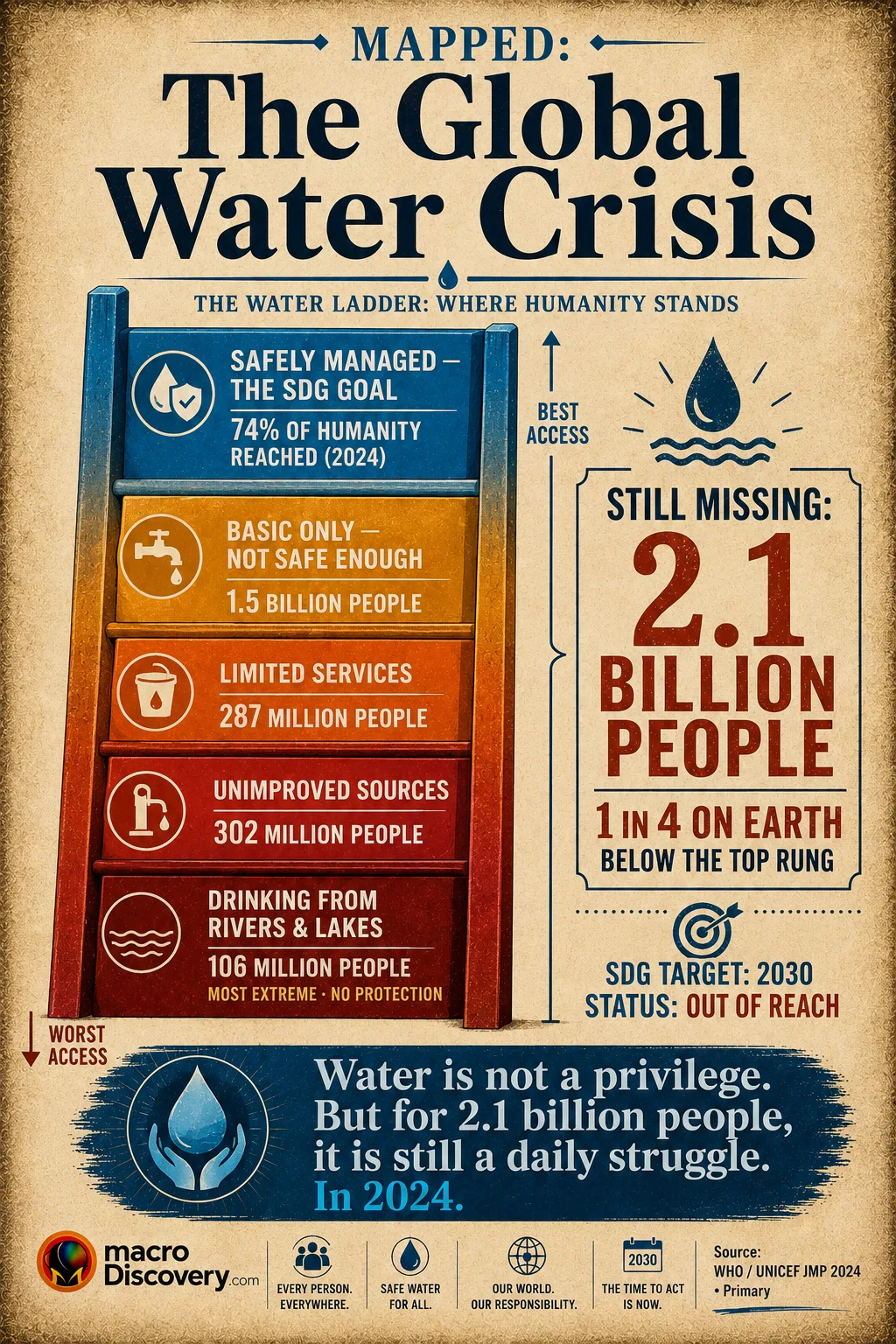
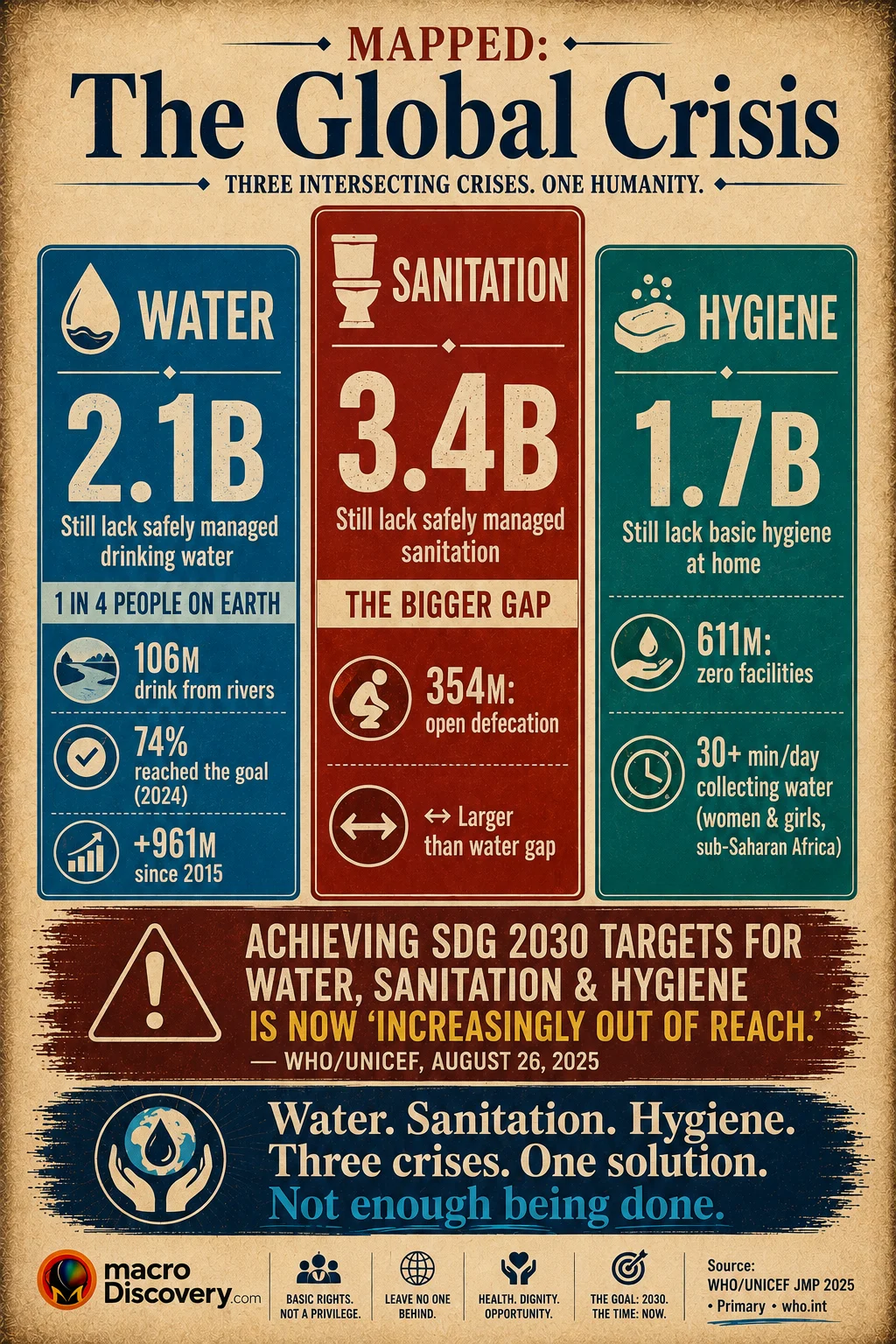
In 2024, 2.1 billion people — one in four people on earth — still lacked safely managed drinking water. 106 million drank directly from rivers and lakes. 3.4 billion had no safe sanitation. The targets set for 2030 are now described as “increasingly out of reach.” Here is the full picture, from the freshest primary data available.
People living without adequate water, sanitation and hygiene (WASH) services globally, 2024. Bars scaled to 3.4 billion (largest gap — sanitation). Source: WHO/UNICEF Joint Monitoring Programme for Water Supply, Sanitation and Hygiene — “Progress on Household Drinking Water and Sanitation 2000–2024” (primary · directly fetched · who.int · released August 26, 2025 · data from 160 countries).
Progress has been made. But not fast enough. The 2030 deadline for universal water access is now out of reach — and the crisis is set to worsen dramatically by 2050. Source: WHO/UNICEF JMP 2025 (primary) · WRI Aqueduct · UN-Water.
Water is the most basic requirement of human life. More basic than food, shelter, or safety. And yet in 2024, one in four people on earth still lacked access to drinking water that was safe, on their premises, and available when they needed it. The WHO and UNICEF released the most comprehensive global measurement of this gap just five days ago. What it shows is stark.
“Water, sanitation and hygiene are not privileges. They are basic human rights.”
— Dr Ruediger Krech, Director a.i., Environment, Climate Change and Health, World Health Organization · August 26, 2025The Sanitation Crisis Is Even Bigger Than the Water Crisis
3.4 billion people lack safely managed sanitation — more than lack safe water. 354 million still practice open defecation. This is not just a dignity issue. It is a water quality issue. Human waste that enters rivers and groundwater becomes the drinking water of the next community downstream. Sanitation and water are the same problem seen from different ends. Without solving sanitation, solving water access is impossible.
Women Collect the Water the World Fails to Deliver
In most countries with available data, women and girls are primarily responsible for collecting household water. In sub-Saharan Africa and Central and Southern Asia, many women spend more than 30 minutes per day on this task alone — every day, for their entire lives. This is not a water statistic. It is a gender equality statistic. Every hour spent collecting water is an hour not spent in school, in paid work, or in rest. The water crisis and gender inequality are the same crisis.