The Future of Healthcare , How is AI being used in healthcare today? , How effective are GLP-1 weight loss drugs like Ozempic and Wegovy? , How many health workers does the world need by 2030? , What are GLP-1 drugs being used for beyond weight loss? , How big is the AI healthcare market? ,
Visualized: The Future
of Healthcare
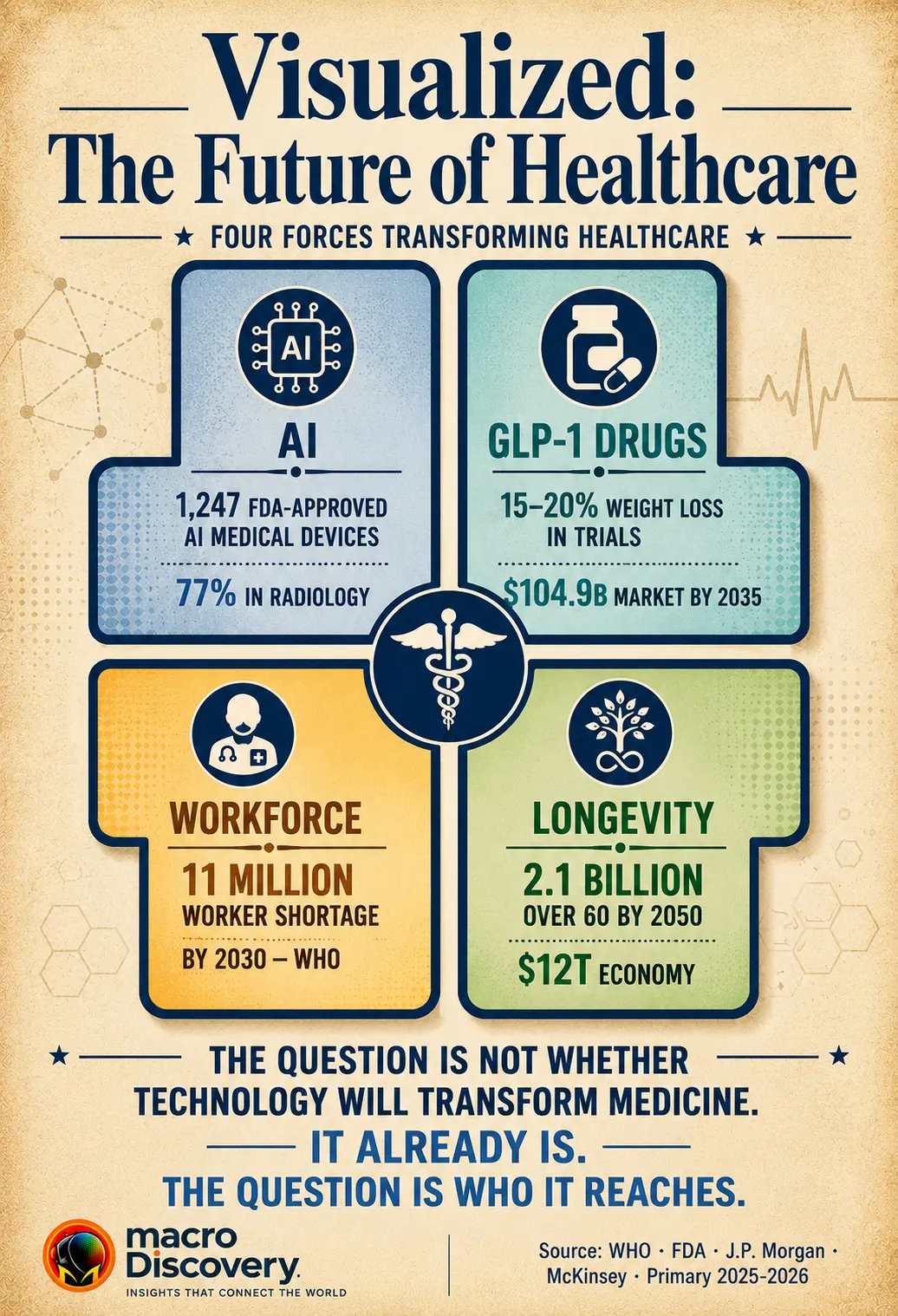
By 2050, 2.1 billion people will be over 60. The WHO projects a global shortage of 11 million health workers by 2030. The FDA has approved 1,247 AI-powered medical devices. GLP-1 weight-loss drugs showed 15–20% weight loss in clinical trials — but only 14% of patients remain on them after three years, and weight returns four times faster than conventional dieting when they stop. Healthcare is being reinvented in real time. The question is not whether technology will transform medicine — it already is. The question is whether the transformation will reach the people who need it most.
| Force / Technology | Where it stands now | Where it is heading | Key risk or gap | Status |
|---|---|---|---|---|
| 🧠 AI in diagnostics | 1,247 FDA-approved AI/ML devices (May 2025). 77% in radiology. 85% of healthcare orgs exploring generative AI. | AI market: $22.4B (2023) → $208B (2030). 10-40% faster drug approval. $100B-$600B in savings by 2050. | Admin AI ≠ clinical AI. 35% of clinicians spend more time on admin than patients — AI mostly solving the wrong problem first. | Operational now |
| 💊 GLP-1 drugs | ~10M US users (2025). Wegovy pill: Dec 2025. Foundayo (Eli Lilly): Apr 2026. 160+ obesity drugs in development. | Market: $19.6B (2025) → $104.9B (2035). 25M US users by 2030. Generics entering key markets from March 2026 (India, China, Brazil, Canada). | Real-world weight loss (~8-12%) is roughly half of trial results (15-20%). Only 14% remain on Wegovy after 3 years. Weight regains 4× faster when stopped (BMJ Jan 2026). | Mainstream 2025 |
| 👨⚕️ Healthcare workforce | 11M shortage projected by 2030 (WHO). 73% of patients face delays. Avg global wait: 70 days. 203K US nurse openings/yr. | Shortage worsens as aging population demand grows. AI administrative tools reduce burden. Agentic AI beginning to triage, document, navigate. | Technology cannot substitute clinical judgment at scale. Low-income countries face most acute shortages with fewest AI tools. | Acute shortage |
| 📄 Chronic disease burden | Chronic diseases: 74%+ of all years lived with disability. 5 diseases → $47T cost by 2030 (WEF). US obesity: 42.5% of adults in 2022. | By 2035: 46.9% of US adults obese (JAMA). By 2050: 86% of global deaths from chronic disease. 94%+ of adults 60+ have ≥2 conditions. | Chronic disease is a prevention failure, not a treatment failure. Prevention requires social, environmental interventions — the healthcare system’s least-funded sector. | Accelerating |
| 🔢 Longevity medicine | Longevity economy: $8T (2025) → $12T by 2030. Supplements: $10.7B (2024). McKinsey: ~10 healthy years unlockable via prevention. | Deloitte: ~19.4 additional healthy years by 2040 via employer investment in prevention, equity, navigation. Biotech: CRISPR, mRNA, targeted therapy advancing. | Longevity medicine concentrated in wealthy consumers. Risk of a two-speed lifespan: long for the affluent, unchanged for the rest. | Early phase |
| 🌎 Equity gap | PwC: $1T in spending shifting to tech-driven models by 2035. But 75M Americans lack primary care access. Low-income countries: fewest workers, most burden. | Technology adoption concentrated in high-income markets. AI devices: 1,247 FDA-approved, almost all in rich-country contexts. GLP-1 access: insurance-dependent. | Every transformational healthcare technology risks widening the gap between those who can access it and those who cannot — from antibiotics to dialysis to GLP-1s. | Structural risk |
Sources: AI devices/market: VentionTeams (FDA basis, May 2025) + DialogHealth (2025). GLP-1 market: IQVIA / ResearchandMarkets (DDW 2025). Clinical trials: STEP-1 (NEJM 2021) / SURMOUNT-1 (NEJM 2022). Real-world adherence: HealthVerity (2025) / BMJ (Jan 2026) via DDW-online (July 2026). Chronic disease: StartUs Insights (WHO/WEF basis). Longevity economy: IMD (April 2026, citing WHO/OECD/McKinsey). Workforce shortage: WHO via StartUs Insights. PwC: Future of Health 2025 (4,000+ US consumer survey).
The Aging Pressure: Why Healthcare Cannot Deliver on Its Current Architecture
By 2050, 2.1 billion people will be over 60 — approximately 20% of the global population — and more than 94% of adults aged 60 and older currently live with two or more chronic conditions simultaneously (WHO/OECD/McKinsey via IMD). The World Economic Forum estimates that five key chronic diseases alone will cost the global economy $47 trillion in lost productivity and healthcare spending by 2030. The US obesity rate reached 42.5% of adults in 2022 and a JAMA analysis projects it will reach 46.9% by 2035. The WHO simultaneously projects an 11-million global health worker shortage by 2030 — a demand surge colliding with a supply collapse. The current healthcare system was designed for episodic acute care: you get sick, you see a doctor, you recover. It was not designed for a population living for decades with multiple simultaneous chronic conditions requiring continuous management.
Why it matters: the chronic disease and aging combination is not a future problem — it is the present structural crisis that all healthcare innovation is responding to.
AI in Medicine: 1,247 Approved Devices — and What Most of Them Actually Do
The FDA had approved 1,247 AI and machine learning-powered medical devices as of May 2025, up from 691 in October 2023 — a near-doubling in under two years. Of those 1,247 devices, 956 (approximately 77%) are in radiology. AI reads X-rays, CT scans, and MRIs faster than human radiologists and with comparable or superior accuracy in specific tasks. Cardiovascular care accounts for 116 devices; neurology 56. The global AI healthcare market is on track to reach $208 billion by 2030 from $22.4 billion in 2023. Yet 35% of healthcare professionals already report spending more time on administrative tasks than on patients (AMA data, cited by VentionTeams). The most immediate impact of AI in healthcare has been in medical imaging — where the data is structured and the task is defined. The harder problems — clinical reasoning, treatment navigation, care coordination — remain largely unsolved by AI.
Why it matters: AI is already transforming what a radiologist can see; it has not yet transformed what a patient can access.
The GLP-1 Revolution: What the Trial Data Shows — and What Real-World Adherence Reveals
GLP-1 receptor agonist drugs — originally developed for type 2 diabetes — have become the most consequential pharmaceutical development since statins. In the pivotal STEP-1 trial, semaglutide (Wegovy) produced approximately 15% mean weight loss at 68 weeks. In SURMOUNT-1, tirzepatide (Zepbound) achieved approximately 20%. The FDA approved the first oral GLP-1, the Wegovy pill, in December 2025; Eli Lilly’s Foundayo (orforglipron) followed in April 2026. The US market of ~10 million users in 2025 is projected to reach 25 million by 2030 (J.P. Morgan Research). The critical gap is adherence and access: real-world weight loss (7.7% for semaglutide, 12.4% for tirzepatide) is roughly half of trial results. Only 14% of patients remain on Wegovy after three years. Weight returns four times faster than conventional dieting when treatment stops (BMJ, January 2026). The global anti-obesity drug market is projected to grow from $19.6 billion in 2025 to $104.9 billion by 2035.
Cardiovascular disease: semaglutide significantly reduced major adverse cardiovascular events in the SELECT trial among patients with obesity but without diabetes — expanding the indication to cardiovascular risk reduction regardless of diabetes status.
Kidney disease: Ozempic under FDA review for peripheral arterial disease. Data emerging on chronic kidney disease protection.
Sleep apnea: tirzepatide (Zepbound) received FDA approval for moderate-to-severe obstructive sleep apnea in patients with obesity (June 2024) — the first drug approval for this indication.
Neurodegeneration: early trials examining GLP-1s for Alzheimer’s and Parkinson’s, based on observed cognitive improvements in diabetic patients.
Addiction: emerging case reports and trials examining GLP-1 effects on alcohol and drug cravings.
As one physician writing for HLTH.com put it: “We have a medication that treats not just obesity, but also diabetes, cardiovascular disease, osteoarthritis, chronic kidney disease, and obstructive sleep apnea.” The adherence and access gap remains the central challenge: a drug this broadly effective must not become another technology that widens health inequality.
Sources: IQVIA (2026) · DDW-online (Feb 2026, July 2026) · GoodRx (July 2026) · HLTH.com (April 2026).
Why it matters: the gap between GLP-1 trial results and real-world outcomes is a system problem — access, affordability, and sustained support — not a drug problem.
What the Next Decade of Healthcare Looks Like — and Who Gets Left Out
PwC’s 2025 US healthcare consumer survey (4,000+ adults) projects that $1 trillion in healthcare spending will shift toward scalable, personal, technology-driven models by 2035. McKinsey Global Institute estimates that improving population health could add approximately 10 healthy midlife years and unlock trillions in economic value. Deloitte modeling suggests employers could catalyse approximately 19.4 additional healthy years of workforce life by 2040 through investment in prevention, equity, and navigation. The longevity economy — spanning healthcare, wellness, financial services, and real estate — is valued at $8 trillion and projected to reach $12 trillion by 2030 (IMD). The structural risk runs through every trend: 75 million Americans lack access to primary care; GLP-1 coverage for obesity remains insurance-dependent; AI medical devices concentrate in high-income systems. Every transformational healthcare technology in history — from antibiotics to dialysis to statins — widened health inequality before eventually narrowing it. The gap between what is medically possible and what is equitably accessible is the defining healthcare question of the next decade.
Why it matters: the future of healthcare is being built simultaneously for those who can afford personalised longevity medicine and those who still cannot access a same-week GP appointment.
- 2.1 billion people will be over 60 by 2050 — 20% of global population — while 94%+ of adults 60+ already live with two or more chronic conditions (WHO/OECD/McKinsey).
- The WHO projects an 11-million global health worker shortage by 2030; 73% of patients already face care delays, averaging 70 days globally (Canada: 131 days; Spain: 128; UK: 109).
- The FDA approved 1,247 AI/ML medical devices by May 2025 — 77% in radiology — as the global AI healthcare market grows from $22.4B (2023) to a projected $208B by 2030.
- GLP-1 clinical trials showed 15–20% weight loss (STEP-1/SURMOUNT-1); real-world results are roughly half that (7.7–12.4%), and only 14% of patients remain on Wegovy after three years.
- Weight returns four times faster than conventional dieting when GLP-1 treatment stops (BMJ, January 2026), raising questions about GLP-1s as chronic-use drugs vs finite courses.
- The global anti-obesity drug market is projected to grow from $19.6B (2025) to $104.9B by 2035 (CAGR 18.3%), with oral GLP-1s opening access to patients who avoided injections.
- The longevity economy is valued at $8 trillion and projected to reach $12 trillion by 2030 — but its benefits concentrate overwhelmingly in high-income consumers and countries.
The future of healthcare is not one future — it is two. In one, AI reads scans more accurately than radiologists, GLP-1 drugs treat obesity and cardiovascular disease and neurodegeneration simultaneously, and longevity medicine extends healthy life by decades. In the other, 11 million healthcare workers are missing, 75 million Americans cannot access primary care, and patients who most need weight-loss drugs cannot afford them or cannot sustain them. Both futures are being built at the same time, by the same industry, in the same decade. The question that will define the next 25 years of healthcare is not what is medically possible — the answer to that is extraordinary. It is who the extraordinary reaches.
- VentionTeams — AI in Healthcare 2025 Statistics (citing FDA primary · “By end of May 2025, FDA had approved 1,247 medical devices powered by AI and ML. Most in radiology (956), cardiovascular (116), neurology (56)” · 85% orgs exploring genAI · $100B-$600B savings by 2050 · 35% clinicians spend more time on admin than patients)
- DialogHealth — AI in Healthcare Statistics (July 2026 · market $22.4B 2023 → $208.2B 2030 · CAGR 36.4% · US $11.8B → $102.2B · generative AI market healthcare $2B 2025 → $10B 2030 · 66% life sciences execs investing in genAI for drug discovery)
- J.P. Morgan Research — GLP-1 Supply and Demand 2026 (primary · ~6M US users 2024 → ~10M 2025 → 25M by 2030 · oral GLP-1s expected to open new frontier · Medicare $50/month copay cap July 2026 via BALANCE program · 55% commercial employers cover GLP-1s for obesity)
- Drug Discovery World — GLP-1 Therapeutics Outlook (July 2026 · BMJ Jan 2026: weight regains 4× faster than conventional dieting after stopping · semaglutide patent expired March 2026 India/China/Brazil/Canada · US/UK/Europe until 2031 · 1.6M adults UK used GLP-1s 2024-2025 per UCL)
- IQVIA — Outlook for Obesity 2026 (January 2026 · GLP-1 market $19.6B 2025 → $104.9B 2035 CAGR 18.3% · Wegovy pill approved Dec 2025 · Foundayo April 2026 · Eli Lilly first pharma over $1T market cap · Italy first country to recognize obesity as chronic disease · 160+ obesity drugs in development)
- IMD — Longevity: Three Trends That Redefine How We Live (April 2026 · 2.1B over 60 by 2050 · longevity economy $8T → $12T by 2030 · McKinsey: ~10 healthy midlife years unlockable · Deloitte: ~19.4 additional healthy years by 2040 via employer investment · supplements market $10.7B 2024)
- StartUs Insights — Future of Healthcare 2025 (June 2025 · WHO 11M shortage by 2030 · 73% of patients face delays / avg 70 days · Canada 131/Spain 128/UK 109 days · 75M Americans no primary care · $22.57T global healthcare market by 2032 · 5 diseases → $47T by 2030 WEF)
how is AI being used in healthcare today what are the statistics,how effective are GLP-1 weight loss drugs like Ozempic Wegovy real world,how many health workers does the world need shortage by 2030,what are GLP-1 drugs being used for beyond weight loss 2025 2026,how big is the AI healthcare market projected size 2030, future of healthcare AI technology , GLP-1 drugs aging population 2025 ,