How the Internet Was Built —
The Infrastructure Behind the Network
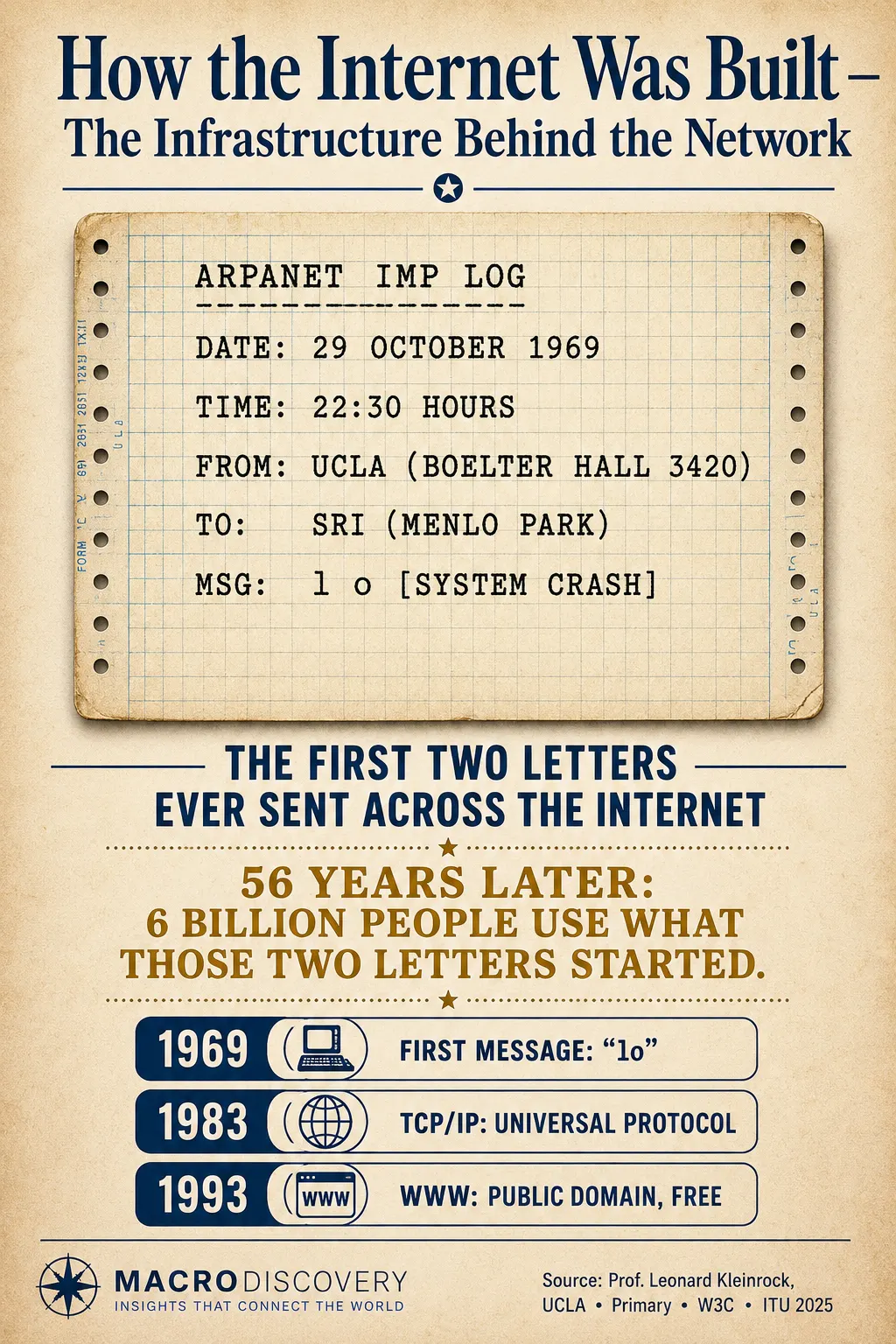
At 22:30 on October 29, 1969, a UCLA graduate student named Charley Kline typed two letters toward a computer 350 miles away — and the receiving machine crashed. Those two letters, “lo,” were the first message ever sent across what became the internet. Fifty-six years later, 6 billion people use the network they created. This is the story of how they built it: from four university computers to the protocol that connects everything, to the software layer that made it usable by anyone.
| Year | Event | Who | Significance |
|---|---|---|---|
| 1958 | ARPA created Foundation |
US Dept of Defense (post-Sputnik). President Eisenhower. | Advanced Research Projects Agency — the funding body that commissioned ARPANET. |
| 1962–64 | Packet switching proposed Concept |
Paul Baran, RAND Corporation. | Baran proposed distributed networks that could route around damaged nodes — motivated by nuclear resilience. His concept influenced, but was separate from, ARPANET. |
| Oct 29, 1969 | “lo” — First message Birth of internet |
Charley Kline (UCLA) → Bill Duvall (SRI). Supervised by Prof. Leonard Kleinrock. | Tried to type “login.” System crashed after “l” and “o.” Full login succeeded ~1 hour later. First permanent link: November 21, 1969. Four nodes by December 5. |
| 1974 | TCP paper published Protocol era |
Vint Cerf (Stanford) + Bob Kahn (DARPA). | “A Protocol for Packet Network Interconnection” — the blueprint for TCP/IP. A universal language allowing different networks to communicate. |
| Jan 1, 1983 | TCP/IP Flag Day Modern internet born |
ARPANET switches to TCP/IP. Any network can now join. | Often called the true “birth of the internet.” The same protocol still runs the internet today, 42 years later. |
| Mar 1989 | WWW proposed Web era |
Tim Berners-Lee, CERN, Geneva. | “Information Management: A Proposal.” His boss wrote: “Vague but exciting.” Proposed HTML, HTTP, and URLs as a linked document system. |
| Dec 20, 1990 | First website live info.cern.ch |
Tim Berners-Lee, CERN. | The world’s first website, describing the World Wide Web project itself. Built on a NeXT workstation at CERN. |
| Apr 30, 1993 | WWW goes public domain Free forever |
CERN releases WWW royalty-free. | The single decision that enabled mass adoption. By not patenting the Web, Berners-Lee ensured it could not be owned. The explosion that followed was immediate. |
| 2025 | 6 billion users 74% of humanity |
ITU Facts & Figures 2025 (primary). | Up from ~50% in 2017. High-income countries: 94%. Low-income: 23%. ~2.2 billion still offline. ~95% of international traffic travels via submarine cables. |
Sources: 1969 first message: Prof. Leonard Kleinrock (primary, lk.cs.ucla.edu, directly fetched). 1974 TCP paper + 1989 WWW proposal: W3C Timeline (w3.org, Tim Berners-Lee, primary). January 1, 1983 flag day + 1993 public domain: Status Code/Medium citing W3C. First website Dec 20, 1990: BBC Science Focus. ITU users 2025: ITU Facts & Figures 2025 (primary, itu.int). Nuclear resilience context: Paul Baran / RAND Corp 1964.
What Actually Happened on October 29, 1969 — and Why “lo” Was Perfect
At 22:30, Charley Kline sat at a UCLA SDS Sigma 7 computer in Boelter Hall room 3420, telephone headset on, talking to Bill Duvall 350 miles north at Stanford Research Institute. Both were trying to transmit the word “login” across ARPANET. Kline typed the “l” — Duvall confirmed receipt. He typed the “o” — confirmed. He typed the “g” and the SRI machine crashed from a buffer overflow. The first message ever sent across what became the internet was “lo.” Leonard Kleinrock, who supervised the transmission, has since noted the accidental poetry: “lo” opens announcements across English literature; it is what a herald says before something important is revealed. The full login completed about an hour later, but nobody remembers that.
Why it matters: the internet began with a system crash — which is a more accurate preview of the next 56 years than a clean success would have been.
The Protocol That Made Everything Connect — What Cerf and Kahn Actually Invented
By the early 1970s, ARPANET worked — but only between computers on ARPANET itself. The problem was interoperability: how could different networks, built by different people with different hardware, talk to each other? In Spring 1973, Bob Kahn (DARPA) invited Vint Cerf (then at Stanford) to solve it. Their 1974 paper, “A Protocol for Packet Network Interconnection,” published in IEEE Transactions on Communications, specified TCP: a universal language for packaging, addressing, routing, and reassembling data across incompatible networks. On January 1, 1983 — “Flag Day” — ARPANET switched to TCP/IP, and any network anywhere could now join simply by adopting the same protocol. That same protocol still runs the internet today.
Why it matters: TCP/IP is the internet’s constitution — written in 1974, adopted in 1983, and unchanged in its fundamental architecture ever since.
The Web Is Not the Internet — What Tim Berners-Lee Actually Built at CERN
In March 1989, Tim Berners-Lee — a British computer scientist working at CERN, the European Organization for Nuclear Research in Geneva — circulated a proposal titled “Information Management: A Proposal.” His supervisor returned it with the handwritten annotation: “Vague but exciting.” The proposal outlined a system of linked documents using three innovations: HTML (a formatting language), HTTP (a transfer protocol), and URLs (a universal addressing system). The first website went live on December 20, 1990 at info.cern.ch. On April 30, 1993, CERN placed the entire WWW in the public domain — royalty-free. That single decision — not patenting the Web — is arguably the most consequential act of intellectual generosity in technological history.
Why it matters: the distinction between internet and Web matters because they have different inventors, different histories, and could theoretically be separated — the internet would still exist without the Web.
From Four Nodes to Six Billion Users — What Happened in Between
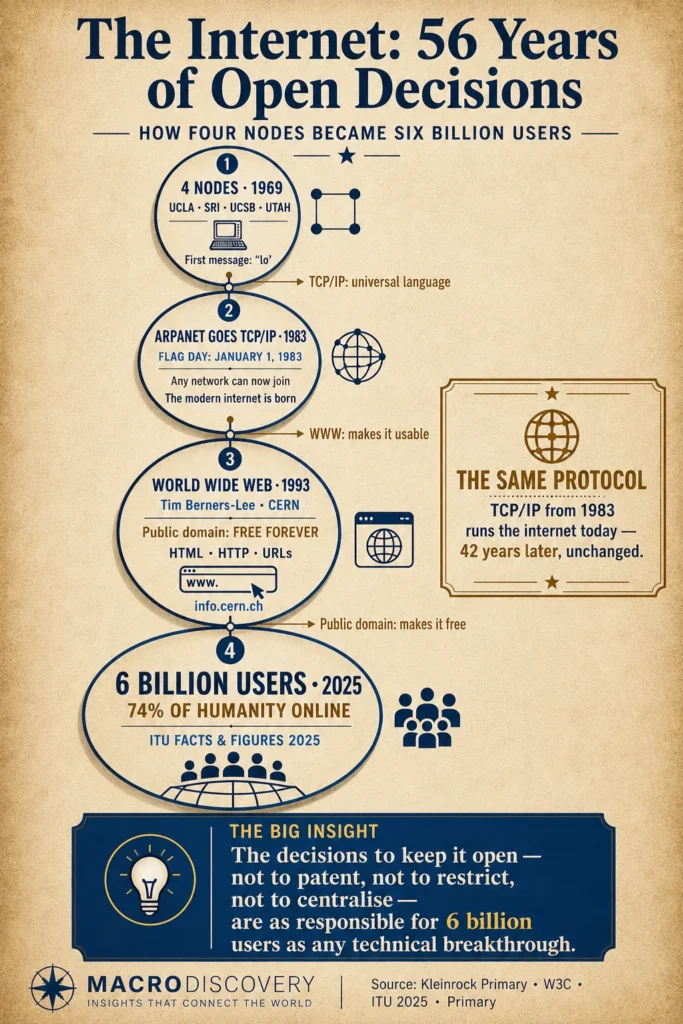
ARPANET had four nodes by December 1969, 15 by 1971. The network expanded through universities and government contractors through the 1970s. TCP/IP in 1983 opened it to any network. The NSFNET (National Science Foundation Network) replaced ARPANET as the backbone in 1985–1990. The Web’s public domain release in 1993 triggered commercial internet access. Netscape (1994) and then Internet Explorer made browsing accessible to non-engineers. Google (1998), Facebook (2004), and the iPhone (2007) each brought another billion users. Today, ITU estimates 6 billion people use the internet — 74% of the global population (ITU, 2025, primary). High-income countries approach 94% penetration; low-income countries sit at 23%. Some 2.2 billion people remain offline, mostly in sub-Saharan Africa and South Asia.
What is true: Paul Baran at the RAND Corporation independently developed the concept of distributed packet-switching networks between 1960 and 1964, explicitly motivated by the desire to create communications infrastructure that could survive nuclear strikes. His papers were published by RAND in 1964.
What is also true: ARPANET adopted packet-switching — the same technique Baran had advocated — but ARPA’s official purpose was resource-sharing: allowing researchers at different universities to access each other’s expensive computers without flying there. The economics of mainframe time-sharing were the point, not nuclear resilience.
The legend: Because ARPA was a defense agency, because packet-switching had been conceived with nuclear survival in mind, and because distributed networks are indeed resilient to node failure, the two histories merged into a single myth. The internet is resilient by architecture — but that was a feature of the underlying technology, not the original mission statement.
Source: Silicon Canals (June 2026) · UCLA / Leonard Kleinrock (primary) · Britannica (Paul Baran) · IEEE Annals of the History of Computing.
Why it matters: the internet grew from four nodes to six billion users in 56 years — the fastest diffusion of any communication technology in human history, enabled not by one invention but by a sequence of decisions to keep the network open.
- The first internet message was “lo” — the first two letters of “login,” sent at 22:30 on October 29, 1969 from UCLA to the Stanford Research Institute before the system crashed (Kleinrock, primary).
- ARPANET was built for computer resource-sharing, not nuclear war survival — though it adopted packet-switching that Paul Baran had separately proposed for nuclear resilience at RAND.
- TCP/IP, invented by Vint Cerf and Bob Kahn in 1974 and adopted on January 1, 1983, is the universal protocol that still runs the internet today — unchanged in fundamental architecture for 42 years.
- The internet and the World Wide Web are different things: the internet is the infrastructure; the Web is software that runs on top of it, invented by Tim Berners-Lee at CERN in 1989.
- CERN placed the World Wide Web in the public domain on April 30, 1993 — royalty-free — the single decision that enabled mass global adoption.
- 6 billion people use the internet in 2025 — 74% of the global population — up from ~50% in 2017 (ITU, primary).
- 2.2 billion people remain offline — mostly in low-income countries where internet penetration is 23%, against 94% in high-income nations.
The internet was not designed by one person or built for one purpose. It grew from a defense research budget into a university experiment, from a protocol paper into a global standard, from a vague proposal annotated “exciting” into the infrastructure of modern civilisation. Every critical expansion required someone to make the network more open: Cerf and Kahn made different networks interoperable; Berners-Lee made documents linkable; CERN made the Web free. The decisions to not close things off — to not patent, not restrict, not centralise — are as responsible for 6 billion users as any technical breakthrough.
- Prof. Leonard Kleinrock, UCLA — “The Day the Infant Internet Uttered its First Words” (primary · directly fetched · lk.cs.ucla.edu · “It took place at 22:30 hours on October 29, 1969” · “They succeeded in transmitting the ‘l’ and the ‘o’ and then the system crashed! Hence, the first message on the Internet was ‘lo'” · IMP Log excerpt)
- ICANN Blog / Leonard Kleinrock — “The First Message Transmission” (primary · October 29, 2019 · 50th anniversary account · Charley Kline / Bill Duvall · telephone headsets · SDS Sigma 7 → SDS 940 · UCLA → SRI Menlo Park · buffer overflow crash)
- W3C — “How It All Started” Timeline (primary · w3.org · Tim Berners-Lee authored · 1974: Cerf & Kahn publish TCP paper · 1980: TBL Enquire notebook at CERN · March 1989: “Information Management: A Proposal” · Dec 1990: first Web client-server communication · April 30 1993: CERN public domain)
- ITU — Facts and Figures 2025: Internet Use (primary · itu.int · 6 billion users = 74% of world population · up from 71% in 2024 · high-income 94% · low-income 23% · 2.2 billion offline · 3.3% year-on-year growth)
- Silicon Canals — “On October 29, 1969 Charley Kline tried to send LOGIN over ARPANET” (June 2026 · buffer overflow technical explanation · “Its purpose was not, despite the persistent myth, to survive a nuclear war” · Paul Baran RAND context · Kleinrock “lo and behold” quote · SRI Menlo Park confirmation)
- BBC Science Focus — “Who really invented the Internet?” (TCP/IP “went public in 1974 and is still used today” · TBL “proposed the idea in March 1989 while working for CERN” · first website info.cern.ch December 20, 1990 · WWW public domain April 30, 1993 · Berners-Lee quote on combining existing technologies)