What Artificial Intelligence
Actually Costs — The Hidden Energy Bill
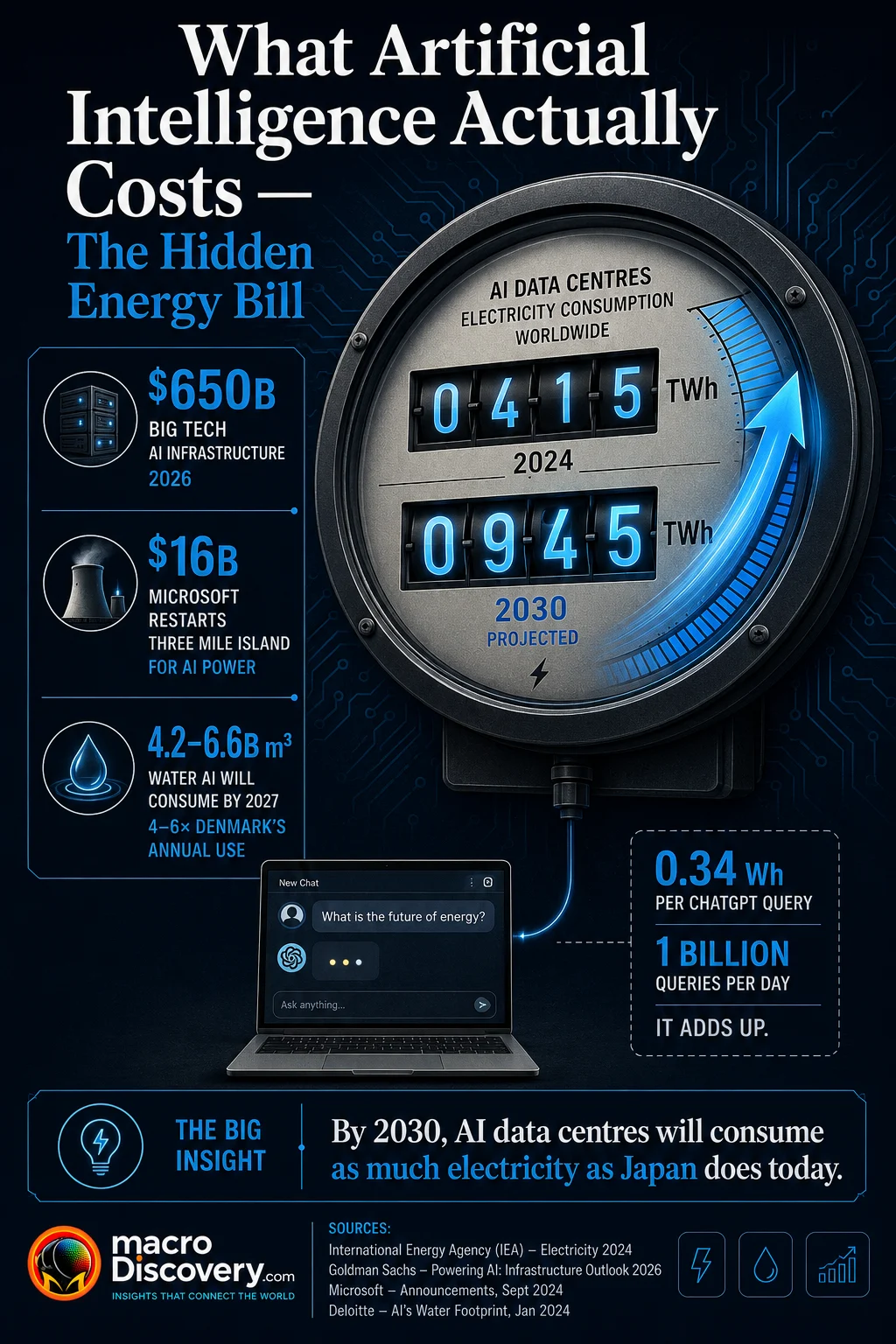
Global data centres consumed 415 terawatt-hours of electricity in 2024 — 1.5% of everything humanity generated. That figure is set to more than double by 2030. Four technology companies will spend over $650 billion on AI infrastructure in 2026 alone. Training GPT-3 consumed 5.4 million litres of water. And an AI query now uses roughly as much electricity as a Google search — but reasoning models use up to 70 times more. The energy cost of AI is not hidden because it is small. It is hidden because it is invisible to the person typing the prompt.
- Global data centres consumed 415 TWh of electricity in 2024 — 1.5% of the world’s total — and this is set to roughly double to 945 TWh by 2030 in the IEA’s base case. AI servers are the fastest-growing component, expanding at 30% per year. The United States accounts for 45% of global data centre electricity use and will see a 130% increase by 2030, taking per-capita data centre electricity consumption from 540 kWh to over 1,200 kWh per person — equivalent to roughly 10% of an American household’s annual electricity use.
- A standard AI text query uses approximately 0.24–0.34 watt-hours of electricity — roughly the same as a conventional Google search, based on official disclosures from OpenAI CEO Sam Altman (June 2025) and Google (August 2025). However, reasoning models like OpenAI’s o3 and DeepSeek-R1 can consume 10 to 70 times more per prompt. The scale is what matters: OpenAI reported approximately 1 billion ChatGPT queries per day as of December 2024. At 0.34 Wh each, that is 340 megawatt-hours every single day from one application alone.
- Four technology companies will spend over $650 billion on AI infrastructure in 2026 alone — Amazon (~$200B), Alphabet ($175-185B), Microsoft (~$145B annualised), and Meta ($115-135B). The IEA found that the capital expenditure of five large technology companies surged to more than $400 billion in 2025 and is set to increase by a further 75% in 2026. This investment-to-revenue gap is stark: AI services currently generate only about $25 billion in direct revenue — roughly 4% of infrastructure spending.
- Water is AI’s other hidden cost. Training GPT-3 in Microsoft’s US data centres consumed an estimated 5.4 million litres of water, including 700,000 litres on-site for cooling (Li et al. 2023). Every 20 to 50 ChatGPT queries uses approximately half a litre of water for cooling. Global AI-related water withdrawals could reach 4.2 to 6.6 billion cubic metres per year by 2027 — equivalent to four to six times Denmark’s total annual water consumption.
- The nuclear industry is being revived by AI data centre demand. Microsoft signed a $16 billion, 20-year agreement with Constellation Energy to restart Three Mile Island’s Unit 1 — the first restart of a closed US nuclear plant in history, driven entirely by AI data centre power needs. The global pipeline of conditional agreements between data centre operators and small modular reactor (SMR) projects grew from 25 gigawatts at the end of 2024 to 45 gigawatts by April 2026, according to the IEA.
Source: IEA — “Energy and AI” Special Report (April 2025 · primary · directly fetched) + “Key Questions on Energy and AI” (April 16, 2026 · primary). 2024 figure: 415 TWh confirmed directly from IEA primary text, representing “about 1.5% of global electricity consumption.” 2025: +17% growth confirmed from IEA April 2026 update (“data centre electricity use surged 17% in 2025”). 2030 IEA base case: 945 TWh (“just under 3% of global electricity”). 2030 fast-growth scenario: >1,200 TWh. 2017 and 2023 figures interpolated from IEA growth rate data (12% per year since 2017). The IEA also models a Headwinds Case (~700 TWh plateau) and a High Efficiency Case (~970 TWh by 2035). Bar lengths are proportional within the chart.
Note: The widely-cited figure of “2.9 Wh per ChatGPT query” appeared in a 2024 estimate (cited in Brookings, April 2026) that reflected earlier, less-efficient models and higher-intensity use cases. Official disclosures from OpenAI (June 2025: 0.34 Wh) and Google (August 2025: 0.24 Wh) reflect current typical text queries as of 2025. Per-query energy varies substantially by model, prompt length, reasoning depth, and data centre energy mix. Microsoft, Meta, Anthropic, Perplexity, and xAI had not published comparable per-query disclosures as of mid-2026 (Earth911, March 2026).
| Company | 2025 Capex | 2026 Capex | YoY Change | Energy strategy | Nuclear commitment |
|---|---|---|---|---|---|
Amazon (AWS)World’s largest cloud provider |
$105B+ | ~$200B | +90% | Renewables + nuclear | 20+ GW renewable PPAs. SMR agreements in place. Largest cloud power load on earth. |
Alphabet / GoogleLargest clean energy PPA buyer 2024 |
$75B | $175–185B | +133% | Acquired power company | Acquired Intersect Power ($4.75B). 500 MW Kairos SMR deal. 1 GW solar PPA TotalEnergies (Feb 2026). Global PUE: 1.09. |
MicrosoftThree Mile Island restart funder |
$80B | ~$145B | +81% | Nuclear pioneer | $16B · 20-yr PPA · Three Mile Island Unit 1 restart · 835 MW · first closed US nuclear plant restart · online 2027. |
MetaLargest clean energy offtaker 2025 |
$60–65B | $115–135B | +92% | 6.6 GW nuclear | Contracted 10.24 GW clean energy in 2025 — largest of any company. Up to 6.6 GW nuclear capacity across TerraPower, Oklo, Vistra, Constellation. Average PUE: 1.08. |
Sources: IEA “Key Questions on Energy and AI” (April 16, 2026 · primary) — “capital expenditure of five large technology companies surged to more than $400 billion in 2025 and is set to increase by a further 75% in 2026.” Individual company figures: Amazon ~$200B (Reuters, Feb 2026), Alphabet $175-185B (earnings guidance), Microsoft ~$145B annualised (nextwavesinsight.com June 2026 · confirmed), Meta $115-135B (earnings guidance). 2025 figures: Amazon >$105B (nextwavesinsight), Google $75B, Microsoft $80B FY2026 (Nadella Jan 2025), Meta $60-65B range. Nuclear deals: MarketScale June 2026 (directly confirmed). PUE figures from arxiv.org/2509.07218v3 (May 2026 peer-reviewed). Click column headers to sort.
How Big Is AI’s Electricity Bill — and Is It Really Growing That Fast?
The IEA’s “Energy and AI” special report — published April 2025, the most comprehensive global assessment available, directly fetched for this article — opens with a number that is easy to underestimate: 415 terawatt-hours. That is how much electricity global data centres consumed in 2024. To contextualise it: Japan consumed approximately 945 TWh that year. That is the same number the IEA expects data centres to reach by 2030. At that point, a sector that barely existed at scale twenty years ago will consume as much electricity as the world’s third-largest economy does today.
The growth rate is what makes the IEA’s figure alarming. Data centre electricity has grown at 12% per year since 2017 — more than four times faster than total global electricity consumption. In 2025, it accelerated further: data centre electricity use surged 17%, with AI-focused centres growing even faster, according to the IEA’s April 2026 update. The IEA projects AI servers specifically to grow at 30% per year through 2030. Within the data centre total, AI’s share is rising from approximately 5-15% in recent years to a projected 35-50% by 2030. The underlying driver is not just more users. Inference — running AI models to answer queries — is 80-90% of total AI computing demand. Every time someone uses ChatGPT, Gemini, Copilot, or Grok, inference hardware runs in a data centre somewhere, consuming electricity and generating heat that requires water to cool.
The United States is the centre of this demand. US data centres accounted for 45% of global consumption in 2024, consuming 183 TWh — roughly equivalent to Pakistan’s entire national electricity demand. By 2030, the IEA projects this will grow by 130% to approximately 423 TWh. Per-capita data centre consumption in the US will reach over 1,200 kWh per year — roughly 10% of the average American household’s annual electricity use — entirely from running data centres that mostly serve digital services the household consumes.
How Much Does a Single AI Query Actually Cost in Energy — and Why Is the Number Confusing?
Few numbers in the AI energy debate have been as widely misquoted as the per-query energy cost. A figure of “2.9 watt-hours per ChatGPT query” circulated widely through 2024 and appeared in a Brookings Institution report as recently as April 2026. It was probably accurate for some use cases in earlier, less-efficient model versions — but it is not the current figure for a standard text query.
The most authoritative current figures come from official company disclosures. In June 2025, OpenAI CEO Sam Altman stated that an average ChatGPT query uses approximately 0.34 watt-hours. In August 2025, Google published detailed methodology showing that a median Gemini text prompt consumes 0.24 watt-hours and produces 0.03 grams of CO₂ equivalent. These are the only two companies to have published comparable data as of mid-2026 — Microsoft, Meta, Anthropic, Perplexity, and xAI had not disclosed per-query energy figures. At 0.24-0.34 Wh, a standard AI text query now costs approximately the same electricity as a conventional Google search. Per query, AI is not the environmental monster some coverage implied.
The nuance lies in two complications. First, reasoning models change the picture dramatically. Models like OpenAI’s o3, DeepSeek-R1, and similar deep-reasoning systems can consume 10 to 70 times more energy per prompt than a standard text model. The efficiency gap between the most and least efficient AI models spans over 200 times. Choosing a small model for a simple task versus a frontier reasoning model for the same task is, at scale, a meaningful sustainability decision. Second, scale overwhelms per-query efficiency. OpenAI reported approximately one billion ChatGPT queries per day as of December 2024. At 0.34 Wh per query, that alone equals 340 megawatt-hours per day — 124 gigawatt-hours per year — from a single application running only text responses. As AI agents, voice interfaces, and multimodal systems expand use cases, query volumes and per-query energy intensity are both rising.
Why Are Tech Companies Spending $650 Billion on AI Infrastructure in One Year?
The scale of Big Tech’s AI infrastructure investment is without precedent in the history of corporate capital expenditure. Amazon plans approximately $200 billion in 2026 capital expenditure, most of it flowing into AWS data centres. Alphabet has guided $175-185 billion for 2026 — nearly doubling its 2025 commitment. Microsoft is running at a $145 billion annualised rate. Meta has earmarked $115-135 billion. Together, four companies are spending more on AI infrastructure in a single year than most countries spend on defence in a decade. The IEA confirmed that the capital expenditure of five large technology companies exceeded $400 billion in 2025 and is set to increase by a further 75% in 2026.
What is this money actually buying? A significant part is GPUs — the specialised processors that power AI training and inference, supplied almost entirely by NVIDIA at the frontier. But increasingly, the bottleneck is not chips. Approximately 40% of announced AI data centre projects face construction delays due to power infrastructure constraints, not chip supply. The constraint is megawatts: the ability to connect a new data centre to the electricity grid, and the ability of the grid to supply reliable, large-scale baseload power at the scale these facilities require. Goldman Sachs estimates that approximately $720 billion of grid investment through 2030 may be needed to support data centre demand growth. The $1.4 trillion grid overhaul underway across 51 US utilities is directly linked to this demand wave.
The investment-to-revenue gap is striking. AI services currently generate only about $25 billion in direct annual revenue — roughly 4% of the infrastructure being spent to support them. Google Cloud is the clearest bright spot, with revenue growing 48% year-on-year to $17.7 billion in Q4 2025. But the broader investment thesis requires AI to generate revenues at a scale that does not yet exist. Whether this investment produces returns proportional to its scale, or whether historians will judge 2025-2026 as the most expensive technology bet in corporate history, depends entirely on how AI revenue scales over the next five years.
Why Is AI Restarting Nuclear Power Plants — and What Does That Tell Us About the Energy Crisis?
The most dramatic evidence that AI’s energy demand is structurally reshaping global energy systems is the nuclear revival it is driving. In September 2024, Microsoft signed a $16 billion, 20-year agreement with Constellation Energy to restart Unit 1 of the Three Mile Island nuclear plant in Pennsylvania — a 835-megawatt reactor shut down in 2019 for economic reasons. This was the first restart of a closed US nuclear plant in history. The reason was simple: Microsoft needed large, reliable, carbon-free baseload power for its AI data centres, and nuclear was the only technology that could supply it at that scale without intermittency.
The nuclear-AI convergence has accelerated rapidly. Google committed 500 megawatts from Kairos Power’s small modular reactors — the first US corporate SMR fleet deal. Meta committed to up to 6.6 gigawatts of nuclear capacity across multiple partners including TerraPower, Oklo, Vistra, and Constellation, and contracted 10.24 gigawatts of clean energy in 2025, the most of any company globally. The global pipeline of conditional agreements between data centre operators and SMR projects grew from 25 gigawatts at the end of 2024 to 45 gigawatts by April 2026, according to the IEA update. Nuclear energy could meet up to 10% of data centre electricity demand by 2035, according to Deloitte analysis.
Big Tech collectively accounted for 43% of all clean energy power purchase agreements signed globally in 2024 — a concentration of clean energy procurement unprecedented in corporate history. PPA prices rose 35% in 2024 alone, driven by this surge. Google went further than any competitor: it acquired Intersect Power outright for $4.75 billion, giving itself in-house renewables development capability to build new generation in lockstep with data centre load. The IEA’s executive director Fatih Birol captured the dynamic precisely: “AI is still an energy taker — it is also becoming an energy maker, driving forward innovative solutions like next-generation nuclear reactors, flexible data centres and long-duration energy storage.”
Does AI’s Energy Use Actually Threaten the Electricity Grid — and Who Pays?
The IEA is careful to contextualise data centre growth within the broader electricity demand picture. In its base case, data centres account for only 8% of global electricity demand growth between 2024 and 2030 — less than electric vehicles (responsible for 838 TWh of new demand), air conditioning (651 TWh), or industrial sectors (1,936 TWh). At 3% of global electricity consumption in 2030, data centres are a significant but not dominant driver of energy transition complexity in aggregate.
The aggregate picture, however, conceals extreme geographic concentration. Data centres, unlike electric vehicles, do not distribute their load across millions of households. They cluster in specific locations, creating intense, localised demand spikes that can destabilise regional grids. Virginia’s “Data Center Alley” in Loudoun County already consumed 26% of the state’s total electricity supply in 2023. A 2024 event in that cluster — a protection system failure — caused 60 of over 200 data centres to simultaneously disconnect from the grid, forcing the utility to rapidly adjust to a sudden change of hundreds of megawatts. This is the nature of data centre grid risk: not slow, manageable growth, but rapid, concentrated, technically demanding load addition in specific counties and regions.
Ordinary households are already paying part of the bill. In the PJM electricity market — stretching from Illinois to North Carolina and serving the densest data centre geography in the world — data centres contributed an estimated $9.3 billion in price increases in the 2025-26 capacity market. The resulting residential bill impact: approximately $18 per month extra in western Maryland and $16 per month in Ohio. A Carnegie Mellon University study estimated that data centres and cryptocurrency mining could drive an 8% increase in average US electricity bills by 2030, with increases potentially exceeding 25% in the highest-demand markets of central and northern Virginia. The energy cost of AI is not invisible to everyone — it is already showing up in monthly electricity bills for people who have never used a chatbot.
- IEA — “Energy and AI: Energy Demand from AI” (primary · April 2025 · directly fetched · 415 TWh 2024 · 945 TWh 2030 · 12%/yr growth since 2017 · 15%/yr growth 2024-30 · AI servers 30%/yr · US 45% of global · per-capita data · regional breakdown · server/cooling breakdown)
- IEA — “Data centre electricity use surged in 2025” (primary · April 16, 2026 · directly confirmed · +17% in 2025 · Big Tech 5 companies >$400B capex · +75% in 2026 · SMR pipeline 25→45 GW · efficiency improving “unprecedented rate” · Birol quote)
- Goldman Sachs Research — “AI to drive 165% increase in data center power demand by 2030” (primary · 55 GW current · 84 GW by 2027 · $720B grid investment needed · AI 14% current → 25%+ by 2027 · DeepSeek context · cloud rack 10× vs AI rack power density)
- Brookings Institution — “Global energy demands within the AI regulatory landscape” (April 10, 2026 · US DOE/LBNL 2024 report · US 4.4% of electricity 2023 → 6.7-12% by 2028 · Anthropic 5 GW estimate by 2027 · Big Tech $364B DC construction 2025 · 43% PPAs · 35% PPA price rise)
- Pew Research Center — “What we know about energy use at U.S. data centers amid the AI boom” (October 2025 · US 183 TWh 2024 · 4% US electricity · Pakistan comparison · Virginia 26% · ND 15% · PJM $9.3B · +$18/mo Maryland · +$16/mo Ohio · CMU 8%/25% bill increase · natural gas 40% coal 15% nuclear 20%)
- Jegham et al. — “How Hungry is AI? Benchmarking Energy, Water, and Carbon Footprint of LLM Inference” (arxiv · May 2025 · peer-reviewed · GPT-4o ~4-5 Wh per interaction · 2 smartphones comparison · 1B queries/day OpenAI December 2024 · Jevons paradox context)
- Expert Assessment: Systemic Environmental Risks of AI (arxiv · December 2024 · Li et al. 2023 GPT-3 water 5.4M litres · 700,000 litres on-site · 4.2-6.6B m³ global AI water by 2027 · Denmark/UK comparison · cooling 30-40% of facility energy · per-query water variability)
- Earth911 — “Your AI Carbon Footprint: What Every Query Really Costs” (March 2026 · Sam Altman June 2025: ChatGPT 0.34 Wh · Google August 2025: Gemini 0.24 Wh / 0.03g CO₂e · Anthropic no disclosed figures · efficiency ranking by model · DeepSeek-R1 least efficient)
- MarketScale — “Microsoft, Google, Amazon, and Meta Are Now Energy Companies” (July 2026 · TMI $16B 20-yr PPA 835 MW 2027 · Google Intersect Power $4.75B · Google TotalEnergies 1 GW solar · Google Kairos 500 MW SMR · Meta 6.6 GW nuclear · Meta 10.24 GW clean energy 2025 · 9.8 GW nuclear across 4 hyperscalers · SMR pipeline 47 GW Q1 2026)
- Carbon Brief — “AI: Five charts that put data-centre energy use — and emissions — into context” (September 2025 · IEA scenario comparison · data centres 8% of demand growth 2024-2030 vs EVs/AC/industry · 1% CO₂ by 2030 · 945 TWh = Japan comparison · AI 5-15%→35-50% of DC use)