AI Tech Gaming Future Automobile Top 10 Space Innovation Trending How To Reviews Discover

---Advertisement---

Visualized: Data Created Every Single Minute in 2025

Macro Discovery
On: June 26, 2026 9:52 AM
Follow Us:
---Advertisement---
Visualized: Data Created Every Single Minute in 2025
Data Created Every Single Minute in 2025 · MacroDiscovery
MacroDiscovery
Technology & AI · 4 min read · 2025 Data
2025 — Data Economy · Internet Activity · AI Training · Digital Infrastructure
Technology & AI

Data Created Every
Single Minute in 2025

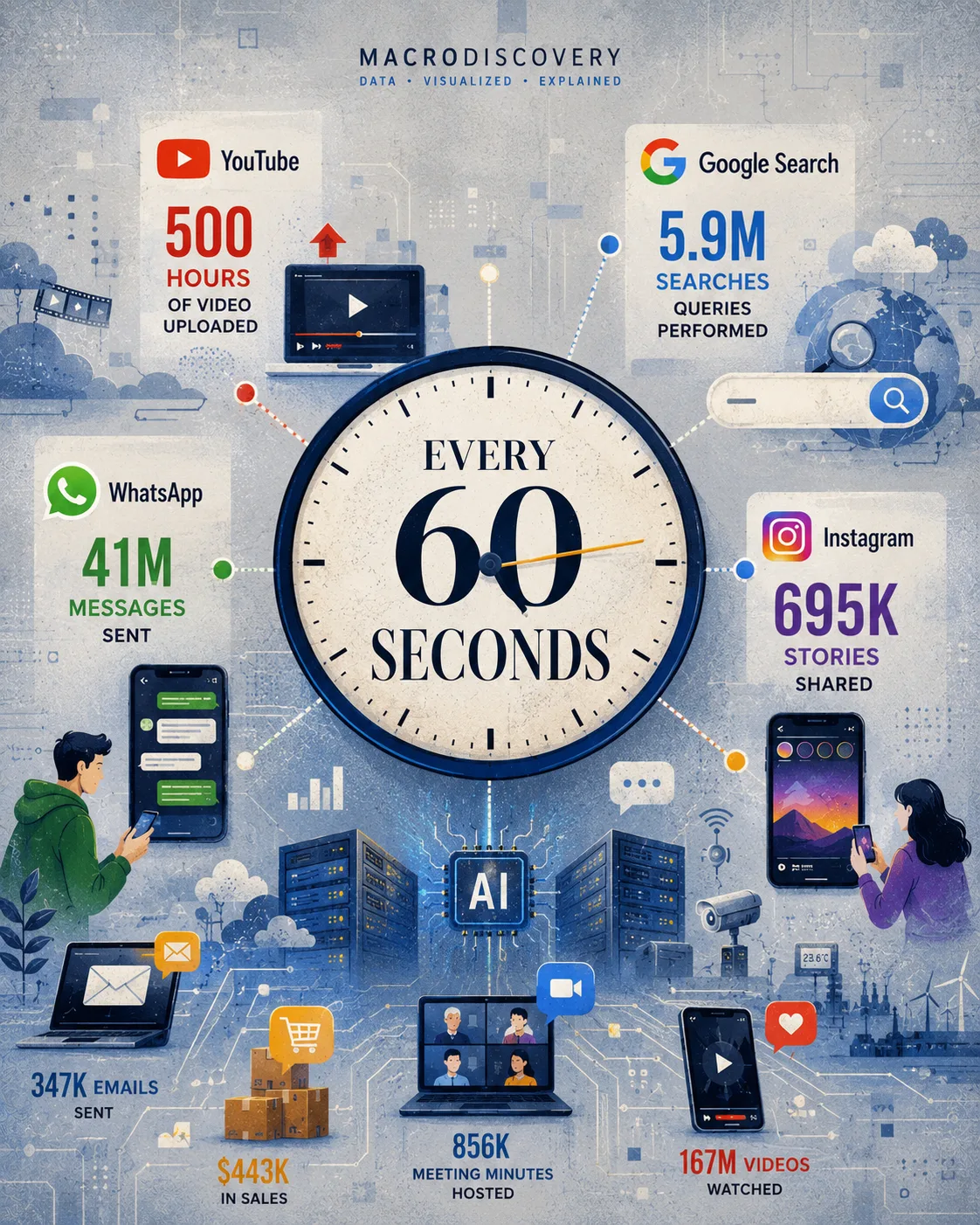
500 hours of video uploaded to YouTube. 695,000 Instagram stories shared. 41 million WhatsApp messages sent. 5.9 million Google searches. Every 60 seconds — simultaneously — while you read this sentence.

By MacroDiscovery
Sources: Domo · Statista · IDC · DataReportal
Updated: 2025
120 ZB
Data created globally in 2025
500 hrs
YouTube video uploaded per minute
5.9M
Google searches per minute
×3
Data growth since 2020
90%
Of all data ever created made in last 3 years
Visualization 01 — One Minute on the Internet
What Happens in 60 Seconds — Every Single Minute of 2025

All figures are per-minute averages based on 2025 platform data, annual reports, and third-party analytics. Sources: Domo “Data Never Sleeps 13.0” 2025, DataReportal, Statista.

EVERY 60 SECONDS ▶ YOUTUBE 500 hrs of video uploaded 🔍 GOOGLE 5.9M searches 💬 WHATSAPP 41M messages sent 📸 INSTAGRAM 695K stories shared 🎵 TIKTOK 167M videos watched ✉ EMAIL 347K emails sent 📹 ZOOM 856K meeting mins hosted 🤖 AI QUERIES 4.2M ChatGPT + Gemini + Claude Sources: Domo Data Never Sleeps 13.0 2025 · DataReportal · Statista · platform public data MacroDiscovery · macrodiscovery.com
Visualization 02 — Platform Volume Ranking
Ranked by Data Generated Per Minute — 2025

Data volume estimated from active users × average data per action × activity rate. Indexed — not all platforms generate comparable data types. Source: Domo 2025, Statista, platform reports.

01 IoT Sensors
~40% of all data — machines talking to machines
~1.7M GB
per minute
02 YouTube
500 hours uploaded · largest single-platform volume
500 hrs
uploaded / min
03 TikTok
167M videos viewed + 100K new uploads
167M
views / min
04 Google Search
5.9M searches — 8.5B per day
5.9M
searches / min
05 WhatsApp
41M messages — 2.5B daily active users
41M
messages / min
06 AI Platforms
4.2M queries — ChatGPT, Gemini, Claude, Copilot
4.2M
queries / min
07 Instagram
695K stories · 66K photos posted
695K
stories / min
08 Email
347K emails — 71% spam filtered out
347K
emails / min
09 Zoom
856K meeting minutes — post-COVID baseline
856K
mins / min
10 Amazon
$443K in sales — AWS + retail combined
$443K
sales / min
Visualization 03 — The Data Explosion
Global Data Created Per Year — 2010 to 2025

Zettabytes (ZB) of data created, captured, copied and consumed globally. One zettabyte = 1 trillion gigabytes. Source: IDC Global DataSphere 2025, Statista.

0 30 ZB 60 ZB 90 ZB 120 ZB 2010 2011 2012 2013 2014 2015 2016 2017 2018 2019 2020 COVID 2021 2022 2023 AI era 2024 2025 120 ZB 90% of all data ever created was made in the last 3 years Source: IDC Global DataSphere 2025 · Statista · 1 ZB = 1 trillion GB
Visualization 04 — What Type of Data Is It?
Where the 120 Zettabytes Actually Live

Share of global data by type. Most data is never seen by a human — it is machines communicating with machines. Source: IDC DataSphere 2025, Seagate, Statista.

📡 IoT & Machine Data
42%
of all global data
Sensors, industrial machines, smart devices, and infrastructure. Most is never stored — generated, transmitted, acted upon, and discarded in milliseconds. Factory floors, power grids, and autonomous vehicles are the primary sources.
🎬 Video Content
29%
of all global data
The single largest stored data type. YouTube alone stores more video than humans could watch in millions of years. Video surveillance, streaming, and user-generated content are all growing at 25%+ annually.
💬 Communications
14%
of all global data
Email, messaging, voice calls, and social media posts. 500 billion emails are sent daily globally. Despite being the most visible data to users, communications are a minority of total volume.
🤖 AI Training & Inference
8%
and growing fastest
The fastest-growing category. Every AI model inference generates logs, embeddings, and feedback data. GPT-4 alone required 45TB of training data. AI data generation is projected to represent 25% of the DataSphere by 2030.
🛍 Commerce & Transactions
4%
of all global data
Financial transactions, e-commerce orders, logistics tracking, and payment processing. $1 trillion in digital transactions flow through global systems daily. High value per byte — regulatory retention requirements mean it is stored longest.
🔬 Scientific & Medical
3%
of all global data
Genomic sequencing, medical imaging, climate modeling, particle physics. A single human genome is 3 gigabytes. The James Webb Telescope produces 57GB per day. Dense, high-value, difficult to compress.

Most Data Is Never Seen by a Human

The data explosion is primarily a machine-to-machine phenomenon — not a social media one.

The popular image of the data economy — tweets, photos, videos — represents a small fraction of total data created. 42% of all data is machine-generated IoT signals from industrial sensors, smart infrastructure, and autonomous systems that never touch a human interface.

Key Insight
The real driver of data growth is not social media — it is industrial digitization. Every factory, power grid, logistics network, and autonomous vehicle fleet continuously streams data that dwarfs what all humans post online combined.

Data volume is an industrial story as much as a consumer one.

AI Is Eating the DataSphere

AI both consumes and generates data at a rate that is reshaping the entire infrastructure layer.

  • Training: GPT-4 required ~45TB of training data. Future models will require orders of magnitude more.
  • Inference: Every AI query generates logs, context windows, embeddings, and feedback loops — creating new data continuously.
  • Synthetic data: AI models are increasingly trained on AI-generated data — a recursive loop that could contribute 10–15% of the DataSphere by 2030.
Why It Matters
AI infrastructure is now the fastest-growing driver of both data center construction and energy consumption. Microsoft, Google, and Amazon collectively committed over $400B in AI infrastructure investment in 2024 alone — primarily to handle this data volume.

Whoever builds the infrastructure to store, process, and act on this data controls the economy of the next decade.

The Storage Paradox

120 zettabytes created — but only 2% is ever stored and used.

IDC estimates that less than 2% of data created is retained and analyzed. The rest is transient — generated, transmitted, and discarded. The challenge is not creating data. It is identifying which 2% is worth keeping and building the infrastructure to act on it in real time.

The scarcest resource in the data economy is not storage — it is the ability to extract signal from noise at scale.

Macro Takeaway — 5 to 10 Year Outlook

The DataSphere Will Hit 175 ZB by 2028

IDC projects continued ~25% annual growth driven by AI, IoT, and edge computing.

At current growth rates, the global DataSphere reaches 175 ZB by 2028 and 290 ZB by 2032. The primary accelerants are autonomous vehicles (each generating 1TB per hour), AI inference workloads, and smart city infrastructure rollouts across Asia.

Data Sovereignty Will Become a National Security Issue

Who controls data infrastructure controls economic intelligence.

The EU’s GDPR, China’s Data Security Law, and the US Cloud Act all reflect the same recognition: data location is a geopolitical variable. The next decade will see accelerating fragmentation of the global internet into regional data blocs — each with its own storage, processing, and AI infrastructure.

Energy Is the Hidden Constraint

Data centers already consume 2% of global electricity — AI is pushing that toward 10%.

The IEA projects data center energy consumption will double by 2026 driven by AI workloads. The constraint on the data economy is not bandwidth or storage — it is the physical energy required to process 120 zettabytes of annual data creation.
Sources & Methodology
  • Domo — Data Never Sleeps 13.0 (2025 edition) (domo.com)
  • IDC — Global DataSphere Forecast 2025–2028 (idc.com)
  • DataReportal — Digital 2025 Global Report (datareportal.com)
  • Statista — Internet Usage & Platform Statistics 2025
  • Seagate — Rethink Data Report 2024 (seagate.com)
  • IEA — Electricity 2026: Analysis and Forecast (iea.org)
  • Google, Meta, YouTube — Platform Transparency Reports 2024–2025
Macro Discovery

Sukh Dhaliwal

Sukh Dhaliwal is the founder of Macro Discovery, an independent digital publication covering AI, technology, science, future trends, and global innovation through visual storytelling and data-driven analysis.

Join WhatsApp

Join Now

Join Facebook

Follow us

Leave a Comment