AI Tech Gaming Future Automobile Top 10 Space Innovation Trending How To Reviews Discover

---Advertisement---

Ranked: How Much Sleep People Get by Country

Macro Discovery
On: June 25, 2026 5:42 PM
Follow Us:
---Advertisement---
Ranked: How Much Sleep People Get by Country
How Much Sleep People Get by Country · MacroDiscovery
MacroDiscovery
Health & Society · 4 min read · 2024 Data
NOW — Sleep Science · Public Health · Productivity · 2024
Health & Society

How Much Sleep People
Get by Country

Japan sleeps over an hour less than Finland. South Korea and Singapore cluster at the bottom alongside the US. The geography of sleep deprivation maps almost perfectly onto working culture, commute time, and artificial light exposure — and it is measurably shortening lives.

By MacroDiscovery
Sources: Sleep Cycle · Philips Sleep Survey · OECD · Nature
Updated: 2024
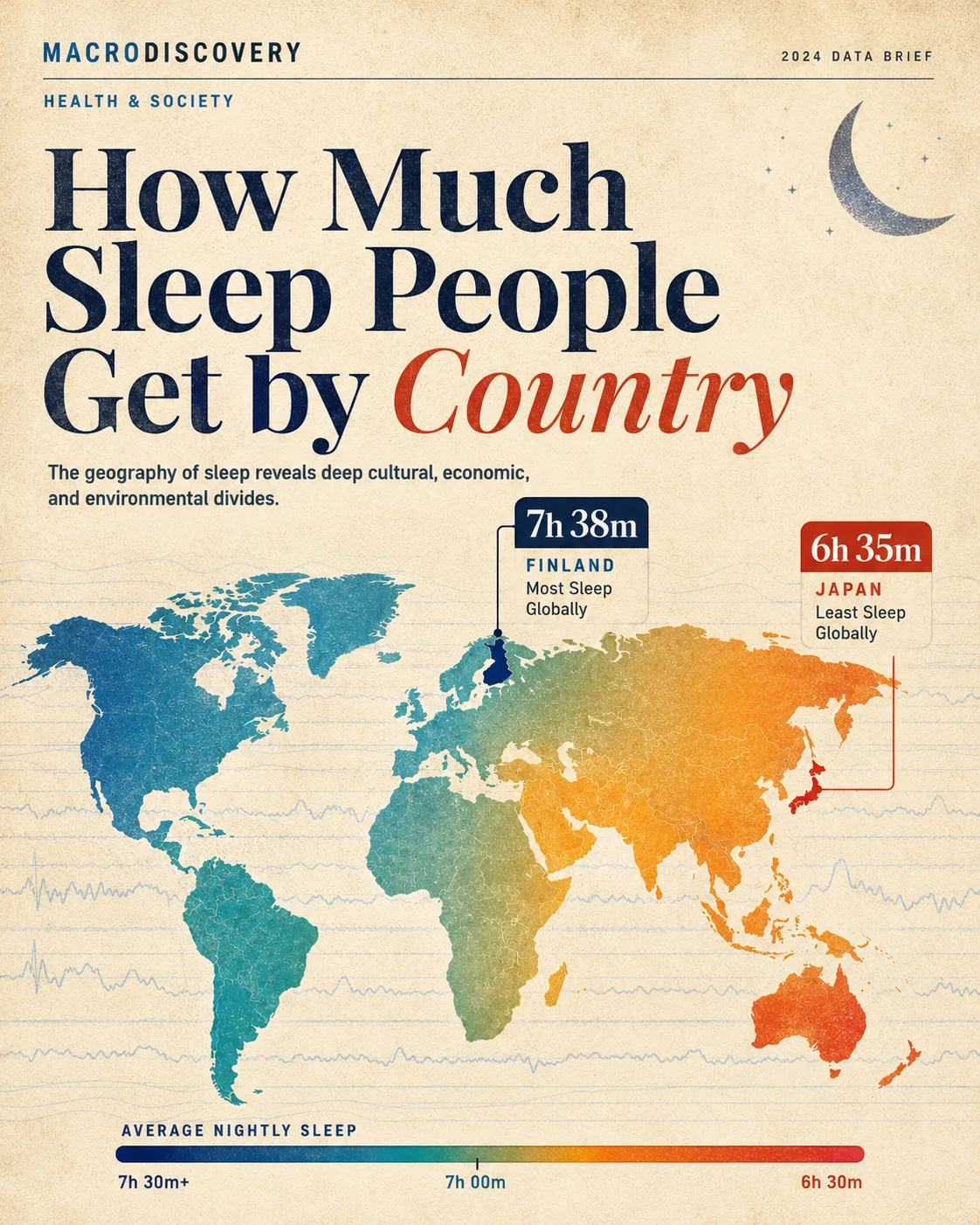
7h 38m
Finland — most sleep globally
6h 35m
Japan — least sleep globally
63m
Gap between most & least sleep
$411B
US economic loss from sleep deprivation/yr
7h
WHO minimum recommended sleep
Visualization 01 — Global Sleep Map
Average Nightly Sleep Duration by Country

Color intensity = average nightly sleep duration. Darker blue = more sleep. Amber/red = sleep-deprived. Based on Sleep Cycle app data (6M+ users), Philips Global Sleep Survey, and OECD Time Use data 2023–2024.

USA 6h 52m CANADA 7h 20m FINLAND 7h 38m EUROPE 7h 04m avg JAPAN 6h 35m KOREA 6h 41m CHINA 7h 00m INDIA 6h 59m S. AMERICA 7h 25m avg AUSTRALIA 7h 24m SUB-SAHARAN AFRICA 7h+ AVG NIGHTLY SLEEP 7h 38m+ 7h 00m 6h 35m Sources: Sleep Cycle 2024 · Philips Global Sleep Survey · OECD Time Use · Nature Human Behaviour 2023
Visualization 02 — Country Rankings
Average Nightly Sleep — 30 Countries Ranked

Hours and minutes of average nightly sleep. Dashed line = WHO 7-hour minimum. Source: Sleep Cycle Global Sleep Report 2024, Philips Sleep Survey 2023.

01 🇫🇮Finland
7h 38m
02 🇳🇱Netherlands
7h 36m
03 🇳🇿New Zealand
7h 33m
04 🇦🇺Australia
7h 24m
05 🇧🇷Brazil
7h 25m
06 🇨🇦Canada
7h 20m
07 🇧🇪Belgium
7h 19m
08 🇸🇪Sweden
7h 18m
09 🇬🇧UK
7h 10m
10 🇩🇪Germany
7h 10m
11 🇫🇷France
7h 08m
12 🇷🇺Russia
7h 10m
13 🇪🇸Spain
7h 06m
14 🇮🇹Italy
7h 05m
15 🇨🇳China
7h 00m
▼ Below WHO 7-hour minimum
16 🇵🇱Poland
6h 58m
17 🇺🇸USA
6h 52m
18 🇮🇳India
6h 59m
19 🇸🇦Saudi Arabia
6h 50m
20 🇵🇭Philippines
6h 47m
21 🇲🇾Malaysia
6h 45m
22 🇧🇷UAE
6h 43m
23 🇸🇬Singapore
6h 42m
24 🇹🇼Taiwan
6h 42m
25 🇹🇭Thailand
6h 41m
26 🇰🇷South Korea
6h 41m
27 🇯🇵Japan
6h 35m
Visualization 03 — Sleep vs. GDP Per Capita
Does Wealth Buy More Sleep — or Less?

Each dot = one country. X-axis = GDP per capita (PPP, log scale). Y-axis = average nightly sleep. The relationship is non-linear — mid-income countries sleep longest; the richest cluster in two camps. Source: OECD, World Bank, Sleep Cycle 2024.

7h min 6h 30m 6h 45m 7h 00m 7h 15m 7h 30m 7h 38m $5K $15K $30K $55K $80K GDP per capita (PPP) — Log scale Avg nightly sleep Nigeria Kenya Brazil Argentina Mexico India China Russia Poland Finland NL UK Germany France Italy USA Canada AUS/NZ UAE KSA Singapore Japan S.Korea CHE Norway East Asia outlier — wealthy but sleep-deprived Work culture overrides economic advantage Nordic nations — wealthy AND well-rested Sources: World Bank GDP PPP 2023 · Sleep Cycle Global Report 2024 · OECD Time Use Database
Visualization 04 — What Steals Sleep by Region
The Six Primary Sleep Thieves — and Where They Strike

Structural factors that reduce sleep duration below optimal. Sources: Nature Human Behaviour, Sleep Foundation, WHO, OECD 2024.

💼 Work Culture & Hours
−45 min
avg loss vs. OECD mean · Japan / South Korea
Japan’s karoshi (death from overwork) culture, South Korea’s 52-hour work-week law (which replaced a 68-hour norm), and long commute times in mega-cities all directly compress sleep windows. The OECD found Japan’s average worker commutes 48 minutes daily — time taken from sleep, not leisure.
📱 Screen Time & Blue Light
−32 min
avg delay to sleep onset · heavy smartphone users
South Korea has the world’s highest smartphone penetration at 95%. Blue-light emission from screens suppresses melatonin production for up to 3 hours after use, pushing sleep onset later. Countries with high smartphone penetration cluster consistently at the bottom of the sleep rankings.
😟 Financial Stress
−28 min
vs. financially secure individuals · APA data
The American Psychological Association found financial stress is the leading cause of sleep disruption in the US. This explains why the US sleeps less than comparable wealthy nations: higher income inequality means a larger share of the population carries chronic financial anxiety even within a high-GDP country.
🕐 Late Social Culture
−22 min
later mean sleep onset · Spain, Italy, Argentina
Spain’s average dinner time is 9:30–10:30 PM. Late social culture delays sleep onset without pushing back work start times. Spain consistently sleeps later and shorter than northern European neighbors with similar incomes. The Spanish government launched a formal commission in 2016 to move the country to Central European Time for this reason.
💡 Artificial Light Pollution
−15 min
avg sleep loss in high light-pollution cities
A 2019 study in JAMA Internal Medicine found sleeping with artificial outdoor light exposure increased the risk of obesity, depression, and shortened sleep by 17%. Tokyo, Seoul, Singapore, and Shanghai all rank in the top 20 most light-polluted cities globally — all cluster at the bottom of the sleep ranking.
🌡 Climate & Heat
−14 min
avg loss per 1°C above optimal sleep temperature
Optimal sleep temperature is 18–20°C. A 2022 Nature Climate Change study found rising temperatures already cost the average person 44 hours of sleep per year — disproportionately affecting tropical and subtropical nations. By 2099, the study projects 58 additional hours of lost sleep annually per person under high-emission scenarios.

The geography of sleep is not random. The clustering visible in the visualizations above — Nordic nations sleeping longest, East Asian nations sleeping least, wealthy but high-inequality nations like the US sitting below the WHO minimum — reflects a set of cultural and structural choices that have been institutionalized over decades. Japan did not accidentally become the world’s most sleep-deprived major economy. It built its post-war economic identity around concepts like karoshi and inemuri — the latter being the culturally acceptable practice of sleeping at one’s desk, which signals dedication rather than exhaustion. The result is a nation that treats chronic sleep deprivation as a mark of commitment rather than a public health crisis.

The scatter plot reveals the most structurally important finding: wealth does not automatically buy more sleep. The Nordic countries and East Asian high-income nations sit at opposite ends of the y-axis despite comparable GDP per capita. What separates them is not income — it is the relationship between working identity and rest. Norway, Finland, and the Netherlands have institutionalized rest through labor law, cultural norms around work-life separation, and generous leave structures. South Korea and Singapore have institutionalized the opposite. The RAND Corporation estimated in 2023 that Japan loses $138 billion annually in productivity — roughly 2.9% of GDP — directly attributable to sleep deprivation among workers.

“Sleep deprivation is not a personal failure. It is the output of an economic system that treats rest as a cost rather than an input — and then pays for it in productivity, health, and decades of life.”

Climate change introduces a new structural driver that will widen the gap between temperate and tropical nations over the coming decades. The finding in Nature Climate Change that heat already costs each person 44 hours of sleep annually — rising to 58 hours under high-emission scenarios — has direct implications for labor productivity in Southeast Asia, South Asia, and sub-Saharan Africa. These are already the regions under greatest economic development pressure. The interaction between heat-driven sleep loss and the economic gap between those regions and temperate-climate wealthy nations creates a compounding disadvantage that climate models have only recently begun to quantify.

Macro Takeaway — 5 to 10 Year Outlook

South Korea’s government has already legislated working hour reductions specifically citing sleep and mental health data. Japan’s government launched its first national sleep health initiative in 2023, setting a target of increasing average sleep duration by 30 minutes by 2030 — an acknowledgment that the data has become impossible to ignore. The economic case for investing in sleep is now being made in GDP terms: RAND, McKinsey, and the WHO have all published analyses showing that countries sleeping below the 7-hour minimum sacrifice between 1.3% and 2.9% of GDP annually.

The next structural shift will come from workplace policy rather than individual behavior change. Four-day work weeks, being piloted in Iceland, the UK, Japan, and Germany, consistently show sleep duration increasing by 20–40 minutes in participant populations. Sleep tracking technology — used by over 60 million people via Fitbit, Apple Watch, Oura Ring, and Samsung Galaxy Watch — is beginning to generate population-level data that allows employers and governments to measure sleep as a public health metric for the first time. The country that figures out how to systematically add 30 minutes of sleep to its workforce will gain a productivity, health, and longevity advantage that compounds over decades.
Sources & Methodology
  • Sleep Cycle — Global Sleep Report 2024 (sleepcycle.com/sleep-report)
  • Philips — Global Sleep Survey 2023 (6,000+ respondents, 12 countries)
  • OECD — Society at a Glance 2023: Time Use Data (oecd.org)
  • RAND Corporation — Why Sleep Matters: Quantifying the Economic Costs 2023
  • Nature Human Behaviour — “Sleep duration and risk of mortality” meta-analysis 2022
  • Nature Climate Change — “Climate change and sleep disruption” 2022 (Obradovich et al.)
  • WHO — Sleep Health Recommendations and Global Burden of Sleep Disorders 2024
  • JAMA Internal Medicine — “Outdoor Artificial Light at Night and Sleep” 2019
Macro Discovery

Sukh Dhaliwal

Sukh Dhaliwal is the founder of Macro Discovery, an independent digital publication covering AI, technology, science, future trends, and global innovation through visual storytelling and data-driven analysis.

Join WhatsApp

Join Now

Join Facebook

Follow us

Leave a Comment