AI Tech Gaming Future Automobile Top 10 Space Innovation Trending How To Reviews Discover

---Advertisement---

Mapped: The Internet’s Undersea Cables

Macro Discovery
On: June 25, 2026 4:13 PM
Follow Us:
---Advertisement---
Mapped: The Internet's Undersea Cables
The Internet’s Undersea Cables
The Internet’s Undersea Cables — MacroDiscovery
MacroDiscovery
Technology & AI · 7 min read · Current Data
NOW — Infrastructure · Geopolitics · Technology
Infrastructure & Technology

The Internet’s
Undersea Cables

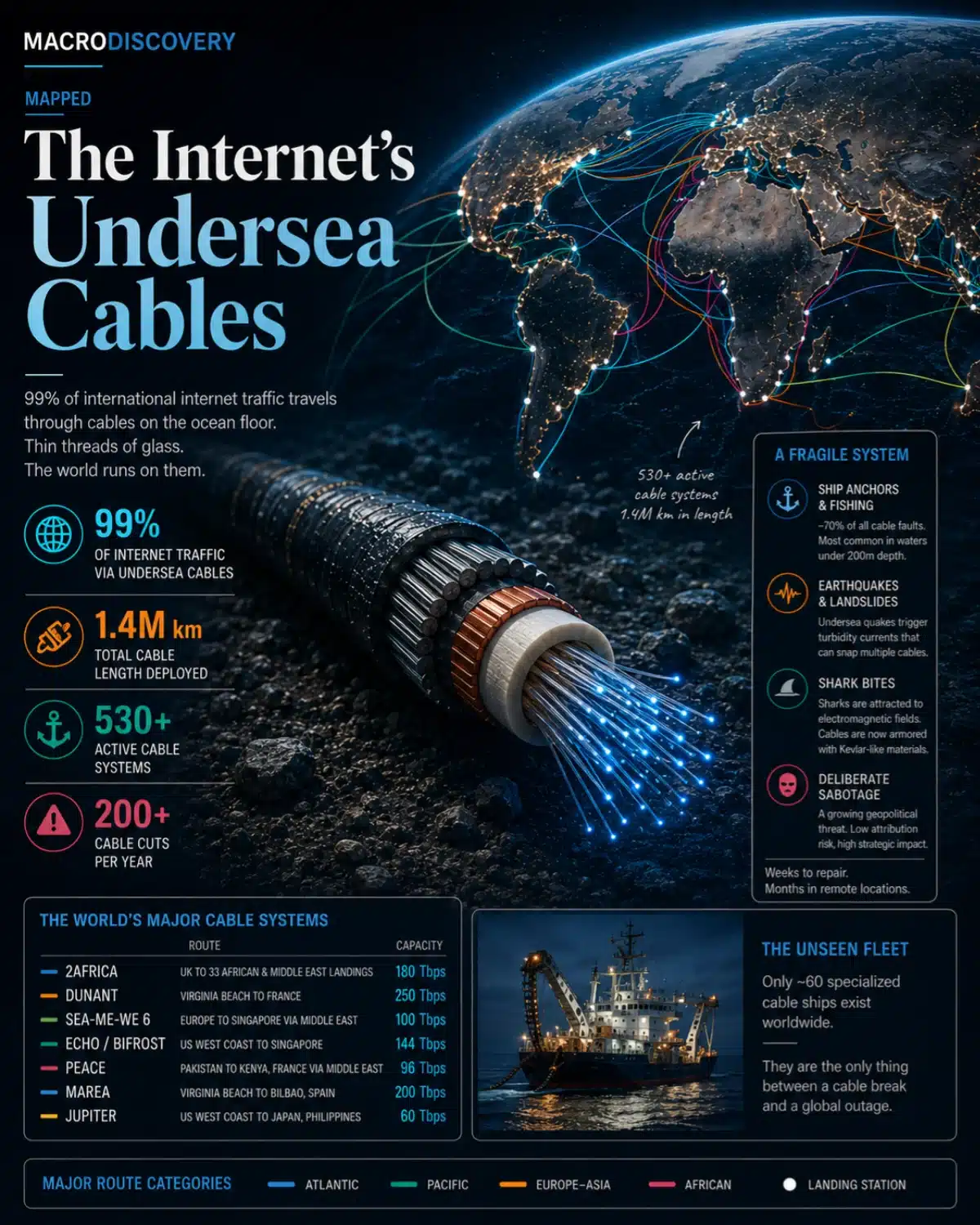
99% of international internet traffic travels through cables on the ocean floor. Not satellites. Not wireless. Thin threads of glass, lying in the dark, 8,000 meters below the surface — and civilization depends on them entirely.

By MacroDiscovery
Sources: TeleGeography · ITU · CSIS
Updated: 2024
99%
Internet via undersea cables
1.4M km
Total cable length deployed
530+
Active cable systems
200+
Cable cuts per year
Visualization 01 — Global Cable Network
The Undersea Internet, Mapped

Major submarine cable routes and landing stations. Each line represents one or more cable systems. Thickness indicates data capacity.

New York Los Angeles London Marseille Fujairah Mumbai Singapore Tokyo Sydney Cape Town MACRODISCOVERY — GLOBAL SUBMARINE CABLE NETWORK 2024 Source: TeleGeography SubmarineCableMap.com · 530+ active systems · 1.4M km total length
Atlantic Routes
Pacific Routes
Europe–Asia (Middle East Corridor)
African Routes
Landing Station
Critical Hub
Visualization 02 — Cable Database
The World’s Most Important Cables

Selected major systems by capacity, route, and ownership. Capacity in terabits per second (Tbps).

Cable System Capacity Length Owner Type
2Africa UK → 33 African + Middle East landings Meta / Consortium 180 Tbps 45,000 km 2024
Dunant Virginia Beach → Saint-Hilaire-de-Riez, France Google 250 Tbps 6,400 km 2020
Curie Los Angeles → Chile, Panama, Peru Google 72 Tbps 10,500 km 2020
SEA-ME-WE 6 France → Singapore via Middle East Consortium 100 Tbps 19,200 km 2025
Echo / Bifrost US West Coast → Singapore (two routes) Meta / Google 144 Tbps 15,000 km 2024
PEACE Pakistan → Kenya, France via Middle East China-backed 96 Tbps 15,000 km 2022
Marea Virginia Beach → Bilbao, Spain Microsoft / Meta 200 Tbps 6,600 km 2017
Jupiter US West Coast → Japan, Philippines Amazon / SoftBank 60 Tbps 14,500 km 2020
Visualization 03 — Risk Analysis
What Can Break the Internet’s Backbone

Four categories of threat to the global cable network — from accidental to deliberate.

Ship Anchors & Fishing
The most common cause of cable breaks. Fishing trawlers and ship anchors drag along the seabed, severing cables in shallow coastal waters. Over 200 cuts occur annually — almost all accidental.
~70% of all cable faults · Most common in waters under 200m depth
🌊
Earthquakes & Landslides
Undersea earthquakes trigger turbidity currents — underwater avalanches of sediment that can snap multiple cables simultaneously. The 2006 Hengchun earthquake cut 7 cables, disrupting internet across Southeast Asia for weeks.
2006 Taiwan earthquake → 7 cables cut simultaneously
🦈
Shark Bites
Less common than folklore suggests, but real. Sharks are attracted to the electromagnetic fields emitted by cables. Google armored their Pacific cables with Kevlar-like materials specifically in response to documented shark attacks.
Google deployed Kevlar wrapping on Pacific cables in 2014
⚠️
Deliberate Sabotage
The growing geopolitical concern. The 2022 Svalbard cable cut, Nord Stream context, and Baltic Sea incidents in 2024 have raised the profile of undersea infrastructure as a target. Military planners now treat cable routes as strategic assets requiring active defense.
NATO established dedicated undersea cable protection unit in 2023

When you send a message from London to New York, the data does not travel through the air. It does not bounce off a satellite in orbit. It travels through a cable thinner than a garden hose, lying on the floor of the Atlantic Ocean, at depths of up to 8,000 meters — in absolute darkness, under pressures that would crush an unprotected human instantly.

The global internet runs on 530 active undersea cable systems stretching 1.4 million kilometers — enough to wrap the Earth 35 times. This infrastructure is the actual physical backbone of the modern world economy. Financial markets. Cloud computing. Streaming services. Diplomatic communications. Military command systems. All of it flows through these cables.

“A single point on the map — the Strait of Malacca — carries cables connecting Europe, the Middle East, India, Southeast Asia, China, Japan, and Australia simultaneously. It is the most critical chokepoint in the global internet.”

Who Owns the Internet’s Infrastructure

Big Tech · The New Cable Owners
75%
Of new undersea cable investment now comes from just four companies: Google, Meta, Amazon, and Microsoft.
As recently as 2012, most submarine cables were owned by telecommunications consortiums — groups of dozens of telecoms companies sharing cost and capacity. Today the architecture has fundamentally changed. Google alone owns or co-owns more than 20 cable systems. Meta is the world’s largest private owner of subsea cable capacity. Amazon’s AWS network relies on cables in every major ocean. The internet’s physical infrastructure has been quietly privatized into the hands of the same companies that run the services on top of it.
Source: TeleGeography Submarine Cable Map 2024 · CSIS — Invisible and Vital, 2023
China · Building a Parallel Network
20+
China-backed cable systems are now active or under construction across Africa, Southeast Asia, the Middle East, and the Pacific.
HMN Technologies (formerly Huawei Marine Networks) has built or upgraded more than 100 cable systems globally. The PEACE cable runs from Pakistan to Kenya to France. The HUMID cable connects the Middle East. This represents a parallel infrastructure strategy — at a time when the US has moved to block Chinese companies from building cables landing on American shores. The geopolitical contest for internet infrastructure has moved to the ocean floor.
Source: CSIS — Invisible and Vital Report, 2023 · Financial Times Submarine Cable Investigation
Chokepoints · Where the System Is Most Fragile
3
Three geographic chokepoints carry the majority of the world’s intercontinental internet traffic — and all three are vulnerable.
The Strait of Malacca between Malaysia and Indonesia carries cables linking Europe, India, the Middle East, and East Asia. The Luzon Strait between Taiwan and the Philippines is a critical Pacific chokepoint. And the waters off Alexandria, Egypt, where multiple cables converge heading from Europe toward Asia. A sustained attack on any one of these three nodes would meaningfully disrupt internet service across entire continents.
Source: CSIS · Naval War College Review · TeleGeography 2024
Repair · The World’s Most Obscure Industry
60
There are approximately 60 cable repair ships in the world — and they are the only thing standing between a severed cable and a prolonged internet outage.
When a cable breaks, a specialized ship must locate the fault — often in complete darkness at depth — raise the cable using grappling hooks, splice in a new section, and lower it back to the seabed. The process takes weeks. In remote locations it can take months. The entire global cable repair industry operates with fewer ships than most major ports have cargo vessels. It is one of the most critical and least discussed bottlenecks in global infrastructure.
Source: ITU — Submarine Cables: An Integral Part of Global Telecoms, 2024

The 2024 Baltic Cable Incidents

In late 2024, two undersea cables in the Baltic Sea — the C-Lion1 cable connecting Finland and Germany, and the BCS East-West Interlink cable connecting Lithuania and Sweden — were severed within days of each other. Investigations pointed to anchor drag from a vessel suspected of acting deliberately. No formal attribution was made publicly.

The incidents accelerated a shift in how governments and militaries think about undersea infrastructure. NATO announced a dedicated undersea infrastructure protection initiative. The EU fast-tracked legislation classifying submarine cables as critical infrastructure. Several countries began examining whether their internet connectivity had adequate redundancy to survive deliberate attack.

The uncomfortable answer, for most countries, was no.

MacroDiscovery Take

The undersea cable network is one of the most important and least visible systems in the modern world. It carries 99% of international internet traffic, enables the global financial system, and underpins military command structures — yet most people have never thought about it, and most governments treated it as someone else’s problem until recently.

Three structural shifts are now underway simultaneously. First, the privatization of cable infrastructure into the hands of a small number of technology companies creates both efficiency and concentration risk. Second, the geopolitical competition between the US and China is extending to the ocean floor, with each side moving to exclude the other from critical cable routes. Third, the Baltic incidents have demonstrated that deliberate sabotage of undersea cables is a viable tool of state conflict — with low attribution risk and high strategic impact.

The internet feels wireless. It isn’t. It is glass and copper on the seabed, and the world is beginning to take that seriously for the first time.
Forecast Cards — Key Data Points
Infrastructure · Internet
99%
Of all international internet traffic travels through undersea cables. Not satellites. Not wireless. Glass on the ocean floor.
TeleGeography, 2024
Infrastructure · Ownership
75%
Of new undersea cable investment now comes from Google, Meta, Amazon, and Microsoft — not telecoms.
CSIS Invisible and Vital Report, 2023
Infrastructure · Vulnerability
200+
Undersea cable cuts per year globally — mostly accidental, but deliberate sabotage is a growing strategic concern.
ITU Submarine Cable Report, 2024
Infrastructure · Expansion
1.4M km
Total active undersea cable length deployed globally — enough to wrap Earth 35 times. Growing by ~100,000 km per year.
TeleGeography SubmarineCableMap, 2024
Sources & Methodology
  • TeleGeography — Submarine Cable Map 2024 (submarinecablemap.com)
  • CSIS — “Invisible and Vital: Undersea Cables and Transatlantic Security” (2023)
  • International Telecommunication Union — “Submarine Cables: An Integral Part of Global Telecoms” (2024)
  • Naval War College Review — “Submarine Cables: Critical Infrastructure for Global Communications”
  • Council on Foreign Relations — “The Geopolitics of Submarine Cables” (2023)
  • Financial Times — “The Invisible Wires That Power the Internet” (2024)
  • NATO — MARCOM Undersea Infrastructure Protection Initiative (2023)
  • Starosielski, N. (2015) The Undersea Network — Duke University Press

Macro Discovery

Sukh Dhaliwal

Sukh Dhaliwal is the founder of Macro Discovery, an independent digital publication covering AI, technology, science, future trends, and global innovation through visual storytelling and data-driven analysis.

Join WhatsApp

Join Now

Join Facebook

Follow us

Leave a Comment