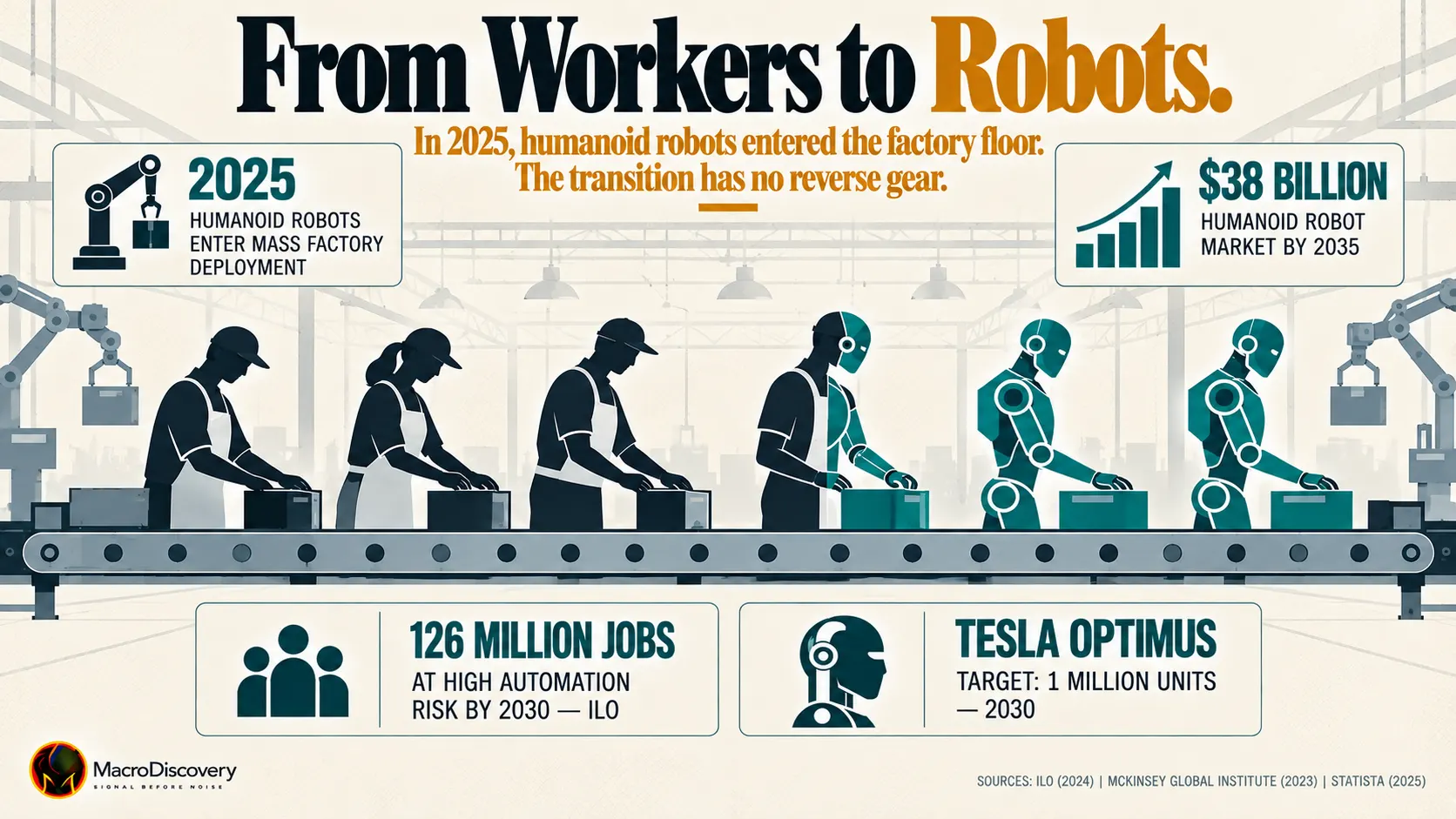
Automation is the story of two simultaneous processes: a physical one and a cognitive one. The physical process is industrial robotics — machines replacing human hands in factories, warehouses, and assembly lines. The cognitive process is AI — algorithms replacing human judgment in data processing, creative work, customer service, and analysis. Both are accelerating. Both are being tracked. Neither is straightforward to interpret.
IFR — World Robotics 2025 Report (PRIMARY · ifr.org · directly fetched · September 25, 2025 · International Federation of Robotics · President: Takayuki Ito)
542K
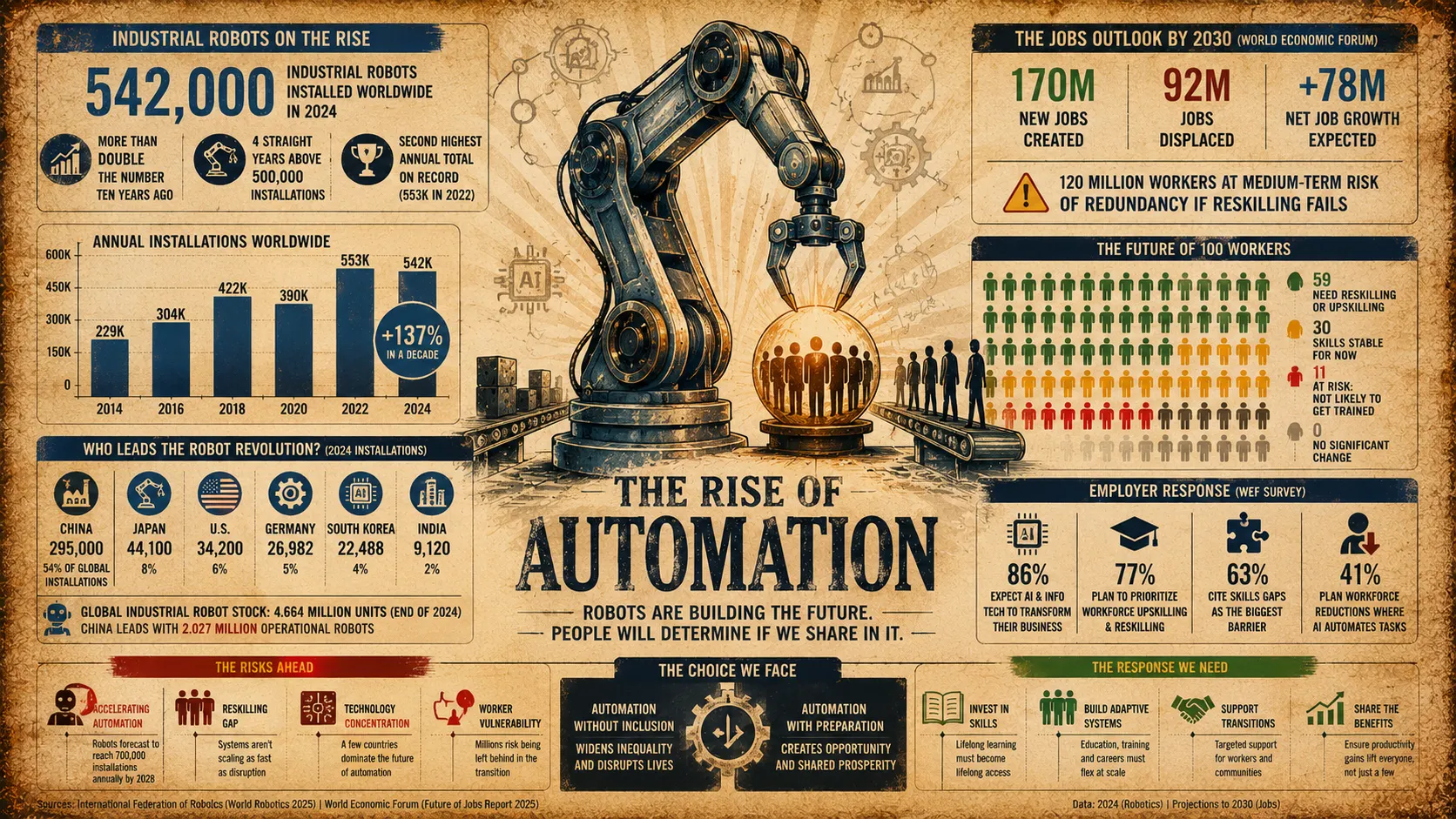
“542,000 robots installed in 2024 — more than double the number 10 years ago. Annual installations topped 500,000 units for the fourth straight year. Asia accounted for 74% of new deployments in 2024, compared with 16% in Europe and 9% in the Americas.” — IFR World Robotics 2025 primary verbatim
The IFR primary release, directly fetched, confirms 2024 was the second-highest year of industrial robot installations in history — only 2% below the all-time record of 553,000 set in 2022. The 4,664,000 robots now in operational use worldwide represent a 9% annual increase and more than double the number of a decade ago. China’s dominance is the defining feature of 2024: 295,000 units installed, 54% of global deployments, and “for the first time, Chinese manufacturers have sold more than foreign suppliers in their home country.” Chinese domestic makers now hold 57% of their home market, up from 28% a decade ago. “China’s operational robot stock exceeded the 2 million mark in 2024, the largest of any country.” The IFR projects 575,000 installations in 2025 and predicts the 700,000-unit mark will be surpassed by 2028. The automotive sector remains the strongest driver globally, with 45% of installations in markets like India. The story in the Americas is more complex: installations fell 9% in the US to 34,200 units, and the US “imports most of its robots from Japan and Europe, with few domestic suppliers.” Europe saw an 8% decline to 85,000 units — still the second-highest in regional history — with Western Europe reaching a record robot density of 267 units per 10,000 manufacturing workers.
Source: IFR — World Robotics 2025 Report (PRIMARY · directly fetched · ifr.org/ifr-press-releases/news/global-robot-demand-in-factories-doubles-over-10-years · September 25, 2025 · International Federation of Robotics · KEY VERBATIM: “542,000 robots installed in 2024 — more than double the number 10 years ago. Annual installations topped 500,000 units for the fourth straight year. Asia accounted for 74% of new deployments in 2024, compared with 16% in Europe and 9% in the Americas” · Takayuki Ito, IFR President: “The new World Robotics statistics show 2024 the second highest annual installation count of industrial robots in history — only 2% lower than the all-time-high two years ago. The transition of many industries into the digital and automated age has been marked by a huge surge in demand. The total number of industrial robots in operational use worldwide was 4,664,000 units in 2024 – an increase of 9% compared to the previous year” · China: “295,000 industrial robots have been installed — the highest annual total on record” · “For the first time, Chinese manufacturers have sold more than foreign suppliers in their home country. Their domestic market share climbed to 57% last year, up from about 28% over the past decade” · “China’s operational robot stock exceeded the 2 million mark in 2024, the largest of any country” · “The United States imports most of its robots from Japan and Europe, with few domestic suppliers” · Europe: “fell 8% to 85,000 units in 2024, still the second largest number recorded in history” · Outlook: “robot installations are expected to grow by 6% to 575,000 units in 2025. By 2028, the 700,000-unit mark will be surpassed”) · IFR — “Robot Density Surges in Europe, Asia, and Americas” (PRIMARY · ifr.org · April 8, 2026 · Western Europe: 267 per 10,000 · North America: 204 · Asia: 131)
“Trends such as generative AI and rapid technological shifts are upending industries and labour markets, creating both unprecedented opportunities and profound risks. The time is now for businesses and governments to work together, invest in skills and build an equitable and resilient global workforce.”
— Till Leopold, Head of Work, Wages and Job Creation, World Economic Forum · WEF Future of Jobs Report 2025 (PRIMARY · weforum.org · directly fetched · January 8, 2025)
170 Million Created. 92 Million Displaced. The Net Is Positive — but the Churn Is What Matters
The WEF Future of Jobs Report 2025 — drawn from over 1,000 companies across 22 industries and 55 economies — is the most comprehensive employer survey on automation’s workforce impact available. Its headline finding is deliberately bilateral: not just “jobs lost” but the full equation. 170 million new roles will be created. 92 million will be displaced. The net is +78 million — a 7% increase in formal employment. The problem is the churn between the two numbers. 22% of the 1.2 billion formal jobs in the survey dataset will be disrupted. Workers who lose existing roles to automation need new skills to access the roles being created. “Frontline roles, including farmworkers, delivery drivers and construction workers, are poised to see the largest job growth in absolute terms by 2030.” These are not the same roles that cashiers, data entry clerks, and administrative assistants occupy. The transition is not automatic. It requires investment, training, and policy.
Why it matters: the net +78 million is an aggregate. Individual workers experience displacement or creation — not the net. A manufacturing worker whose job is automated does not automatically become a renewable energy engineer. The geographic and skills mismatch between where automation displaces and where new roles are created is the central policy challenge of the decade.
WEF — Future of Jobs Report 2025 (PRIMARY · weforum.org · directly fetched · January 8, 2025 · 1,000+ companies · 22 industries · 55 economies)
78M
“Job disruption will equate to 22% of jobs by 2030, with 170 million new roles set to be created and 92 million displaced, resulting in a net increase of 78 million jobs.” — WEF Future of Jobs 2025 primary verbatim. Among the fastest declining: cashiers, administrative assistants, “now joined by roles including graphic designers as generative AI rapidly reshapes the labour market.”
The WEF’s 2025 employer survey captures two simultaneous dynamics. First, the optimistic case: demand for roles in AI, big data, cybersecurity, green energy, nursing, teaching, and frontline services is rising fast and absolutely. Technology creates its own demand — someone must build, maintain, sell, and regulate the automation systems. Second, the sobering case: 41% of employers plan to reduce their workforce as AI automates certain tasks. 86% expect AI to transform their business by 2030. And 63% already identify the skills gap — not the technology itself — as their primary barrier to transformation. The skills gap is compounded by the reskilling gap: “nearly 40% of skills required on the job set to change” between now and 2030. Of 100 workers, 59 need reskilling; 11 are projected to not receive it. That 11 translates directly to over 120 million workers at medium-term risk of redundancy — not because automation won’t create new roles, but because those workers won’t be trained for them. Graphic designers — previously assumed to be in the creative, AI-resistant category — appearing on the fastest-declining list for the first time in 2025 signals how rapidly generative AI is expanding the perimeter of automation beyond routine tasks into creative and analytical work.
Source: WEF — Future of Jobs Report 2025 (PRIMARY · directly fetched · weforum.org/press/2025/01/future-of-jobs-report-2025-78-million-new-job-opportunities-by-2030-but-urgent-upskilling-needed-to-prepare-workforces/ · January 8, 2025 · KEY VERBATIM: “job disruption will equate to 22% of jobs by 2030, with 170 million new roles set to be created and 92 million displaced, resulting in a net increase of 78 million jobs” · “the skills gap continues to be the most significant barrier to business transformation today, with nearly 40% of skills required on the job set to change and 63% of employers already citing it as the key barrier they face” · “If the global workforce were represented by a group of 100 people, 59 are projected to require reskilling or upskilling by 2030 – 11 of whom are unlikely to receive it; this translates to over 120 million workers at medium-term risk of redundancy” · “Frontline roles, including farmworkers, delivery drivers and construction workers, are poised to see the largest job growth in absolute terms by 2030” · “roles such as cashiers and administrative assistants remain among the fastest declining but are now joined by roles including graphic designers as generative AI rapidly reshapes the labour market” · “77% of employers planning to [upskill workers]” · “41% plan to reduce their workforce as AI automates certain tasks” · “86% of employers expect AI and information processing technologies to transform their business by 2030” · Till Leopold quote · “Drawing on data from over 1,000 companies in 22 industries and 55 economies”)
The Skills Gap Is the Automation Crisis — 120 Million Workers Who Will Not Be Reached
The automation debate often focuses on how many jobs will be destroyed and how many created. The WEF’s framing shifts that focus to a harder question: of the workers who need new skills to survive this transition, how many will actually receive them? The answer is troubling. Of every 100 workers, 59 need reskilling by 2030. Eleven of those 59 are projected not to receive it. That is not a rounding error — it is over 120 million people. They will not be unreached because retraining is impossible. They will be unreached because it is underfunded, poorly targeted, or structurally inaccessible. The skills most in demand by 2030 combine technology literacy — AI, big data, cybersecurity — with human skills: analytical thinking, resilience, creative problem-solving, and collaboration. These are not skills taught by short online courses. They require sustained investment in education systems, apprenticeship programmes, employer-led training schemes, and public-private partnerships that most governments have not yet built at the scale required.
Why it matters: 77% of employers plan to prioritise upskilling. But employer-led upskilling reaches existing workers in existing firms. The 120 million most at risk — those in roles being automated out of existence — are precisely the workers least likely to be retrained by the employers automating them away. That gap is the core failure mode of even the optimistic automation scenario.
WEF — Future of Jobs Report 2025 (PRIMARY · directly fetched · January 8, 2025) · IFR — World Robotics 2025 (PRIMARY · directly fetched · September 25, 2025)
120M
“59 are projected to require reskilling or upskilling by 2030 – 11 of whom are unlikely to receive it; this translates to over 120 million workers at medium-term risk of redundancy.” — WEF Future of Jobs 2025 primary verbatim. Meanwhile, robot installations are forecast to reach 700,000 units annually by 2028 — accelerating the displacement pressure faster than reskilling systems are scaling.
The 120 million figure is the intersection of two trajectories: robot installations growing from 542,000 in 2024 toward 700,000 by 2028, and reskilling programmes growing far more slowly than the pace of displacement they are meant to address. The IFR projects “10% growth on average each year until 2028” for China alone — the world’s largest and fastest-growing robot market, now with over 2 million machines operating in factories. As robot density rises (Western Europe already at 267 per 10,000 manufacturing workers, North America at 204), the tasks being automated shift from purely manual to mixed manual-cognitive. The robot installing car parts and the LLM drafting legal briefs are automating different layers of the same workforce. Together, they are moving through the skills pyramid faster than the education system can respond. The WEF notes that “nearly 40% of skills required on the job set to change” between 2025 and 2030. That is not a minor curriculum refresh. It is a structural transformation of what qualifications mean in practice — and it is happening on a five-year timeline while most education policy operates on decade-long cycles.
Source: WEF (PRIMARY · directly fetched · January 8, 2025 · verbatim: “59 are projected to require reskilling or upskilling by 2030 – 11 of whom are unlikely to receive it; this translates to over 120 million workers at medium-term risk of redundancy” · “nearly 40% of skills required on the job set to change” · “63% of employers already citing [skills gap] as the key barrier they face”) + IFR (PRIMARY · directly fetched · September 25, 2025 · verbatim: “10% growth on average each year until 2028” for China · “By 2028, the 700,000-unit mark will be surpassed” · China: “no indication that robot demand in China will decrease”) + IFR Density release (PRIMARY · April 8, 2026 · Western Europe: 267 per 10,000 · North America: 204 · Asia: 131)