Ranked: The World’s
Most Spoken Languages
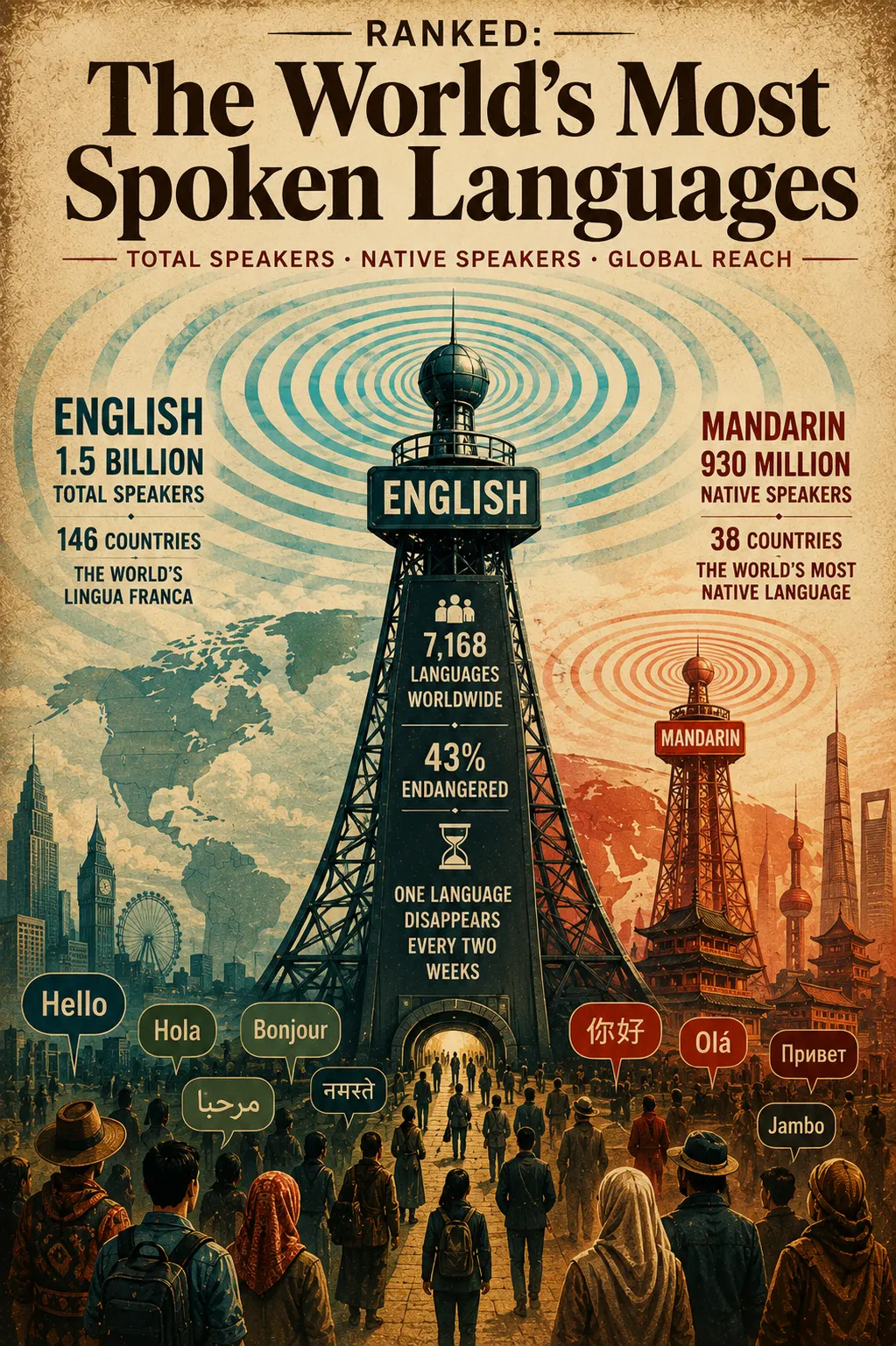
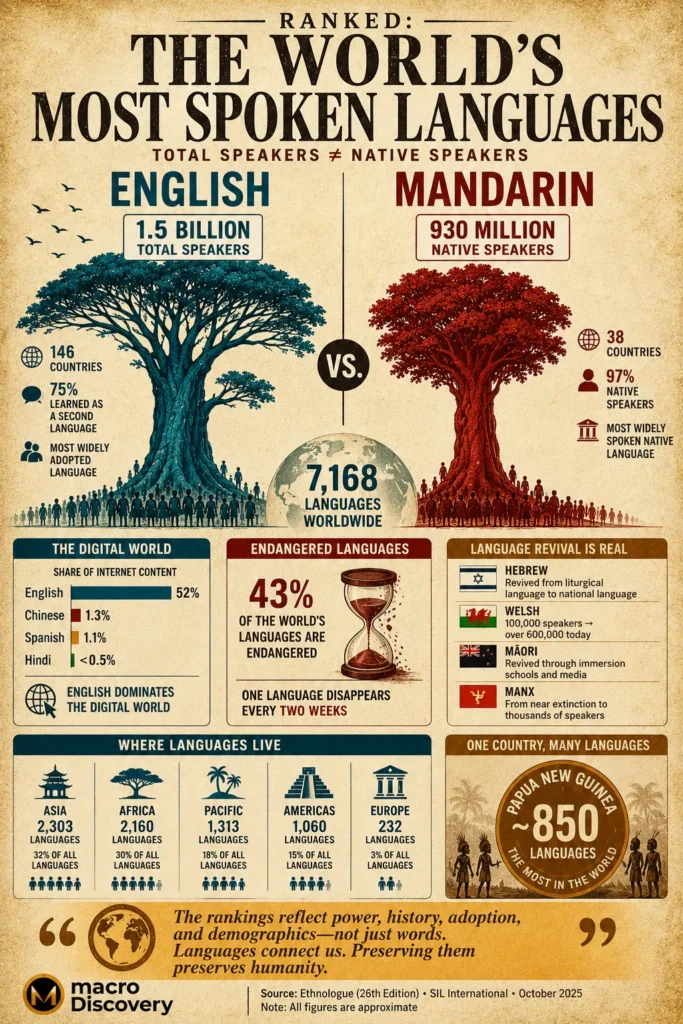
English is the most spoken language on earth by total speakers — approximately 1.5 billion. But three-quarters of those speakers learned it as a second language. Mandarin Chinese has nearly a billion native speakers and is the world’s largest language by birth — yet exists in only 38 countries, against English’s 146. These two statistics reveal the most important distinction in the entire ranking: the difference between a language that spread through adoption, and one that grew through population. Meanwhile, 43% of the world’s 7,168 languages are endangered, and one disappears approximately every two weeks.
| Rank (total) | Language | Total speakers | Native speakers | % native | Countries | Type of reach |
|---|---|---|---|---|---|---|
| #1 | 🇬🇧🇺🇸 English | ~1.49–1.53B | ~380–390M | ~25% | 146 | Adopted lingua franca |
| #2 | 🇨🇳 Mandarin Chinese | ~1.18–1.2B | ~930–990M | ~84% | 38 | Population-driven |
| #3 | 🇮🇳 Hindi | ~609–611M | ~340M | ~56% | India + diaspora | National + diaspora |
| #4 | 🇪🇸 Spanish | ~558–561M | ~485–490M | ~87% | 20+ countries | Colonial spread + native |
| #5 | 🇸🇦 Standard Arabic | ~335M | ~315M | ~94% | 22+ countries | Regional + religious |
| #6 | 🇫🇷 French | ~300M | ~80–85M | ~27% | 29 countries | Colonial + African growth |
| #7 | 🇧🇩 Bengali | ~284M | ~230M+ | ~81% | Bangladesh + India | Population-driven |
| #8 | 🇧🇷 Portuguese | ~264M | ~240M | ~91% | 9 countries | Colonial + Brazil |
| #9 | 🇵🇰 Urdu | ~246M | ~70M | ~28% | Pakistan + India | National lingua franca |
| #10 | 🇷🇺 Russian | ~238M | ~138M | ~58% | Post-Soviet states | Imperial + diaspora |
Source: Ethnologue (SIL International, primary, directly fetched, ethnologue.com — “Mandarin Chinese is the largest language in the world when counting only first language speakers” · “English is the largest when factoring in second, third, and higher language speakers” · “English is spoken in 146 countries, a stark difference to Mandarin’s 38”). Speaker counts: Visual Capitalist 2025–2026 (Ethnologue basis). Arabic: Standard Arabic only; all Arabic varieties combined exceed 400M. French “% native” note: large and fast-growing African L2 base inflates total.
Why English Is #1 by Total Speakers — But Only Third by Native Speakers
The Ethnologue primary page states it directly: English’s scale is a product of “first the colonial influence of the British Empire, but later the spread of American culture.” Of the approximately 1.5 billion people who speak English, only around 390 million — roughly 25% — learned it at home as their first language. The remaining 75% acquired it as a second, third, or additional language through schooling, migration, work, or digital media. Mandarin Chinese, by contrast, has approximately 930–990 million native speakers (Ethnologue, primary): 84% of its total speaker base learned it as children. This reversal — English leads by total; Mandarin leads by native — is the central fact that most rankings obscure by collapsing two very different phenomena into one number.
Why it matters: a language that spreads through adoption is geographically and politically vulnerable in ways that a language anchored in native speakers is not.
The Digital Gap: Why 900 Million Mandarin Speakers Represent Only 1.3% of the Web
The starkest illustration of what linguistic power actually means in 2025 is the gap between spoken scale and digital representation. English, with 1.5 billion total speakers, accounts for approximately 52.1% of all website content globally. Mandarin Chinese, with 1.2 billion speakers — nearly as many — represents only 1.3% of websites. Hindi and Bengali together have approximately 900 million speakers but account for less than 0.5% of web content. This is not just a linguistic statistic — it is a map of who participates in the global digital economy and who does not. The internet was built primarily in English, and the majority of its knowledge base, commercial infrastructure, and scientific literature remains in English, creating structural advantages for English speakers that compound over time regardless of shifts in spoken population.
Why it matters: the gap between a language’s spoken scale and its digital representation determines which speakers access the full internet — and which access a translated fragment of it.
Why 43% of the World’s Languages May Not Survive the Century
Ethnologue tracks 7,168 living languages. Of these, 3,078 — 43% — are classified as endangered. A further 1,431 have fewer than 1,000 native speakers; 240 have fewer than 20. UNESCO estimates that approximately one language disappears from the world every two weeks. At current rates of language loss, between 50% and 90% of all languages spoken today could be extinct by 2100 (UNESCO conservative estimate: 50%; Ethnologue modelling worst case: 90%). The key metric, as UNESCO’s Atlas of the World’s Languages in Danger establishes, is not speaker count — it is whether children are still learning the language at home. A language with 200,000 adult speakers is dying if none of them are passing it to the next generation. Only 490 languages have formal institutional roles in government, education, and media; those 490 languages cover 6.1 billion speakers. The remaining 6,678 languages share the rest of humanity, most without any institutional infrastructure at all.
Hebrew: the most dramatic language revival in recorded history. Hebrew ceased to be a spoken vernacular around the 2nd century CE and survived only as a liturgical and scholarly language for approximately 1,700 years. Its revival as the daily language of the modern State of Israel required a deliberate nation-building effort in the late 19th and early 20th centuries, driven by Eliezer Ben-Yehuda, who modernised vocabulary for contemporary life. Today ~9 million people speak Modern Hebrew natively.
Welsh: under severe pressure through the 20th century, rescued in part by the Welsh Language Act, BBC Wales broadcasting in Welsh, and Welsh-medium schooling. Around 900,000 speakers as of 2021 census.
Māori (New Zealand): revived through kōhanga reo (language nest) preschools in the 1980s, where children are immersed in Māori from birth. The policy has produced a new generation of speakers who did not inherit the language from parents.
Manx (Isle of Man): classified as “extinct” in 1974 when the last native speaker died. A revival effort using recordings produced new L2 speakers; Manx is now taught in schools and used in broadcasting.
Each revival required the same three elements: political will, institutional infrastructure (schools, media, government use), and a generation willing to speak a minority language when a dominant alternative was easier.
Sources: UNESCO Atlas of the World’s Languages in Danger · BBC · Globe Language (January 2025) · LingoBright (2026).
Why it matters: language death is not inevitable — it is a policy outcome, and language revival is possible, but it requires resources and institutional commitment that most governments do not allocate to minority languages.
Where the World’s Linguistic Diversity Actually Lives — and Why It Matters
The world’s 7,168 languages are not distributed evenly. The most linguistically diverse country on earth is Papua New Guinea, with approximately 850 distinct languages spoken across a population of fewer than 10 million people — more languages than exist in the entirety of Europe. Indonesia hosts approximately 700 languages; Nigeria over 500. Africa and the Pacific together contain the majority of the world’s linguistic diversity. The 10 most spoken languages account for approximately half of all humanity; the remaining 7,158 languages are distributed across the other half. French is an unusual case in this context: with only 80–85 million native speakers, it ranks sixth by total speakers at approximately 300 million because of a vast African second-language base that is growing fast as sub-Saharan Africa’s population expands — making French potentially one of the largest languages in the world by 2050.
Why it matters: the geography of linguistic diversity is also the geography of cultural knowledge — languages encode unique ways of understanding ecosystems, kinship, time, and causation that do not translate, and are lost permanently when a language dies.
- English is #1 by total speakers (~1.5 billion) but only third by native speakers, behind Mandarin (~930M native) and Spanish (~485M native). 75% of English speakers learned it as a second language (Ethnologue, primary, directly fetched).
- Mandarin Chinese is spoken in only 38 countries vs English’s 146 — yet has nearly as many total speakers, because 84% of Mandarin speakers are native (Ethnologue primary).
- English accounts for 52.1% of all website content; Mandarin Chinese — with 1.2 billion speakers — accounts for only 1.3%. Hindi and Bengali together represent less than 0.5% of the web.
- Of the world’s 7,168 living languages, 3,078 (43%) are endangered; 1,431 have fewer than 1,000 native speakers (Ethnologue 27th edition).
- A language disappears approximately every two weeks; at current rates, 50–90% of all languages spoken today could be extinct by 2100 (UNESCO / Ethnologue).
- Papua New Guinea hosts approximately 850 languages in a population under 10 million — more linguistic diversity than the entire continent of Europe.
- French ranks 6th by total speakers (~300M) despite only ~80M native speakers because of a vast and growing African second-language base — making it one of the fastest-growing languages by total speakers.
The most spoken language on earth is not the most natively spoken language on earth. English’s 1.5 billion speakers reflect the reach of empire and global culture; Mandarin’s 930 million native speakers reflect the weight of China’s population. The ranking is a fact about power and history as much as about linguistics. What the endangered language data adds is the other side of the story: while a handful of languages spread to billions of people, 43% of the world’s languages are contracting toward extinction, and the cultural knowledge they carry — encoded over millennia — disappears with them permanently, one last speaker at a time.
- Ethnologue — SIL International — “What is the most spoken language?” (primary · directly fetched · ethnologue.com · “Mandarin Chinese is the largest language in the world when counting only first language (native) speakers” · “English is the largest when factoring in second, third, and higher language speakers” · “English is spoken in 146 countries, a stark difference to Mandarin’s 38” · Chinese macrolanguage = 13 languages · English dominance attributed to “colonial influence of British Empire, then spread of American culture”)
- Visual Capitalist — “Ranked: The World’s Most Spoken Languages in 2026” (Ethnologue basis · June 2026 · English 1.49B · Mandarin 1.2B · Hindi 609M · Spanish 558M · Arabic 335M · “only two languages have crossed the one-billion-speaker mark” · English “spoken by nearly one in six people worldwide”)
- Visual Capitalist — “Ranked: The World’s Most Spoken Languages by Total Speakers” (Dec 2025 · Ethnologue basis · English 1.53B · Mandarin 1.18B · “Mandarin’s 990M first-language speakers make up 84% of its total” · “English’s lead is built on adoption rather than birth” · Spanish 87% native)
- LingoBright — “Dying Language Statistics 2026” (Ethnologue 27th edition + UNESCO basis · 3,078 of 7,168 = 43% endangered · 1,431 have <1,000 L1 speakers · 240 with <20 speakers · 490 institutional languages cover 6.1B speakers · 88M people speak a language that may not survive the century · 90% disappear by 2100 worst case)
- UNESCO — Atlas of the World’s Languages in Danger (primary · ~2,473–3,000 languages classified · endangerment levels: vulnerable / definitely endangered / severely endangered / critically endangered · “half of 7,000 languages could be lost by end of century” · language dies every two weeks · key factor: child transmission at home)
- ICLS (citing Ethnologue) — “10 Most Spoken Languages in the World in 2026” (English 1.52B · 75% non-native · Mandarin 1.2B · “941M native speakers” · English 186 countries version vs Ethnologue’s 146 · Chinese 1.3% of websites · Hindi/Bengali <0.5% · digital divide analysis)