The 15 Countries With
the Most UNESCO World Heritage Sites
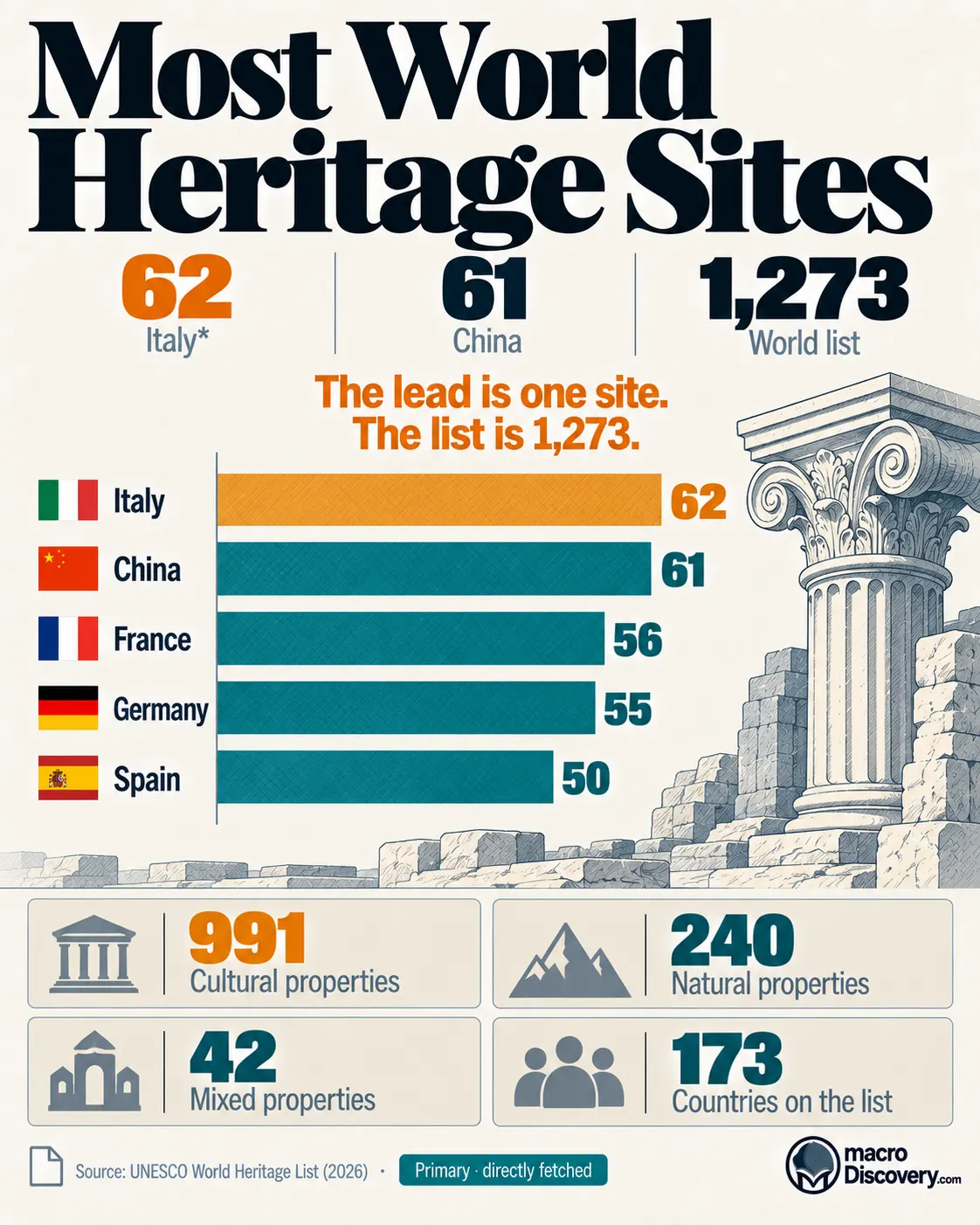
Italy leads the world with 61 sites. China is one behind and closing fast. Germany added Neuschwanstein in 2025. And nearly half of all 1,248 sites on Earth are in Europe — a legacy not just of great civilizations, but of who showed up first to nominate them.
There are now 1,248 UNESCO World Heritage Sites across 170 countries. They range from the Pyramids of Giza to the Great Barrier Reef to the historic centres of entire cities. But the distribution is anything but even — a handful of nations dominate the list, and understanding why reveals as much about global politics as it does about civilization.
- Italy leads with 61 sites — more than any other country — including the Colosseum, Venice, Pompeii, Cinque Terre, and the Amalfi Coast. Nearly every major Italian city contains at least one inscribed site.
- China added the Xixia Imperial Tombs in 2025, reaching 60 sites and closing within one of Italy. China’s 15 natural sites are more than any European country holds.
- Europe accounts for nearly half of all sites worldwide — not because it has more history than Asia or Africa, but because European countries were the first signatories of the 1972 Convention and built early administrative advantages in the nomination process.
- 28 countries that have ratified the Convention have zero inscribed sites, including The Bahamas, Bhutan, and the Maldives — a gap UNESCO is actively working to close.
Source: Wikipedia “World Heritage Sites by country” (October 2025, directly fetched · post-47th session) · Statista 2025 · GeographyPin March 2026 (citing UNESCO state-party pages). Positions 9–15 carry approx. qualifiers where secondary sources show minor variation between session years. Shared/transnational sites counted for each participating country.
Italy Has Been Number One Since the Beginning — and for Good Reason
Italy’s 61 sites are not just numerous — they are extraordinarily dense. The country is smaller than California yet contains more UNESCO World Heritage Sites than any nation on Earth. The reason is the sheer layering of civilizations: Etruscan, Roman, Byzantine, Norman, Renaissance, Baroque, and modern all left major physical legacies within a compact geography. Nearly every major Italian city — Rome, Venice, Florence, Siena, Ravenna, Naples — holds at least one inscribed site.
The most recent addition in 2025 was the Domus de Janas — prehistoric rock-cut tombs in Sardinia dating to between 3000 and 5000 BCE. Italy’s sites cover everything from Roman engineering to Renaissance painting to natural coastlines. 54 are cultural, 6 are natural, and 1 is mixed — a ratio that perfectly mirrors Italy’s self-image as a civilization with both deep human roots and exceptional natural beauty.
China Is One Site Behind Italy — and Growing Faster
China reached 60 sites after the 2025 session added the Xixia Imperial Tombs — the imperial cemetery of the Xixia Dynasty in Ningxia. What makes China’s position remarkable is its balance: 41 cultural, 15 natural, and 4 mixed. Those 15 natural sites are more than any European country holds, reflecting China’s extraordinary geographic range — from subtropical karst landscapes in Guangxi to the giant panda sanctuaries of Sichuan to the ancient Silk Road corridors of the northwest.
China began nominating sites later than most European nations and has been adding them rapidly. Its tentative list — nominations in preparation — remains long. If the current pace continues, China will overtake Italy within a few sessions.
Why Europe Dominates the List — and Why That Is Changing
Europe accounts for nearly half of all 1,248 inscribed sites worldwide. This is not because Europe has more history or greater natural beauty than Asia or Africa — it is because European nations were the first signatories of the 1972 World Heritage Convention and built early institutional advantages: experienced nomination committees, detailed documentation systems, and decades of practice navigating UNESCO’s complex criteria.
The 10 selection criteria that UNESCO uses to evaluate sites were themselves shaped in an era when “monumental stone architecture” — Gothic cathedrals, Roman forums, Renaissance palaces — was the dominant model of heritage. That framework favoured European submissions. UNESCO has been actively working to rebalance the list. The 2025 session’s spotlight on African heritage — four new African sites inscribed — reflects this effort. India’s tentative list of over 50 potential nominations, and Iran’s similarly long pipeline, signal that the rankings will look different in a decade.
Iran and the USA — Two Very Different Stories About What Gets Protected
Iran’s approximately 27 sites represent one of the ancient world’s most sophisticated civilizations — the Persian Empire. Persepolis, the ceremonial capital of the Achaemenid Empire; Naqsh-e Jahan Square in Isfahan, a 17th-century urban masterpiece; the Hyrcanian Forests, a temperate woodland older than the last ice age. Iran has a tentative list of dozens more pending nominations, and sites like Pasargadae and the ancient city of Susa remain among the world’s most significant unprotected archaeological landscapes.
The United States takes almost the opposite approach. With approximately 26 sites, nearly half are natural — Yellowstone, the Grand Canyon, the Everglades, Yosemite, the Redwood forests. This makes the US unusual among top-15 nations, where cultural sites typically dominate. The US has more natural UNESCO sites than it has cultural ones — a reflection of a country that built its national identity as much around its landscapes as its built history. Mount Fuji in Japan, by contrast, was inscribed as a cultural site — not for its geology, but for its 1,400 years of spiritual significance to Japanese artists and pilgrims.
The Gap at the Bottom of the List
Of the 196 countries that have ratified the World Heritage Convention, 28 have zero inscribed sites — including Bhutan, the Maldives, The Bahamas, Brunei, and Tonga. This is not because these countries lack heritage worth protecting. It is because the nomination process requires significant administrative resources: preparing dossiers in UNESCO’s official languages, commissioning independent expert evaluations, funding site management plans, and sustaining years of correspondence with the World Heritage Centre. Small island states and lower-income countries face structural barriers that the top-15 nations have long since solved.
UNESCO’s own response — funding expert training, streamlining nomination support, and actively prioritising African and Pacific nominations — has begun to shift the pattern. The 2025 session inscribed four African sites and one Australian Aboriginal landscape (the Murujuga Cultural Landscape in Western Australia, supported directly by the local Murujuga Aboriginal community). The list is slowly becoming more representative of the world it is meant to preserve.
- Wikipedia — “World Heritage Sites by country” (October 2025 · directly verified)
- Statista — “Italy Is the Country With the Most World Heritage Sites” (2025 session data)
- UNESCO — “26 new World Heritage Sites inscribed” (47th session, Paris 2025)
- GeographyPin — “Countries with Most UNESCO World Heritage Sites” (March 2026, citing UNESCO state-party pages)
- WorldAtlas — “Countries With the Most UNESCO Heritage Sites” (2026)
- UNESCO World Heritage Centre — Official World Heritage List (whc.unesco.org)
- UNESCO — 46th session (New Delhi 2024): total 1,223 sites confirmed · 47th session (Paris 2025): 26 new sites, total 1,248 confirmed