The Global Diabetes Epidemic , Which country has the highest diabetes rate in the world? , Global Diabetes Statistics: Countries, Rates & Projections , global diabetes statistics by country , which country has the highest diabetes rate in the world , how many people have diabetes worldwide , what percentage of diabetes cases are undiagnosed globally , how much does diabetes cost the world per year , Which country has the highest diabetes rate in the world? , How many people have diabetes worldwide in 2024? , What percentage of diabetes cases are undiagnosed? , How much does diabetes cost the world each year? , Which type of diabetes is most common? ,
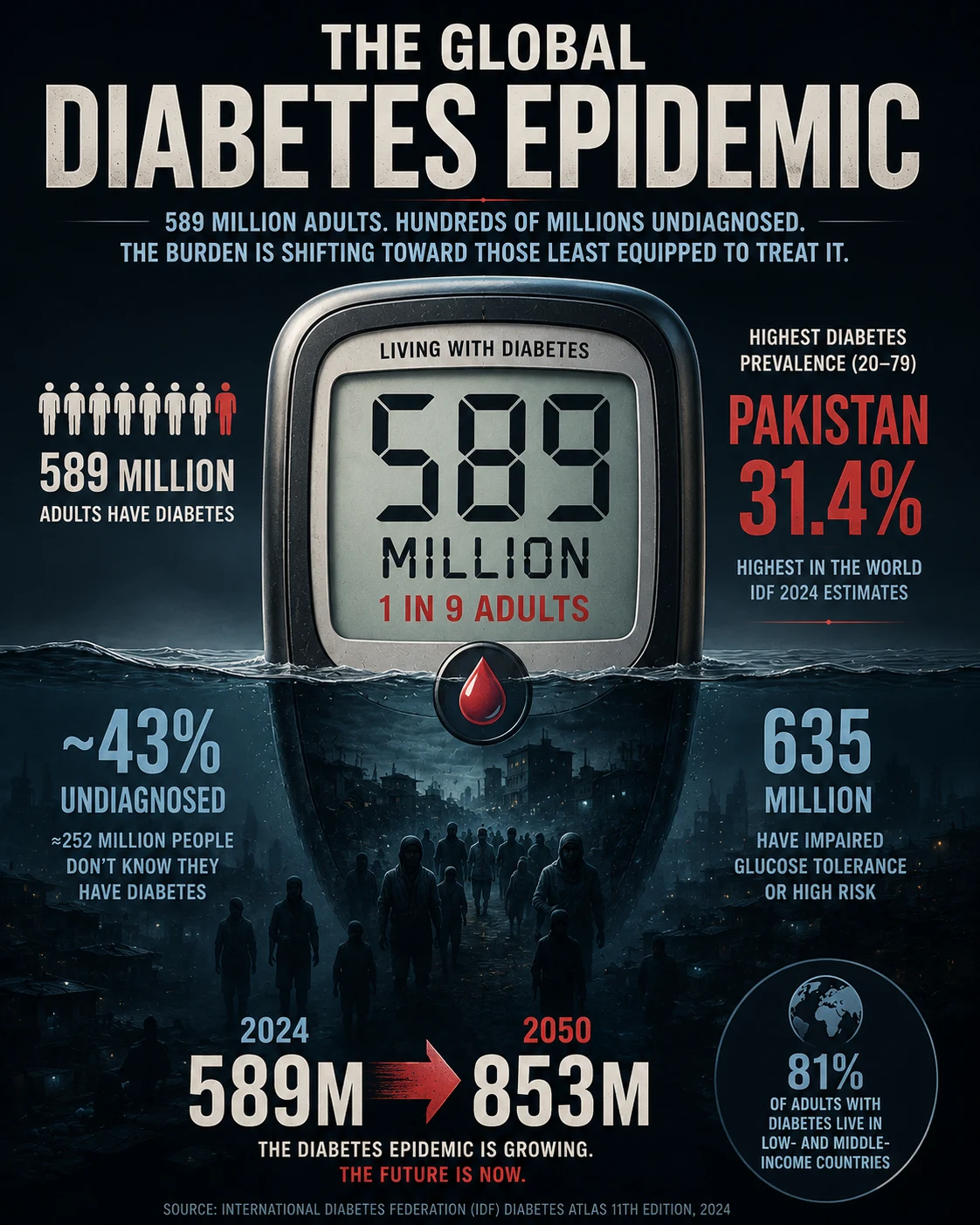
Mapped: The Global Diabetes Epidemic
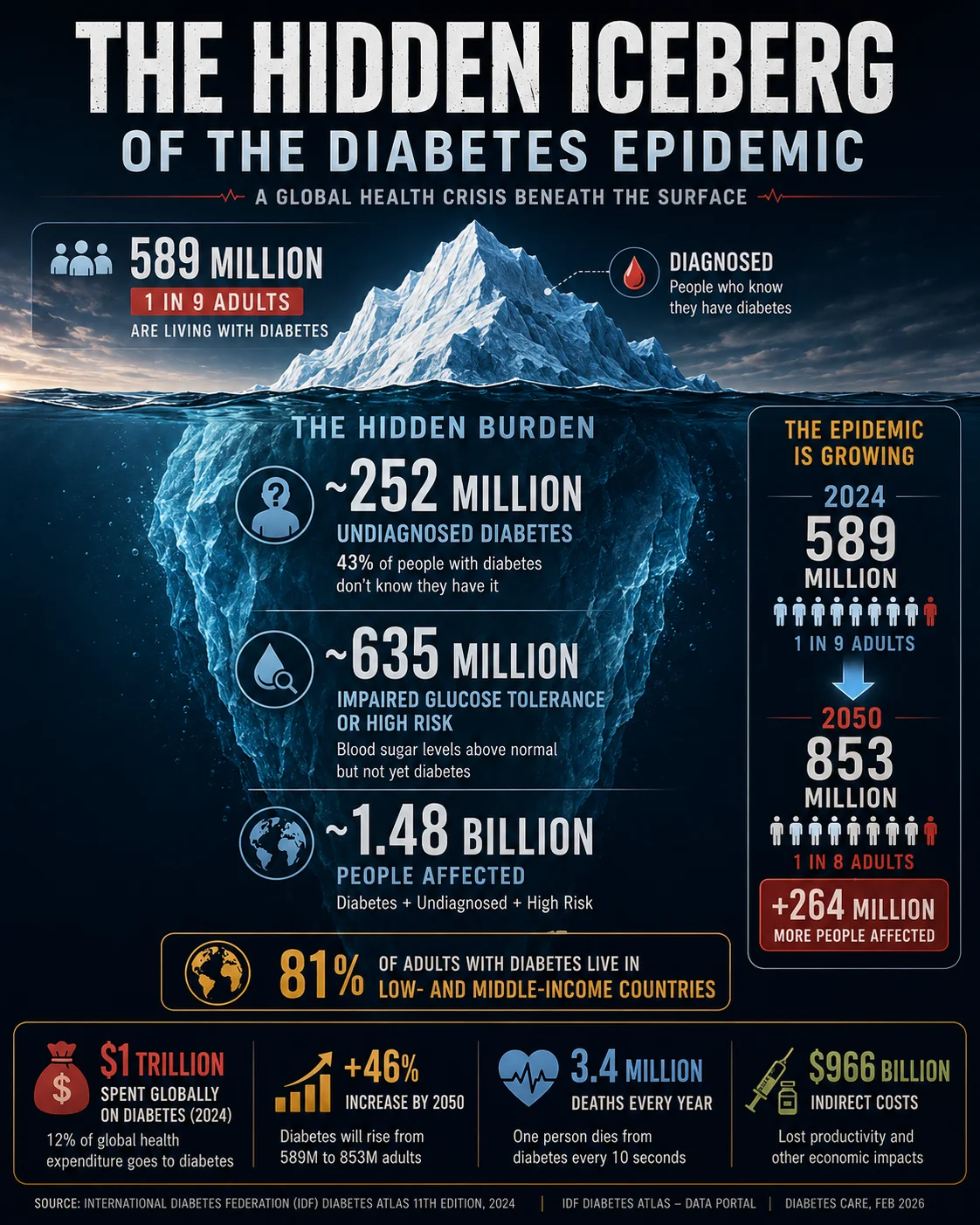
1 in 9 adults on earth has diabetes. 43% of them don’t know it. Pakistan’s rate has reached 31.4% — nearly 1 in 3 adults. The world spent $1 trillion managing the disease in 2024. And 95% of the growth between now and 2050 will happen in countries least equipped to handle it.
Source: IDF Diabetes Atlas 11th Edition (primary · diabetesatlas.org · 2024) · NCBI Bookshelf full text confirmed. Age-standardised prevalence, adults 20–79 years.
| Country / Region | Spend/person (USD) | % Undiagnosed | Status |
|---|---|---|---|
| Switzerland | $12,234 | ~20% | Highest spend |
| United States | $10,497 | ~29% (NAC region) | 2nd highest |
| Global average | $1,760 | 42.8% | Baseline |
| Pakistan | $79 | High | 133× gap vs USA |
| Bangladesh | $74 | High | Lowest spend |
| Africa (region) | Very low | 72.6% | Most undiagnosed |
| Western Pacific (region) | Mixed | 50.0% | High undiagnosed |
| N. America & Caribbean | Highest region | 29.1% | Most diagnosed |
Sources: IDF Diabetes Atlas 11th Edition (primary · 2024 · spend per person). Undiagnosed rates by region: Diabetes Care, February 20, 2026 (primary · doi:10.2337/dc25-2583).
Why Pakistan Has the World’s Highest Diabetes Rate
Pakistan’s 31.4% prevalence — nearly 1 in 3 adults — reflects a collision of genetic predisposition, rapid urbanisation, and dietary transition. As millions moved to cities, traditional diets gave way to refined carbohydrates and ultra-processed foods, while work became sedentary. The same pattern explains the Gulf states and Pacific Island nations clustering in the global top 10: Kuwait (25.6%), Samoa (25.4%), Kiribati and Qatar (24.6%) all experienced fast economic or lifestyle shifts without the healthcare infrastructure to manage the metabolic consequences. Pakistan also spends just $79 per person with diabetes annually — against a global average of $1,760 — meaning it has the world’s heaviest burden and the least capacity to treat it.
Why it matters: the countries with the highest prevalence have the lowest spending per patient — the crisis falls hardest where the system is weakest.
The 252 Million People Who Don’t Know They Have It
Of the 589 million adults with diabetes globally, 251.7 million — 42.8% — are undiagnosed. In Africa, that figure reaches 72.6%: nearly 3 in 4 people with diabetes have never been told. The Western Pacific region sits at 50%. China, India, and Indonesia alone account for 50.5% of all undiagnosed cases globally — 127 million people living with a progressive disease that silently damages kidneys, eyes, nerves, and the cardiovascular system. Undiagnosed diabetes is not a passive condition; every year without treatment accelerates organ damage, raises the probability of heart attack and stroke, and dramatically increases the cost of eventual care. Source: Diabetes Care, February 2026, primary.
Why it matters: the largest share of diabetes deaths occurs before a diagnosis is ever made.
A $1 Trillion Disease — and Where the Money Is Not Going
Global diabetes health expenditure crossed $1 trillion for the first time in 2024 — up from $232 billion in 2007, a 338% increase in 17 years. That sum equals 12% of all global health spending. But its distribution is radically skewed: Switzerland spends $12,234 per person with diabetes per year; the United States $10,497; Bangladesh $74. The countries absorbing 95% of new cases by 2050 — low- and middle-income nations — are precisely those spending the least. The $1 trillion figure reflects the cost of managing diabetes in wealthy systems; it says almost nothing about what is being done to prevent it where the epidemic is fastest-growing.
Why it matters: the world spends $1 trillion treating a disease that is 90% preventable through lifestyle change.
What 2050 Looks Like If Nothing Changes
The IDF projects 852.5 million adults with diabetes by 2050 — a 45% increase, against expected population growth of 25%. Ninety-five percent of that numerical rise will occur in low- and middle-income countries, driven by urbanisation, population growth, and ageing. Sub-Saharan Africa, which today has the world’s lowest rates, will see some of the fastest relative growth. Pakistan is projected to reach 34.2% by 2050. In addition to those with diagnosed disease, another 635 million adults currently have impaired glucose tolerance — pre-diabetes — placing them at high risk of crossing the threshold. The pipeline of future cases is already visible in today’s data.
Why it matters: Africa’s low rates today mask the fastest-growing trajectory in the world for the next 25 years.
635 million adults (1 in 8) have impaired glucose tolerance — blood sugar elevated but not yet at diabetic levels. Without intervention, many will convert to type 2 diabetes within 5–10 years.
488 million adults (1 in 11) have impaired fasting glucose.
23 million live births (1 in 5) are affected by some form of hyperglycaemia in pregnancy — which raises the child’s own lifetime diabetes risk.
Together, these populations represent the next wave of the epidemic. Source: IDF Diabetes Atlas 11th Edition (primary, 2024).
- 589 million adults have diabetes in 2024 — 1 in 9 — rising to 853 million (1 in 8) by 2050.
- Pakistan leads at 31.4%, followed by Marshall Islands (25.7%) and Kuwait (25.6%).
- 43% of cases are undiagnosed; in Africa, that rises to 72.6% — nearly 3 in 4.
- China, India, and Indonesia account for 50.5% of all undiagnosed cases globally.
- $1.015 trillion was spent on diabetes in 2024 — a 338% rise since 2007.
- Bangladesh spends $74 per patient per year; the US spends $10,497 — a 133× gap.
- 95% of new cases by 2050 will occur in low- and middle-income countries.
Diabetes is not a rich-world disease waiting to be exported. It is already a global epidemic, concentrated in exactly the countries with the least money to diagnose it, treat it, or prevent it. The $1 trillion the world spent in 2024 represents a system managing failure — not preventing it. The 635 million people already in pre-diabetes are the next cohort. The trajectory to 853 million by 2050 is not a forecast to be averted. It is the cost of decisions already made.
- IDF Diabetes Atlas 11th Edition — Global Data (primary · directly fetched · diabetesatlas.org · 2024 · 589M adults · 11.1% · 3.4M deaths · $1.015T · 43% undiagnosed · 635M IGT · 488M IFG)
- NCBI Bookshelf — IDF Diabetes Atlas 11th Edition, Chapter 3 (primary full text · Pakistan 31.4% · Marshall Islands 25.7% · Kuwait 25.6% · Zimbabwe 1.5% · urban 12.7% vs rural prevalence · Switzerland $12,234/person · USA $10,497 · Bangladesh $74 · Pakistan $79 · China largest deaths 1.4M · Singapore/Pakistan/Israel 29% of deaths)
- Diabetes Care — “Global, Regional, and National Estimates of Undiagnosed Diabetes in Adults: Findings From the 2025 IDF Diabetes Atlas” (primary · February 20, 2026 · doi:10.2337/dc25-2583 · Africa 72.6% undiagnosed · Western Pacific 50.0% · NAC 29.1% · S&CA 30.4% · China+India+Indonesia 127.1M = 50.5% of all undiagnosed)
- IDF — Diabetes Facts and Figures (primary · idf.org · 11.1% = 1 in 9 adults · 853M by 2050 = 1 in 8 · 46% increase · >90% type 2 · 95% of new cases in LMICs · 23M live births affected)
- IDF Diabetes Atlas 11th Edition — Global Factsheet PDF (primary · $1.015T = 12% global health expenditure · avg $1,760/person · 338% increase since 2007)