What Is the Largest Religionin the World?
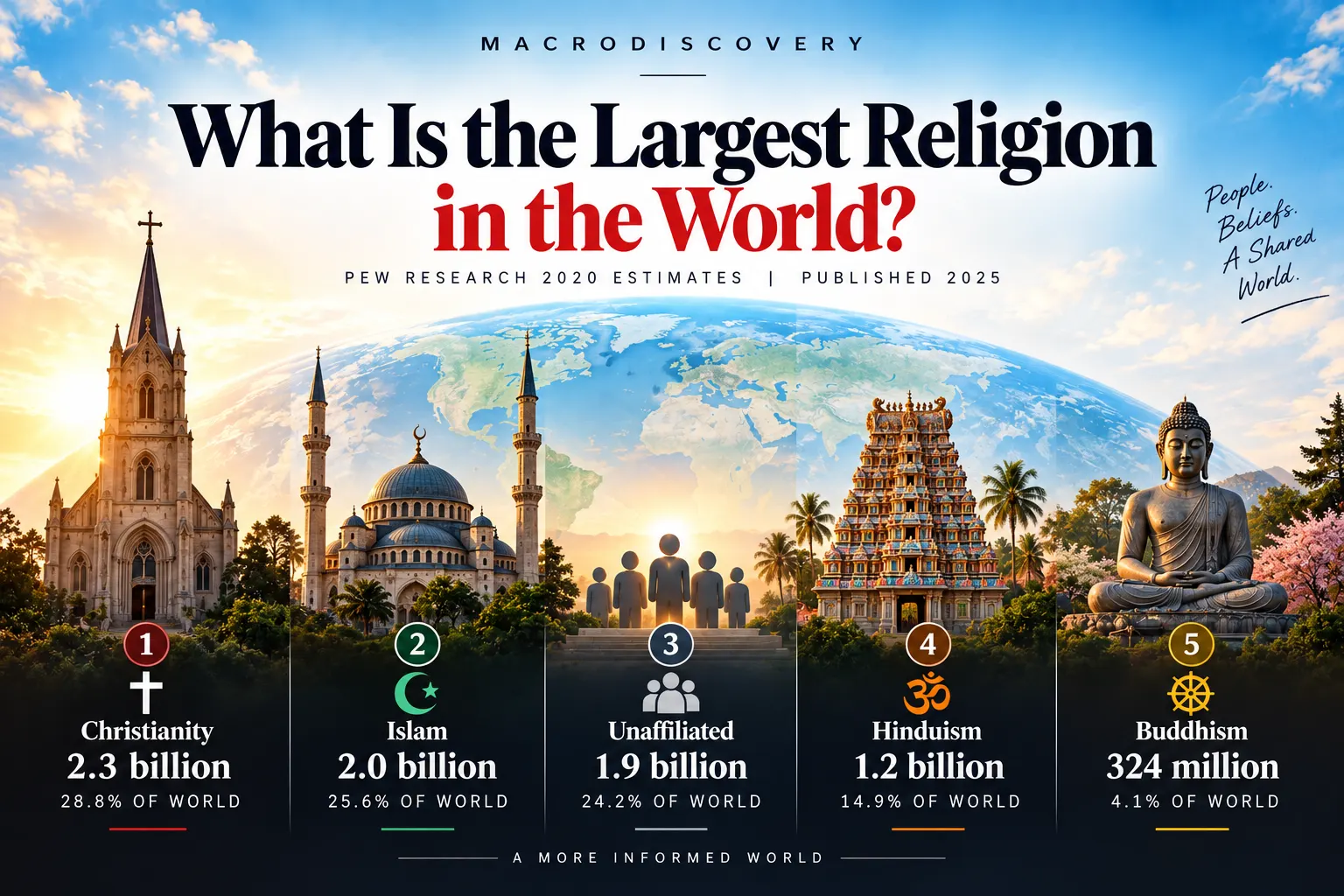
Pew Research Center’s most recent comprehensive global study uses 2020 data and was published in 2025. In those estimates, Christianity remained the world’s largest religious group. Islam was second — and growing faster. The third-largest group was not another faith. It was people with no religious affiliation.
2.3 billion
2.0 billion
Main ranking below uses Pew Research Center estimates for 2020, published 9 June 2025. The figures come from more than 2,700 censuses and surveys covering 201 countries and territories — about 99.98% of the world’s population. They are estimates, not exact headcounts.
Methodology and limits
This article’s main ranking uses Pew Research Center’s 2020 estimates. Pew published that comprehensive study in June 2025. It is the most recent Pew report that measures all major religious groups worldwide on one consistent method.
Pew groups people into seven categories: Christians, Muslims, Hindus, Buddhists, Jews, people who belong to other religions, and people with no religious affiliation. “Christians” means all Christian traditions counted together. “Unaffiliated” includes atheists, agnostics, and people who say they have no religion.
Limits: these are 2020 snapshots, not 2026 live counts. Different projects (Pew vs World Religion Database vs Vatican yearbooks) use different definitions and years. This article keeps those datasets separate and labels each source.
Pew dataset coverage and method: Global Religious Composition Estimates for 2010 and 2020.
Christianity was the largest religious group in 2020
According to Pew’s 2020 estimates published in 2025, about 2.3 billion people identified as Christian. That was 28.8% of the global population. (Pew, 9 June 2025)
Christianity includes Catholics, Protestants, Orthodox Christians, and smaller traditions. Pew counts all of them as one religious group.
The number of Christians rose by 122 million between 2010 and 2020. World population grew faster, so Christianity’s share fell from 30.6% in 2010 to 28.8% in 2020.
Pew says growth in the Christian total was slowed by high rates of disaffiliation, especially in Europe and the Americas. Factors Pew measured.
Is Islam the largest religion in the world?
No — not in Pew’s 2020 estimates. Islam was the second-largest religion, with about 2.0 billion Muslims, or 25.6% of the world.
It was the fastest-growing major religion in that decade. From 2010 to 2020, the Muslim population rose by 347 million — more than the combined growth of all non-Muslim religious groups. (Pew, 10 June 2025) Pew attributes most of that growth to a younger age profile and higher fertility, not mainly to conversion.
Muslims added 347 million people from 2010 to 2020. Christians added 122 million.
The Christian–Muslim share gap narrowed
Pew published these global shares:
2010: Christians 30.6%, Muslims 23.9%
2020: Christians 28.8%, Muslims 25.6%
Macro Discovery calculation from those Pew shares: the gap between the Christian share and the Muslim share fell from 6.7 percentage points in 2010 (30.6 − 23.9) to 3.2 percentage points in 2020 (28.8 − 25.6).
That is a change in population share, not a claim that Islam had already become the largest religion. Pew still ranked Christians first in 2020. Researchers have said the two groups may converge later if current demographic patterns hold. That is a projection, not a completed result.
Inputs are Pew’s published 2010 and 2020 percentage shares. Macro Discovery subtracted those shares. No new survey was conducted.
What are the three biggest groups?
In Pew’s 2020 ranking, the top three groups were:
1. Christianity — 2.3 billion
2. Islam — 2.0 billion
3. Religiously unaffiliated — 1.9 billion
The unaffiliated include atheists, agnostics, and people who say they have no religion. Pew treats them as a category, not a church. If that category is excluded, the third-largest named religion is Hinduism.
Many older lists put Hinduism third because they skip the unaffiliated. Pew’s 2010–2020 update places “nones” ahead of Hindus. Pew, 9 June 2025
What is the third largest religion?
Two answers, depending on the definition:
Third-largest group overall: the religiously unaffiliated, about 1.9 billion people (24.2%). Pew estimates that China is home to the world’s largest unaffiliated population.
Third-largest named religion: Hinduism, about 1.2 billion people (14.9%). Nearly all Hindus live in the Asia-Pacific region; Pew reports that about 95% live in India. (Pew, 9 June 2025)
Hinduism grew by 126 million people from 2010 to 2020, roughly in line with world population growth, so its global share stayed almost flat at 14.9%.
What are the top 5 largest religions?
| Rank | Group | People (2020) | Share | 2010–20 change |
|---|---|---|---|---|
| 1 | Christianity | 2.3 billion | 28.8% | +122 million |
| 2 | Islam | 2.0 billion | 25.6% | +347 million |
| 3 | Unaffiliated | 1.9 billion | 24.2% | +270 million |
| 4 | Hinduism | 1.2 billion | 14.9% | +126 million |
| 5 | Buddhism | 324 million | 4.1% | −19 million |
After these five, Pew places “other religions” at about 2.2% (including Sikhs, Jains, Baha’is, Daoists, Shintoists and many folk traditions) and Jews at about 0.2%.
Buddhism was the only major group Pew measured that declined in absolute numbers between 2010 and 2020. Pew main report
What is the largest religious denomination?
This question uses a different unit from Pew’s 2020 religion ranking. Pew does not publish a 2020 global ranking of every denomination inside Christianity and Islam in that same report.
Inside Christianity, the Catholic Church is the largest single denomination in Vatican statistics. The Holy See’s yearbooks report about 1.406 billion Catholics in 2023 and just over 1.422 billion in 2024. (L’Osservatore Romano / Annuarium Statisticum Ecclesiae; Vatican News, 2026)
These Vatican figures must not be mixed into Pew’s 2020 ranking. They use a later year and a different method: baptized Catholics counted by the Church, not Pew’s 2020 self-identified religious groups. A 2024 Catholic total cannot be stacked against Pew’s 2020 Muslim or Hindu totals as if they were one table.
If Islam is split into branches using a third dataset, the World Religion Database (Boston University / Brill, 2025 estimates) puts Sunnis at about 22.4% of the world and Catholics at about 15.4%. That is WRD’s classification, not Pew’s 2020 table.
Keep three ledgers separate: Pew 2020 groups, Vatican Catholic yearbook counts, and WRD branch estimates.
Why published rankings can look different
Lists disagree when they mix years, count folk religions separately, or ignore the unaffiliated.
Pew’s 2025 report also changed the picture of “nones.” Earlier Pew global snapshots put the unaffiliated near 16% in 2010. The 2020 estimate is 24.2%. China accounts for a large part of that unaffiliated total.
The World Religion Database uses a different method and usually reports a higher Christian share and a smaller unaffiliated share. Both projects are serious research products. They are not measuring exactly the same thing.
For this explainer, Pew’s 2020 estimates published in 2025 are the main ranking. Other sources are labeled when used.
What is driving the change?
Pew separates two engines: births and deaths, and people switching religion. (Pew, factors driving change, 9 June 2025)
Islam grew mainly because Muslim populations were younger and had higher fertility.
Christianity still added people through births, especially in sub-Saharan Africa, but lost many adults to disaffiliation in Europe and the Americas. That is why its global share fell even as its raw number rose.
The unaffiliated grew mostly by switching — people leaving a childhood religion — not by having more children.
Hinduism stayed stable as a share of the world because fertility was close to the global average and switching out was rare in surveys.
Buddhism declined because of low fertility, an older age structure, and switching away in parts of East Asia.
So what does this mean?
A careful reading of Pew’s 2020 snapshot, published in 2025:
- Christianity was the largest group in 2020.
- Islam was second, and the share gap narrowed.
- Unaffiliated people were third overall.
- Hinduism was the third-largest named religion.
- Catholic yearbook data is a separate series.
- No dataset here is a 2026 live headcount.
Sources
— Pew Research Center, “How the Global Religious Landscape Changed From 2010 to 2020,” 9 June 2025— Pew Research Center, “Islam was the world’s fastest-growing religion from 2010 to 2020,” 10 June 2025
— Pew Research Center, “How demographics, religious switching drove global religious change, 2010–2020”
— Pew Research Center, Dataset of Global Religious Composition Estimates for 2010 and 2020
— L’Osservatore Romano and Vatican News summaries of the Annuario Pontificio and Annuarium Statisticum Ecclesiae (Catholic counts for 2023–2024; not part of the Pew 2020 ranking)
— World Religion Database, Boston University / Brill (2025 estimates used only for branch-level comparison)