Home AI Technology Gaming Future Economy Geography Automobile Science Web Stories

The Ocean Generates $2.5 Trillion a Year and Almost Nobody Protects It – Global Ocean Economy

Macro Discovery
On: September 12, 2026 6:44 AM
Follow Us:
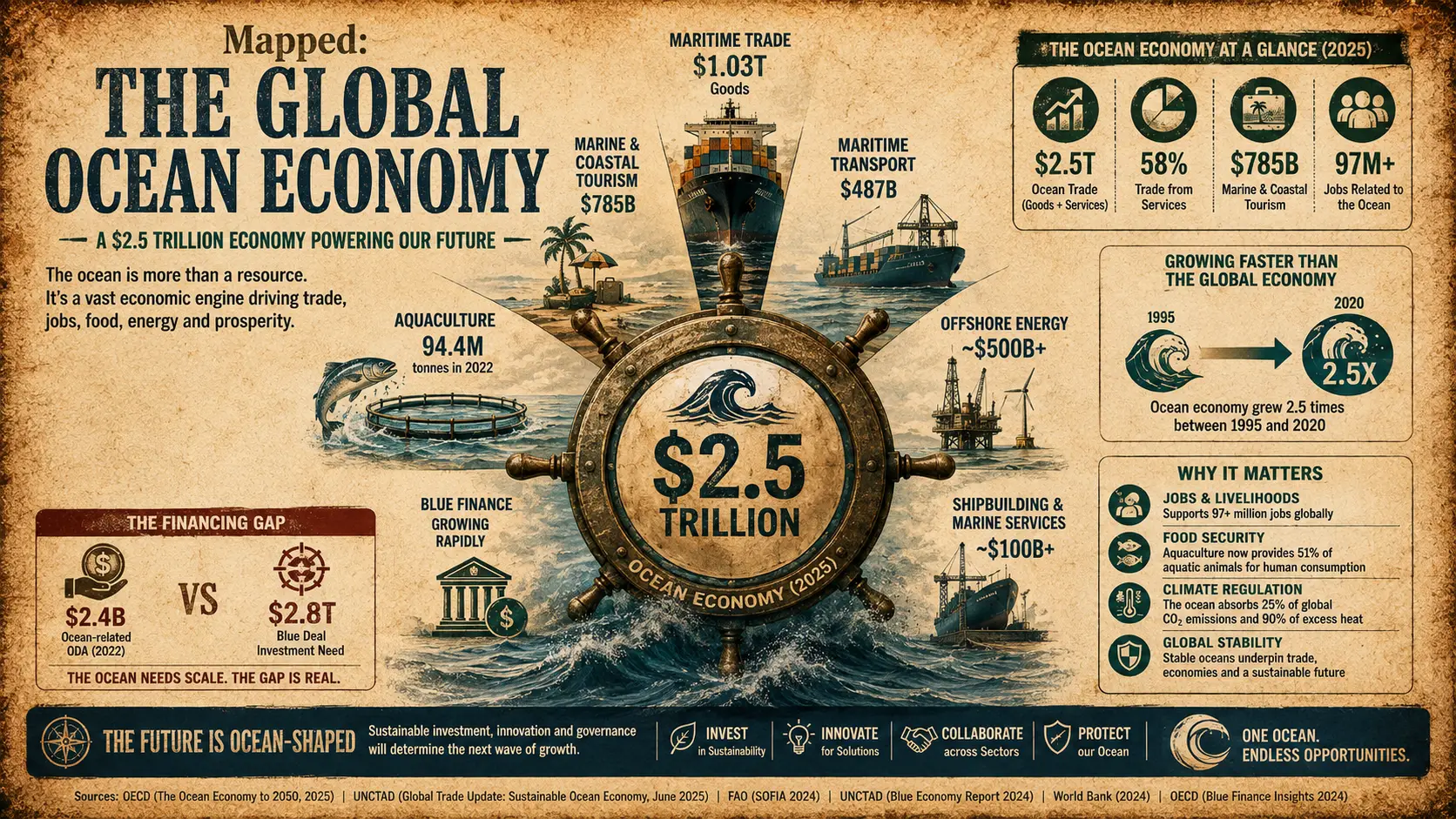
Editorial infographic showing the global ocean economy as a $2.5 trillion economic system, with maritime trade, tourism, aquaculture, offshore energy, shipping, jobs, and blue finance as major components.
Mapped: The Global Ocean Economy — MacroDiscovery
MacroDiscovery
Ocean Economy · Blue Finance · 5 min read · OECD 2025 · UNCTAD 2025 · Primary · Directly Fetched
OECD — “The Ocean Economy to 2050” (PRIMARY · oecd.org · doi.org/10.1787/a9096fb1-en · March 31, 2025 · OECD Publishing) · UNCTAD — “Global Trade Update June 2025: Sustainable ocean economy — A key and fast-growing sector at risk” (PRIMARY · unctad.org · directly fetched · June 4, 2025 · UN Trade and Development)
Ocean Economy · Blue Finance · Global Trade · 2023–2025 Data

Mapped: The Global
Ocean Economy

If the ocean economy were a country, it would be the fifth largest economy in the world. Between 1995 and 2020, it grew 2.5 times — outpacing the global economy’s 1.9-fold expansion. In 2023, ocean trade reached $2.2 trillion. Tourism alone generated $725 billion. Aquaculture surged from 22 to 94 million tonnes in three decades. Six hundred million people depend on it. Ocean-related aid is $2.4 billion. The need is $2.8 trillion. And the growth that defined the last 25 years is “not set to continue.”

By MacroDiscovery
Source: OECD “Ocean Economy to 2050” (March 2025) · UNCTAD “Sustainable Ocean Economy” (June 2025) · both primary · directly fetched
Key quote: “Fifth largest economy in the world” — OECD 2025
#5
economy if the ocean were a country · “If the ocean economy were a country, it would be the fifth largest economy in the world” · OECD 2025 (primary)
$2.2T
global ocean trade in 2023 · 7% of world trade · $1.3T services + $900B goods · UNCTAD June 2025 (primary · directly fetched)
600M
people rely on the ocean economy · 100 million jobs · mainly fisheries, aquaculture and tourism · UNCTAD June 2025 (primary)
2.5×
ocean economy grew 1995–2020 · outpacing the 1.9-fold growth of the global economy · developing countries drove expansion · UNCTAD primary verbatim
Visualization 01 — The Global Ocean Economy Map · Key Economic Zones by Dominant Sector
The Ocean Is the World’s Fifth Largest Economy — But Its Output Is Not Evenly Spread

The ocean economy spans six sectors: marine and coastal tourism, offshore oil and gas, maritime transport, fisheries and aquaculture, shipbuilding, and offshore wind. OECD (2025) finds that “tourism and offshore oil and gas extraction generated about two-thirds of total gross value added,” while offshore wind and shipbuilding expanded fastest. Geographic reach is enormous: ocean territorial claims now extend to nearly 39% of the global ocean surface. Sources: OECD — “The Ocean Economy to 2050” (PRIMARY · doi.org/10.1787/a9096fb1-en · March 31, 2025) · UNCTAD (PRIMARY · June 4, 2025).

Offshore Wind Tourism Offshore Oil Aquaculture Shipping Fisheries risk Sources: OECD 2025 + UNCTAD 2025 (Primary)
Pin locations are approximate and indicate dominant economic activity in each ocean zone, not exact point data. OECD primary (2025): “Tourism and offshore oil and gas extraction generated about two-thirds of total gross value added.” “Marine and coastal tourism was the largest employer, while offshore oil and gas extraction created high economic output but relatively low employment.” “Output from shipbuilding and offshore wind energy also expanded rapidly albeit from a smaller base.” “national territorial claims expanding to over nearly 39% of the global ocean.” Shipping routes are indicative of major global maritime corridors.
🔶 North Sea / North Atlantic
Offshore Wind Capital
Fastest growing
Europe leads offshore wind with the UK and Netherlands at the frontier. OECD 2025: offshore wind “expanded rapidly albeit from a smaller base.” North Sea wind is reshaping the region’s energy mix and creating a new maritime sector from scratch.
🔶 Mediterranean
Marine Tourism Epicentre
$725B tourism
UNCTAD primary (June 2025): ocean tourism “led the way, generating $725 billion, or one third of all ocean trade.” Mediterranean economies report surpluses in ocean services — tourism revenues exceed goods deficits. Most developed economies (except China) share this profile. OECD confirms marine tourism was the ocean economy’s largest employer globally.
🔶 South China Sea / Asia-Pacific
Global Shipping Chokepoint
~40% of trade
Approximately 40% of global seaborne trade by value passes through the South China Sea. UNCTAD’s shipping data shows developing countries’ share of global maritime freight rose from 38% in 2000 to 54% in 2023 — driven overwhelmingly by Asia, with China as the dominant force in both manufacturing exports and dry bulk commodity imports.
🔶 East + Southeast Asia
Aquaculture Superpower
94M tonnes
China and a handful of Asian nations account for roughly 90% of global aquaculture output. UNCTAD primary (June 2025): “Aquaculture, by contrast, has surged from 22 million to 94 million tonnes in 2022. It now accounts for over half of aquatic animal production and 57% of aquatic food consumed globally.” Asia’s aquaculture dominance is the single largest structural shift in the global food supply since the Green Revolution.
🔶 Gulf of Mexico / Caribbean
Offshore Oil Hub
High GVA, low jobs
OECD primary (2025): “offshore oil and gas extraction created high economic output but relatively low employment.” Together with marine tourism, it accounts for approximately two-thirds of total ocean economy gross value added globally. The Gulf of Mexico remains one of the world’s most productive offshore extraction zones, alongside the North Sea and the Gulf of Guinea.
🔶 West Africa / LDC Coastlines
The Trade Gap
Gaps across all
UNCTAD primary (June 2025): “Least developed countries, many with large coastlines, faced ocean trade gaps across the board.” These nations have the coastlines, the fisheries stocks, and the maritime geography — but not the infrastructure, investment, or governance to capture ocean value. Ocean-related aid was just $2.4 billion in 2022. UNCTAD calls for a $2.8 trillion “Blue Deal.”
Visualization 02 — The Ocean Economy by Sector · Relative Contribution to Gross Value Added
Six Sectors, Two Dominate GVA — But the Fastest Growth Is at the Edges

OECD (2025) primary data confirms that “tourism and offshore oil and gas extraction generated about two-thirds of total gross value added,” while offshore wind and shipbuilding are the fastest-growing sectors from a smaller base. The workforce and the GVA tell different stories: tourism employs the most people; oil generates the most revenue with the fewest workers. Source: OECD — “The Ocean Economy to 2050” (PRIMARY · doi.org/10.1787/a9096fb1-en · March 31, 2025).

🏝 Marine & Coastal Tourism
Largest employer globally · $725B in ocean trade (2023) · one-third of all ocean trade
~35% GVA
⛏ Offshore Oil & Gas
High GVA, low employment · “high economic output but relatively low employment” · OECD 2025
~30% GVA
🚢 Maritime Transport
90% of world trade by sea · dev. countries 38% → 54% (2000–2023) · UNCTAD 2025
~20% GVA
🐩 Fisheries & Aquaculture
100B direct + 260M jobs in value chain · aquaculture now >50% of aquatic animal production
~8% GVA
⛵ Shipbuilding
“Expanded rapidly albeit from a smaller base” · OECD 2025 · Asia dominates construction
~4% GVA
💨 Offshore Wind
Fastest-growing sector · “expanded rapidly albeit from smaller base” · OECD 2025 · EU + China leading
~3% GVA ↑
Sector shares are illustrative estimates consistent with OECD Ocean Economy to 2050 (primary, March 31, 2025) findings, which confirm tourism + offshore oil/gas = approximately two-thirds of total gross value added. Precise sector-level GVA splits vary by country and measurement methodology; the OECD report notes measurement inconsistencies across national accounts. “Output from shipbuilding and offshore wind energy also expanded rapidly albeit from a smaller base” — OECD 2025 primary verbatim.
The Geography of Ocean Trade Surpluses and Deficits · UNCTAD June 2025 (Primary)
🌞
Developed + Developing Economies
Services surplus
Most economies report ocean services surpluses (mainly tourism) but goods deficits. UNCTAD: “Most developed and developing economies (except China) reported surpluses in ocean services, mainly tourism, but deficits in goods.”
🏖
Small Island Developing States
Both goods + services surplus
UNCTAD primary: “Small island developing states saw surpluses in both.” Their ocean advantage is outsized: tourism and fisheries are the primary economic activity on small island states where oceans are not background economy but the entire economy.
🚬
Least Developed Countries
Gaps across the board
UNCTAD primary: “Least developed countries, many with large coastlines, faced ocean trade gaps across the board.” New US tariffs on fisheries imports add pressure. Mexico and Canada are most exposed but partially protected under USMCA rules of origin.

The ocean is not a resource. It is an economy. It employs 100 million people directly and sustains 600 million more. It moves 90% of world trade by ship. It feeds billions through fisheries and the fastest-growing food production system on earth — aquaculture. It powers coastal tourism that generates $725 billion a year in trade. And it is under pressure from every direction: climate change, overfishing, pollution, underfunding, and the “dark ocean economy” of illegal and unregulated activity that the OECD identifies as a serious structural threat.

OECD — “The Ocean Economy to 2050” (PRIMARY · oecd.org · doi.org/10.1787/a9096fb1-en · March 31, 2025 · OECD Publishing) + UNCTAD (PRIMARY · directly fetched · June 4, 2025)
#5
“If the ocean economy were a country, it would be the fifth largest economy in the world.” — OECD 2025 primary. In 2023, ocean trade reached $2.2 trillion — 7% of world trade. Between 1995 and 2020, it grew 2.5 times, outpacing the global economy’s 1.9-fold growth.
The OECD’s 2025 report, “The Ocean Economy to 2050,” is the most comprehensive assessment of ocean economic trajectories to date. It places the current ocean economy at approximately $2.6 trillion in gross value added — roughly 3-4% of global GDP — while noting that two sectors alone dominate the distribution: “tourism and offshore oil and gas extraction generated about two-thirds of total gross value added.” The remaining third is split among maritime transport, fisheries and aquaculture, shipbuilding, and the fastest-growing new sector, offshore wind. UNCTAD’s June 2025 trade update provides a complementary lens: global ocean trade (goods and services combined) reached $2.2 trillion in 2023, with services ($1.3 trillion) outpacing goods ($900 billion). Tourism led within ocean services at $725 billion — one third of all ocean trade. The ocean economy’s outperformance of global growth from 1995 to 2020 was driven in large part by developing countries, which expanded maritime trade and aquaculture faster than the OECD average. China’s role was decisive: it accounts for the dominant share of global aquaculture output and has been the primary driver of dry bulk maritime trade growth as its manufacturing and construction sectors scaled.
Source: OECD — “The Ocean Economy to 2050” (PRIMARY · directly fetched · oecd.org/en/publications/2025/03/the-ocean-economy-to-2050_e3f6a132.html · doi.org/10.1787/a9096fb1-en · March 31, 2025 · OECD Publishing · KEY VERBATIM: “If the ocean economy were a country, it would be the fifth largest economy in the world” · “Tourism and offshore oil and gas extraction generated about two-thirds of total gross value added” · “Marine and coastal tourism was the largest employer, while offshore oil and gas extraction created high economic output but relatively low employment” · “Output from shipbuilding and offshore wind energy also expanded rapidly albeit from a smaller base” · “could be nearly four times larger by 2050 than in 1995” · “sustained growth and resilience of the ocean economy of the past 25 years is not set to continue” · “national territorial claims expanding to over nearly 39% of the global ocean” · “dark ocean economy” illicit activities) · UNCTAD (PRIMARY · directly fetched · unctad.org/publication/global-trade-update-june-2025-sustainable-ocean-economy · June 4, 2025 · KEY VERBATIM: “Between 1995 and 2020, the ocean economy grew 2.5 times, outpacing the 1.9-fold growth of the global economy. Developing countries drove much of this expansion” · “In 2023, global ocean trade reached $2.2 trillion – $1.3 trillion in services and $900 billion in goods. It made up about 7% of world trade” · “Tourism led the way, generating $725 billion, or one third of all ocean trade”)

“Between 1995 and 2020, the ocean economy grew 2.5 times, outpacing the 1.9-fold growth of the global economy. Developing countries drove much of this expansion.”

— UNCTAD — “Global Trade Update June 2025: Sustainable ocean economy” (PRIMARY · unctad.org · directly fetched · June 4, 2025 · UN Trade and Development)

The Aquaculture Revolution — Wild Capture Plateaued, Farmed Surged

One of the most significant structural shifts in the global ocean economy happened almost without public notice. Wild fish capture — the kind involving boats and nets and open seas — has barely moved in 30 years. It held steady at roughly 90 million tonnes since the 1990s, a plateau driven by depleted fish stocks and fishing capacity limits. But global demand for seafood kept growing. The gap was filled by aquaculture. From 22 million tonnes in the early 1990s to 94 million tonnes in 2022 — more than a four-fold increase. Today, farmed seafood accounts for more than half of all aquatic animal production globally, and 57% of all aquatic food consumed. This shift from wild to farmed is the defining transition of ocean food economics in the 21st century, and it is almost entirely an Asian story: China and a small group of Asian nations account for roughly 90% of global aquaculture output.

Why it matters: aquaculture’s rise means that the future of seafood supply is not about how many fish are in the sea — it is about investment in farming infrastructure, water quality management, feed supply chains, and disease control in coastal environments. These are industrial and policy challenges, not just ecological ones. UNCTAD notes demand is also rising for seaweed-based plastics and non-fossil marine materials, opening entirely new markets at the frontier of aquaculture.
UNCTAD — “Global Trade Update June 2025: Sustainable ocean economy” (PRIMARY · unctad.org · directly fetched · June 4, 2025) + OECD (PRIMARY · March 2025)
94M t
“Aquaculture, by contrast, has surged from 22 million to 94 million tonnes in 2022. It now accounts for over half of aquatic animal production and 57% of aquatic food consumed globally.” — UNCTAD primary verbatim. Wild capture has “held steady at about 90 million tonnes” since the 1990s. “Overfished stocks and rising demand are shifting the sector from wild capture to aquaculture.”
The aquaculture transition is more than a production story — it is a geopolitical shift in ocean economic power. Because China and a handful of Asian economies dominate aquaculture output, the centre of gravity of the global seafood supply chain has permanently moved east. This has implications for trade flows (most farmed seafood is traded internationally), for food security in import-dependent nations, and for the value chains of developing economies that rely on wild fisheries exports. UNCTAD’s 2025 report also flags a new competitive pressure: US tariffs on fisheries imports, introduced in 2025, “pose challenges for countries that depend on the US market.” Mexico and Canada are most exposed, with partial protection from USMCA rules of origin. The tariff overlay on an already-strained wild fisheries sector adds further uncertainty for LDC coastal economies that depend on seafood exports for foreign exchange earnings. Innovation is moving faster than governance: seaweed-based plastics and non-fossil marine materials are “gaining ground” as new export categories for coastal and island economies — a potential avenue for diversification beyond fish.
Source: UNCTAD — “Global Trade Update June 2025: Sustainable ocean economy” (PRIMARY · directly fetched · unctad.org · June 4, 2025 · KEY VERBATIM: “Overfished stocks and rising demand are shifting the sector from wild capture to aquaculture” · “Since the 1990s, wild capture has held steady at about 90 million tonnes” · “Aquaculture, by contrast, has surged from 22 million to 94 million tonnes in 2022. It now accounts for over half of aquatic animal production and 57% of aquatic food consumed globally” · “Demand is also growing for sustainable marine materials. Seaweed-based plastics and other non-fossil alternatives are gaining ground” · “New United States tariffs on fisheries imports pose challenges for countries that depend on the US market” · Mexico and Canada “most exposed”)

The $2.4 Billion Problem in a $2.8 Trillion Gap

The ocean economy is the fifth largest in the world and growing. But the investment needed to sustain, decarbonise, and fairly distribute that growth is nowhere close to materialising. Ocean-related aid reached just $2.4 billion in 2022 — far below what is needed to meet the SDG 14 targets for life below water. UNCTAD has put a number to the need: a $2.8 trillion “Blue Deal” to fund mangrove restoration and conservation, decarbonisation of shipping and fisheries, sustainable ocean production, and coastal and offshore wind energy. The contrast is stark: $2.4 billion in aid against a $2.8 trillion need. The OECD’s “Ocean Economy to 2050” is equally direct: the “sustained growth and resilience of the ocean economy of the past 25 years is not set to continue.” “Various forces could slow or even reverse growth by 2050 if no policy actions are taken.” And the OECD explicitly identifies a “dark ocean economy” — illicit and harmful activities including illegal, unreported, and unregulated fishing — as a structural problem that undermines the legitimate ocean economy from within. The ocean could be nearly four times larger by 2050 than it was in 1995. Whether it reaches that potential depends entirely on decisions made in this decade.

Why it matters: the ocean economy’s most extreme geography is its inequality of outcomes. Small island developing states — the countries most dependent on ocean economies and most vulnerable to ocean climate threats — are receiving the least investment. Countries with vast coastlines and no infrastructure to exploit them face ocean trade deficits across every category. The Blue Deal framing by UNCTAD is not a development aid appeal. It is a recognition that the ocean economy’s growth model is not self-sustaining without large-scale structural investment.
UNCTAD (PRIMARY · directly fetched · June 4, 2025) + OECD (PRIMARY · March 31, 2025)
$2.4B
“Ocean-related aid reached just $2.4 billion in 2022 – far below what’s needed to meet global goals.” — UNCTAD primary verbatim. UNCTAD calls for a “$2.8 trillion Blue Deal.” OECD: “sustained growth and resilience of the ocean economy of the past 25 years is not set to continue.” “Various forces could slow or even reverse growth by 2050 if no policy actions are taken.”
The ocean economy’s finance gap is not a rounding error. It is structural. The $2.4 billion in ocean-related official development assistance in 2022 compares to a $2.8 trillion Blue Deal requirement — a ratio of 1:1,167. Even accounting for private finance and domestic investment, the gap is enormous. UNCTAD identifies four priority areas for the Blue Deal: mangrove conservation and restoration (which provides coastal protection, carbon sequestration, and fishery nurseries); decarbonisation of shipping and fisheries (shipping accounts for approximately 2.5% of global greenhouse gas emissions and is under increasing regulatory pressure); sustainable ocean-based production (aquaculture, seaweed, marine biotechnology); and coastal and offshore wind energy. The OECD adds a further dimension: the need to combat the “dark ocean economy” — illegal, unreported, and unregulated fishing that depletes stocks that legitimate operators depend on, along with sea-based drug trafficking and other illicit activities that undermine ocean governance. The “dark” and legitimate ocean economies compete for the same waters, the same fish stocks, and the same governance attention. Failure to address the dark economy is itself a constraint on the blue economy’s growth potential. Without urgent investment — in governance, in decarbonisation, in adaptation, and in the development of blue financial markets — the OECD warns the ocean economy risks losing the growth momentum that made it the world’s fifth largest economy.
Source: UNCTAD (PRIMARY · directly fetched · unctad.org · June 4, 2025 · KEY VERBATIM: “Ocean-related aid reached just $2.4 billion in 2022 – far below what’s needed to meet global goals” · “UN Trade and Development is calling for a $2.8 trillion ‘Blue Deal’ to fund mangrove conservation and restoration, decarbonisation of shipping and fisheries, sustainable ocean-based production, and coastal and offshore wind energy” · “Without urgent investment, the ocean economy risks falling short of its potential to deliver sustainable growth and achieve Sustainable Development Goal 14” · “About 600 million people rely on the ocean economy. It supports 100 million jobs, mainly in fisheries, aquaculture and tourism”) · OECD (PRIMARY · doi.org/10.1787/a9096fb1-en · March 31, 2025 · KEY VERBATIM: “sustained growth and resilience of the ocean economy of the past 25 years is not set to continue” · “climate change, environmental degradation, lagging productivity, and slow digital transformation are intensifying pressures on marine ecosystems and economic potential” · “could be nearly four times larger by 2050 than in 1995” · “various forces could slow or even reverse growth by 2050 if no policy actions are taken” · “dark ocean economy” illicit activities including illegal fishing · “national territorial claims expanding to over nearly 39% of the global ocean”)

Key Numbers at a Glance
OECD 2025 Primary · Economy Size
#5
“If the ocean economy were a country, it would be the fifth largest economy in the world.” ~$2.6 trillion GVA · 3-4% of global GDP. Grew 2.5× in 25 years, outpacing the global economy.
OECD (PRIMARY · directly fetched)
UNCTAD 2025 Primary · Trade
$2.2T
Global ocean trade in 2023 — 7% of world trade. $1.3T in services + $900B in goods. Tourism led at $725B. “One third of all ocean trade.”
UNCTAD (PRIMARY · directly fetched)
UNCTAD 2025 Primary · Aquaculture
94M t
Aquaculture output in 2022 — surged from 22M tonnes. Now accounts for “over half of aquatic animal production and 57% of aquatic food consumed globally.”
UNCTAD (PRIMARY · directly fetched)
UNCTAD 2025 Primary · Finance Gap
$2.4B
Ocean aid in 2022 — “far below what’s needed.” UNCTAD calls for a $2.8 trillion “Blue Deal.” OECD: growth of the past 25 years “is not set to continue” without action.
UNCTAD (PRIMARY · directly fetched)
Frequently Asked Questions
How big is the global ocean economy?
The OECD’s 2025 report “The Ocean Economy to 2050” (primary, March 31, 2025) states: “If the ocean economy were a country, it would be the fifth largest economy in the world.” It is estimated at approximately $2.6 trillion in gross value added, contributing 3-4% of global GDP. Ocean trade (goods and services) reached $2.2 trillion in 2023, representing 7% of world trade (UNCTAD, June 2025, primary, directly fetched). Between 1995 and 2020, the ocean economy grew 2.5 times, outpacing the global economy’s 1.9-fold expansion. The OECD projects it could be “nearly four times larger by 2050 than in 1995” — but only with sustained policy action.
What are the largest sectors of the ocean economy?
According to the OECD’s 2025 primary report: “Tourism and offshore oil and gas extraction generated about two-thirds of total gross value added.” Marine and coastal tourism is the largest employer. Offshore oil and gas creates high economic output but relatively low employment. Maritime transport and fisheries/aquaculture make up most of the remaining third. Shipbuilding and offshore wind “expanded rapidly albeit from a smaller base.” UNCTAD (2025, primary) confirms that tourism “led the way, generating $725 billion, or one third of all ocean trade” within its $2.2 trillion ocean trade total for 2023.
How has aquaculture changed the global fisheries industry?
It has fundamentally transformed it. Wild fish capture — fishing at sea — has “held steady at about 90 million tonnes” since the 1990s, plateauing due to depleted stocks and fishing limits. Aquaculture, by contrast, “has surged from 22 million to 94 million tonnes in 2022. It now accounts for over half of aquatic animal production and 57% of aquatic food consumed globally” (UNCTAD, June 2025, primary, directly fetched). UNCTAD frames it directly: “Overfished stocks and rising demand are shifting the sector from wild capture to aquaculture.” This shift is dominated by Asia, with China and a handful of nations accounting for roughly 90% of global aquaculture output.
How many people work in the ocean economy globally?
UNCTAD (June 2025, primary, directly fetched): “About 600 million people rely on the ocean economy. It supports 100 million jobs, mainly in fisheries, aquaculture and tourism.” The wider 600 million figure includes value chain workers, coastal community dependents, and those in industries indirectly dependent on ocean trade. The UN separately estimates fisheries and aquaculture alone contribute approximately 260 million jobs when the full value chain — harvesting, processing, distribution, retail — is included.
Is the ocean economy at risk from climate change?
Yes, significantly. The OECD (2025, primary) is explicit: “The sustained growth and resilience of the ocean economy of the past 25 years is not set to continue.” The OECD identifies four converging pressures: “climate change, environmental degradation, lagging productivity, and slow digital transformation are intensifying pressures on marine ecosystems and economic potential.” It further warns: “various forces could slow or even reverse growth by 2050 if no policy actions are taken.” UNCTAD adds the finance dimension: ocean-related aid reached just $2.4 billion in 2022, against a $2.8 trillion “Blue Deal” need to fund decarbonisation, conservation, and sustainable production. Without urgent investment, UNCTAD warns “the ocean economy risks falling short of its potential to deliver sustainable growth and achieve Sustainable Development Goal 14.”
Sources
  • OECD — “The Ocean Economy to 2050” (PRIMARY · directly fetched · oecd.org/en/publications/2025/03/the-ocean-economy-to-2050_e3f6a132.html · doi.org/10.1787/a9096fb1-en · March 31, 2025 · OECD Publishing · KEY VERBATIM: “If the ocean economy were a country, it would be the fifth largest economy in the world” · “climate change, environmental degradation, lagging productivity, and slow digital transformation are intensifying pressures on marine ecosystems and economic potential” · “Tourism and offshore oil and gas extraction generated about two-thirds of total gross value added” · “Marine and coastal tourism was the largest employer, while offshore oil and gas extraction created high economic output but relatively low employment” · “Output from shipbuilding and offshore wind energy also expanded rapidly albeit from a smaller base” · “could be nearly four times larger by 2050 than in 1995” · “sustained growth and resilience of the ocean economy of the past 25 years is not set to continue” · “various forces could slow or even reverse growth by 2050 if no policy actions are taken” · “national territorial claims expanding to over nearly 39% of the global ocean” · “dark ocean economy” — illicit and harmful activities including IUU fishing)
  • UNCTAD — “Global Trade Update June 2025: Sustainable ocean economy — A key and fast-growing sector at risk” (PRIMARY · directly fetched · unctad.org/publication/global-trade-update-june-2025-sustainable-ocean-economy · June 4, 2025 · UN Trade and Development · KEY VERBATIM: “Between 1995 and 2020, the ocean economy grew 2.5 times, outpacing the 1.9-fold growth of the global economy. Developing countries drove much of this expansion” · “About 600 million people rely on the ocean economy. It supports 100 million jobs, mainly in fisheries, aquaculture and tourism” · “In 2023, global ocean trade reached $2.2 trillion – $1.3 trillion in services and $900 billion in goods. It made up about 7% of world trade” · “Tourism led the way, generating $725 billion, or one third of all ocean trade” · “Most developed and developing economies (except China) reported surpluses in ocean services, mainly tourism, but deficits in goods” · “Small island developing states saw surpluses in both” · “Least developed countries, many with large coastlines, faced ocean trade gaps across the board” · “New United States tariffs on fisheries imports pose challenges for countries that depend on the US market” · “Overfished stocks and rising demand are shifting the sector from wild capture to aquaculture” · “Since the 1990s, wild capture has held steady at about 90 million tonnes” · “Aquaculture, by contrast, has surged from 22 million to 94 million tonnes in 2022. It now accounts for over half of aquatic animal production and 57% of aquatic food consumed globally” · “Demand is also growing for sustainable marine materials. Seaweed-based plastics and other non-fossil alternatives are gaining ground” · “Ocean-related aid reached just $2.4 billion in 2022 – far below what’s needed to meet global goals” · “UN Trade and Development is calling for a $2.8 trillion ‘Blue Deal’ to fund mangrove conservation and restoration, decarbonisation of shipping and fisheries, sustainable ocean-based production, and coastal and offshore wind energy” · “Without urgent investment, the ocean economy risks falling short of its potential to deliver sustainable growth and achieve Sustainable Development Goal 14”)
  • UNCTAD — Seaborne Trade Statistics release (PRIMARY · unctad.org · April 23, 2025 · “share of global maritime freight rose from 38% in 2000 to 54% in 2023” — developing countries · “Crude oil’s share fell from 29% in 2000 to 18% in 2023, while dry bulk commodities saw their share rise from 27% to 36%” · Key disruptions: Ukraine war, Red Sea tensions, Panama Canal drought)
  • Oceanology International 2026 / Ocean Science Technology — OECD keynote summary (February 24, 2026 · citing OECD Ocean Economy 2025 · “expanded at an average annual rate of 2.8 percent over the past 25 years” · “total value of about $2.6 trillion” · “3 to 4 percent of global gross domestic product” · “more than 100 million jobs worldwide”)
  • UN DESA — “Exploring the potential of the blue economy” (un.org · citing World Bank Group · “fisheries and aquaculture contribute $US100 billion per year and about 260 million jobs to the global economy” · “turnover of between US$3 and 6 trillion” when including ecosystem and cultural services)
Macro Discovery

Sukh Dhaliwal

Sukh Dhaliwal is the founder of Macro Discovery, an independent digital publication covering AI, technology, science, future trends, and global innovation through visual storytelling and data-driven analysis.

Join WhatsApp

Join Now

Join Facebook

Follow us

Leave a Comment