The Economics of Retirement —
Who Can Actually Afford to Stop Working
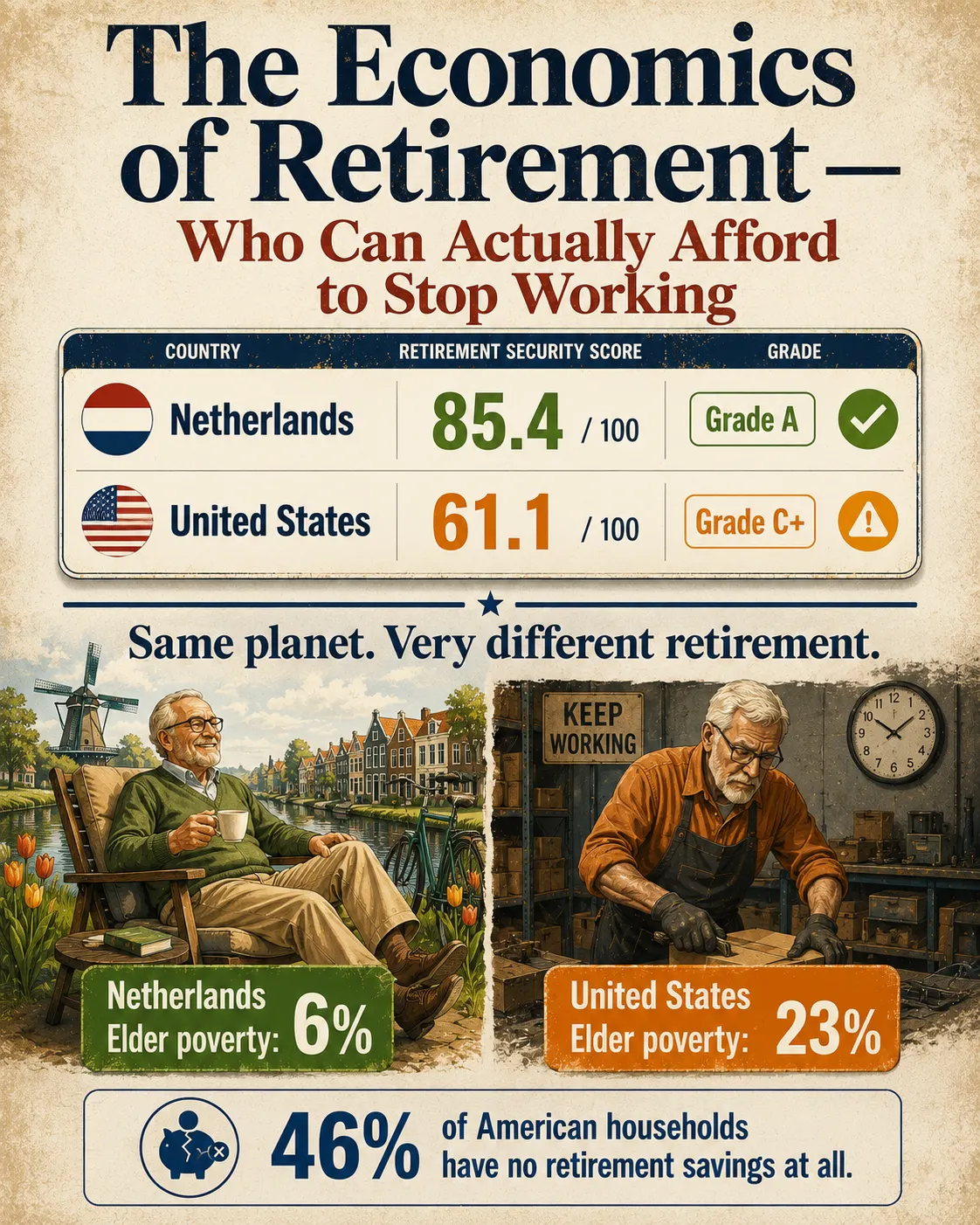
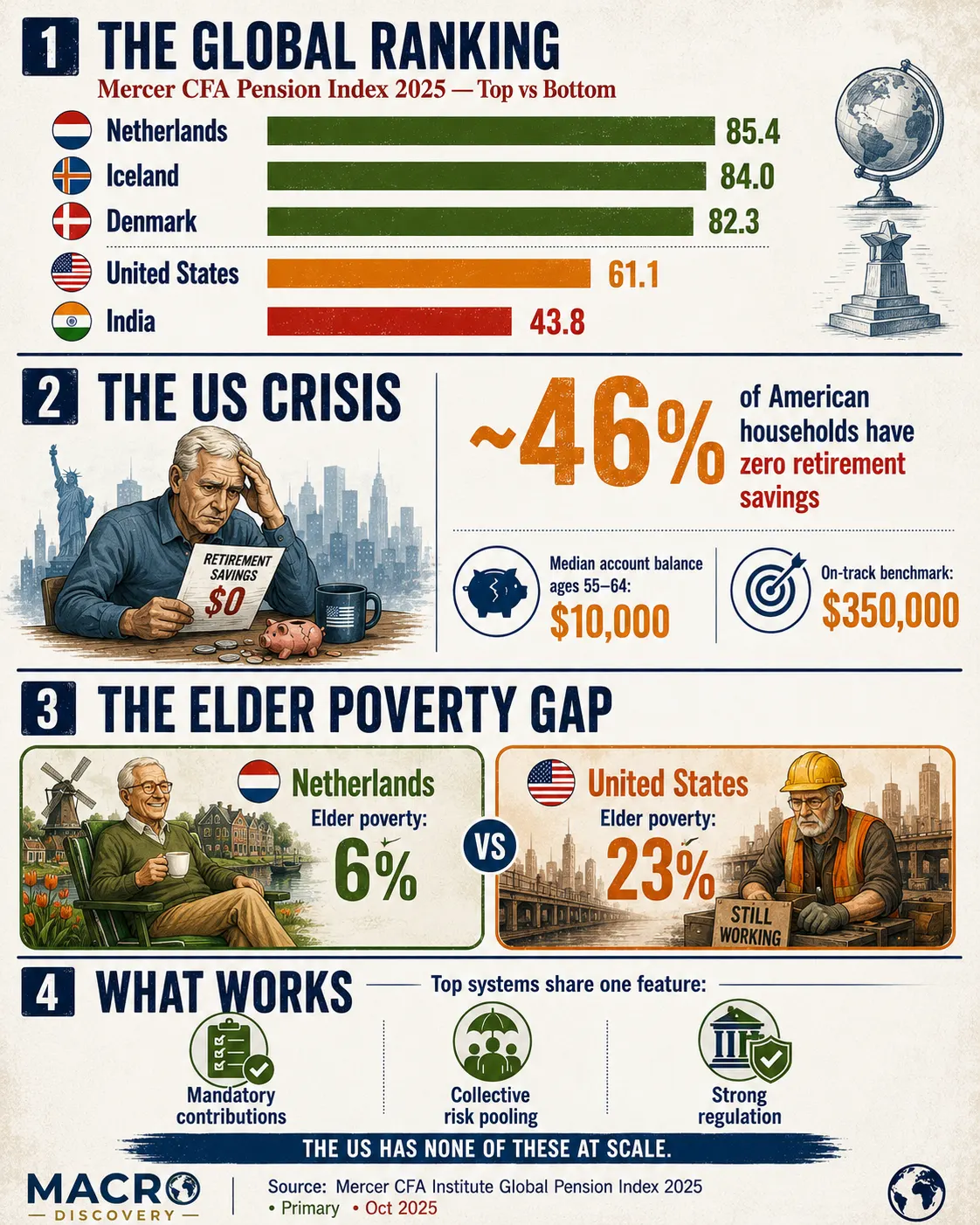
About half of American households have no retirement savings at all. The US ranks 30th out of 52 countries on the world’s most authoritative pension index — in the same grade as Colombia and Spain. The Netherlands, Denmark, and Iceland score at the top. They are not richer than the US. They simply built a different system. Here is what that system looks like — and what happens in countries that didn’t.
Source: Mercer CFA Institute Global Pension Index 2025 (primary · rpc.cfainstitute.org · October 15, 2025 · 52 countries · 65% of world population). Full grade breakdown: A (>80) · B+ (76–80) · B (66–75) · C+ (61–65) · C (51–60) · D (35–50). Scores cited from Pension Policy International and Chief Investment Officer (October 2025) citing MCGPI 2025 primary.
Why the Netherlands Tops the World — and What Makes It Different
The Dutch pension system rests on three pillars: a universal state pension (AOW) paying approximately €1,450 gross per month for single retirees; mandatory occupational pensions covering about 90% of employers; and optional private top-ups. The occupational layer is the decisive one. Industry-wide pension funds — including ABP for civil servants and PFZW for healthcare workers — pool contributions of approximately 27% of pay (18% from employers, 9% from employees) into collectively managed portfolios. Total pension assets reached €1,600 billion, equal to 160% of Dutch GDP. The system’s target is to replace 70% of average salary at retirement — a standard most Americans have no institutional mechanism to reach.
Why it matters: the Netherlands proves that retirement security is an engineering problem, not a wealth problem — and it has been solved.
Why the US Scores 61 Out of 100 — in the Same Grade as Colombia
The United States ranked 30th of 52 countries in the Mercer 2025 index, scoring 61.1 — a C+, the same grade as Colombia (62.5), Spain (63.8), and the UAE (64.9). Its weakest sub-score is integrity (58.0), reflecting the fragmented, voluntary nature of US retirement saving. There is no mandatory occupational pension. The 401(k) system depends on workers having access to a workplace plan, choosing to enrol, and contributing enough. Roughly 46% of American households have no retirement savings at all, per the Federal Reserve Survey of Consumer Finances. Among households aged 55–64 approaching retirement, economist Teresa Ghilarducci of The New School found 44% have no savings whatsoever. In a 2024 US Senate hearing, Ghilarducci testified that 50% of Americans will not be able to meet their retirement standards.
Why it matters: the US holds $45 trillion in retirement assets — concentrated at the top — while half its households hold nothing.
The Cost of Getting It Wrong: Elder Poverty Across Countries
The practical consequence of weak pension systems is visible in elder poverty rates. The United States has the highest elder poverty rate among high-income OECD nations at 23%, measured against the international standard of 50% of national median income. France and the Netherlands each sit at approximately 6% (SCEPA, December 2025, citing OECD data). Among Americans aged 62–74, research from Ghilarducci’s Schwartz Center for Economic Policy Analysis (SCEPA) found that half have less than $25,000 per person per year — near the US poverty threshold — far below the international benchmark of $42,000. Defined benefit pensions once covered half of US workers aged 50–60; by 2022, that share had fallen to one quarter (USAFacts, citing Federal Reserve SCF).
Why it matters: a 23% vs 6% elder poverty gap between the US and the Netherlands is not a difference in culture — it is a difference in system design.
Singapore Just Became the First Asian Country to Score Grade A — What Changed?
Singapore’s Central Provident Fund (CPF) achieved Grade A in the 2025 Mercer index — the first Asian country in the 17-year history of the index to reach that standard. The CPF is a mandatory, fully funded, individually owned savings system: employees contribute 20% of wages, employers contribute 17%, for a combined 37%. Funds accumulate across accounts for retirement, housing, and healthcare. The model differs from the Dutch collective approach but shares its core feature: mandatory, broad, employer-matched contributions that workers cannot easily avoid. The contrast with the US is stark: Singapore legally requires workers to save for retirement; the US offers workers the option to, and nearly half decline or lack access.
In a 2024 Senate hearing, she stated: “50 percent [of Americans] will not be able to meet their retirement standards and most of them won’t be able to meet poverty standard.”
Her research at SCEPA finds that wealth for the bottom 90% of households nearing retirement has fallen in real terms over the past 30 years. Social Security is the only significant source of retirement wealth for most Americans. The median retirement account balance for households aged 55–64 is $10,000 — against a benchmark of $350,000 needed to be on track.
Source: SCEPA / The New School (2024–2025) · Forbes Q&A (September 2025) · Senate testimony (February 2024).
Why it matters: Singapore’s Grade A shows that mandatory saving works regardless of a country’s cultural context — it is a policy choice, not an inheritance.
- The Netherlands scores 85.4 and the US scores 61.1 — a 24-point gap on the Mercer CFA Global Pension Index 2025.
- ~46% of US households have no retirement savings (Federal Reserve Survey of Consumer Finances).
- The US elder poverty rate is 23% — the highest among high-income OECD nations — versus 6% in France and the Netherlands.
- The median retirement account balance for US households aged 55–64 is $10,000 — against an on-track benchmark of $350,000 (Ghilarducci/SCEPA, 2024).
- Singapore joined the Grade A club in 2025 — the first Asian country in the 17-year history of the index.
- The top systems share one feature: mandatory, broad, employer-matched contributions that most workers cannot opt out of.
- In 1989, half of US workers aged 50–60 had a defined benefit pension; by 2022, only a quarter did.
The countries that have solved retirement did not do so by being richer. They did it by making saving mandatory, pooling risk collectively, and designing systems that work without requiring workers to be disciplined investors. The US chose a different model — voluntary, individual, employer-dependent — and approximately half its population is arriving at retirement with nothing to show for it. That is not bad luck. It is the predictable outcome of a system designed around the assumption that most people will do the right thing on their own. Most do not.
- Mercer CFA Institute — Global Pension Index 2025 (primary · directly fetched · October 15, 2025 · 52 systems · Netherlands 85.4 · Iceland 84.0 · Denmark 82.3 · US 61.1 #30 · India 43.8 last · Singapore first Asian A · scores 43.8–85.4)
- Pension Policy International — MCGPI 2025 summary (October 2025 · all grade breakdowns · US integrity 58.0 adequacy 64.1 sustainability 59.9 · Kuwait highest adequacy 86.6 · Finland highest integrity 90.6 · Singapore A grade confirmed)
- Federal Reserve — Report on the Economic Well-Being of US Households 2024 (primary · May 2025 · 67% of adults had retirement-designated assets · 70% of ages 55–64 had tax-preferred accounts · 35% of non-retirees think savings on track)
- Economic Innovation Group — Q&A with Teresa Ghilarducci (March 2024 · 44% of households aged 55–64 have no savings · Social Security only significant retirement wealth for most · bottom 90% real wealth fallen 30 years)
- SCEPA / The New School — “Most Americans Do Not Have Enough to Retire” (December 2025 · Ghilarducci · half ages 62–74 have less than $25,000/yr · US elder poverty 23% · Netherlands France ~6% · median private retirement wealth ages 51–56 = $55,000 vs $350,000 needed)
- Pensioenfederatie — The Dutch Pension System (primary · pensioenfederatie.nl · €1,600B = 160% GDP · three pillars · Future Pensions Act 2023 · DB to CDC transition by 2028 · solidarity scheme)
- Forbes — Q&A with Teresa Ghilarducci (September 15, 2025 · 79% agree US faces retirement crisis · Late Boomers/GenX/Millennials face less secure landscape · $1.3T increased spending by 2040 without reform · Book: Work Retire Repeat)