Age of the Universe
How the age of the universe was measured and why the number is 13.8 billion years.
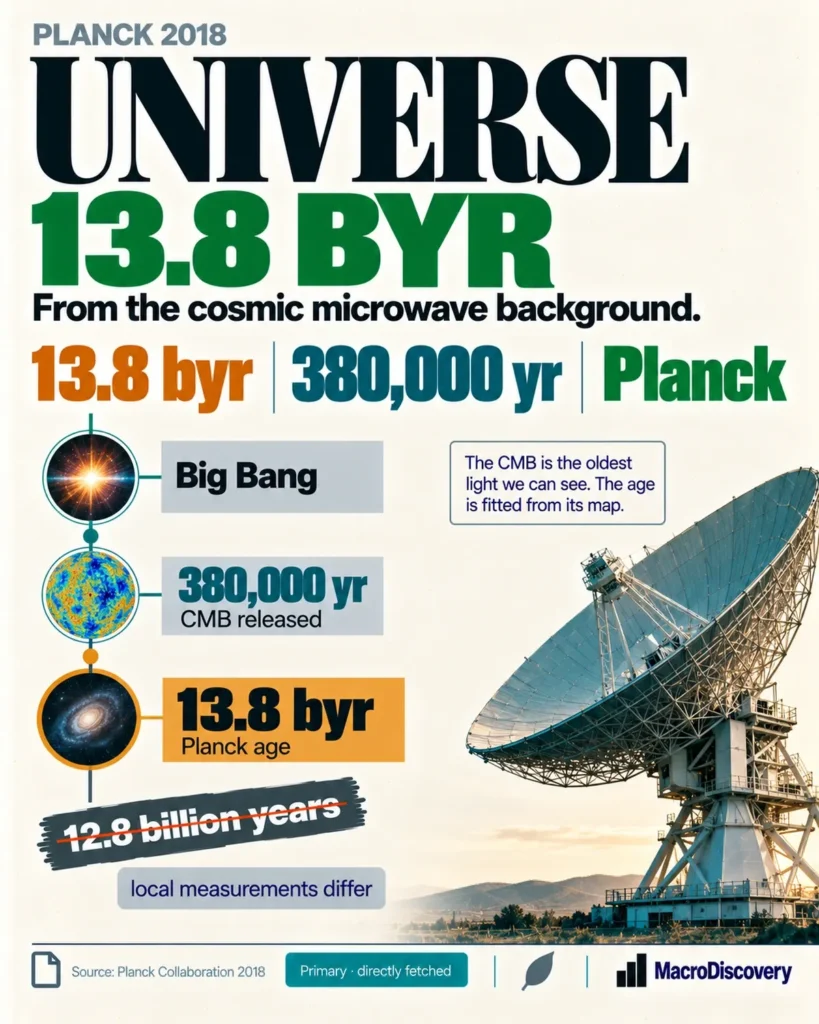
The universe is 13.8 billion years old according to Planck 2018 data. The precise figure is 13.787 ± 0.020 billion years. The cosmic microwave background was released when the universe was about 380,000 years old. Local expansion measurements create a tension with this age.
Three numbers
- 13.787 ± 0.020 billion years — Planck 2018 age of the universe from cosmic microwave background data. Commonly rounded to 13.8 billion years. Source: Planck Collaboration.
- 380,000 years — age of the universe when the cosmic microwave background was released. Source: standard cosmology.
- Hubble tension — local expansion measurements give a higher rate than CMB predictions, implying a slightly younger universe. Source: ongoing observational discrepancy.
What the data shows
A common claim is that the age of the universe is uncertain by billions of years. The fact is that the best measurement from the cosmic microwave background is 13.787 ± 0.020 billion years, from the Planck satellite’s 2018 analysis. That is commonly stated as 13.8 billion years. The figure comes from fitting the patterns in the CMB — the afterglow of the Big Bang — to the standard cosmological model. The light we see as the CMB was released when the universe was about 380,000 years old, once it had cooled enough for neutral atoms to form and photons could travel freely.
Earlier estimates ranged widely. Before precise CMB maps, ages were inferred from the expansion rate and from the ages of the oldest stars and globular clusters. Those methods produced a broad range. WMAP, the predecessor to Planck, narrowed it to about 13.7 billion years. Planck refined it further to 13.787 ± 0.020 billion years. Independent checks from the ages of the oldest stars are consistent with this figure within their larger uncertainties. The CMB method is the most precise because the early-universe physics is well modeled and the sky has been mapped in detail.
A persistent tension remains. Local measurements of the current expansion rate (the Hubble constant) give a higher value than the rate predicted by the CMB data under the standard model. A higher expansion rate would imply a younger universe if applied over the full history. This Hubble tension is an active research area. It does not change the Planck CMB-derived age of 13.8 billion years under the standard model, but it indicates that something — either in the measurements or in the model — is not fully resolved. The accepted age from the early universe is therefore 13.8 billion years, with a known and quantified tension from late-universe measurements.
| Milestone | Age or result |
|---|---|
| CMB released | ~380,000 years after Big Bang |
| WMAP age | ~13.7 billion years |
| Planck 2018 age | 13.787 ± 0.020 billion years |
| Common statement | 13.8 billion years |
Age from Planck 2018 CMB analysis fitted to the Lambda-CDM model. CMB release at recombination. Hubble tension is the discrepancy between early- and late-universe expansion rates.
How it was measured
The age is derived by fitting the temperature and polarization patterns in the cosmic microwave background to the standard cosmological model. The model includes ordinary matter, dark matter and dark energy. The best fit to Planck 2018 data gives 13.787 ± 0.020 billion years. The claim of multi-billion-year uncertainty is contradicted by this precision under the model assumptions.
What it means
It is settled that the Planck 2018 CMB analysis gives 13.787 ± 0.020 billion years, commonly stated as 13.8 billion years. It is settled that the CMB was released at about 380,000 years. It is not settled that the Hubble tension has been resolved — local expansion rates remain higher than CMB predictions. Use 13.8 billion years for the standard age. Note the tension with late-universe measurements. Do not treat the age as uncertain by billions of years.
Common misreadings
- The age is not uncertain by billions of years. Planck gives 13.787 ± 0.020 billion years.
- The 13.8-billion-year figure is from early-universe CMB data, not from local expansion alone.
- The Hubble tension does not invalidate the Planck age under the standard model, but it remains unresolved.
Where the numbers come from
How we built this
- Dataset: Planck 2018 CMB analysis. Standard recombination timing. Known Hubble tension.
- Scope: CMB-derived age. Precision under Lambda-CDM. Distinction from local expansion measurements.
- Figures: 13.787 ± 0.020 billion years. Commonly 13.8 billion years. CMB at 380,000 years.