Economics of Secondhand Markets
The secondhand economy hit $200 billion in 2025. It is growing faster than fast fashion.
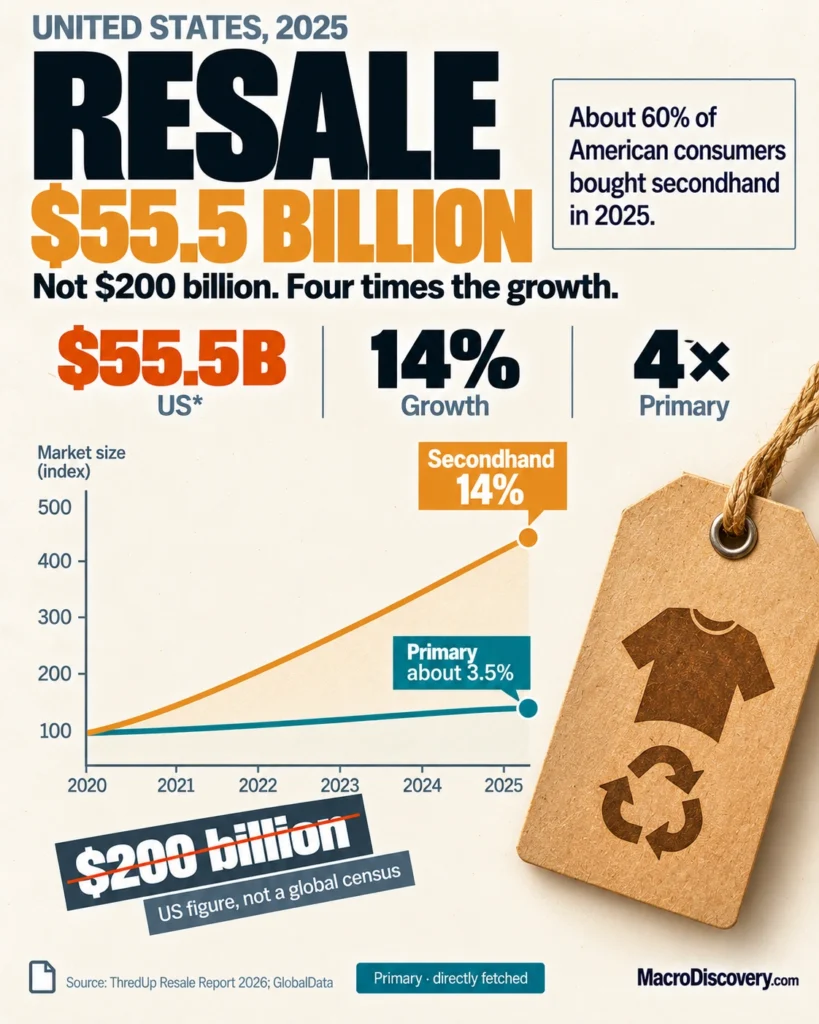
The US figure is $55.5 billion. A $200 billion global number is an estimate. US resale grew about four times faster than the primary market.
Three numbers
- $55.5 billion — US secondhand apparel in 2025, about 12% of clothing spend. Source: ThredUp and GlobalData.
- 14% — US growth that year, about four times the primary fashion market. Source: same report.
- $393 billion — global secondhand apparel projection for 2030. Not a 2025 census. Source: same report.
What the data shows
A common claim is that the secondhand economy hit $200 billion in 2025 and is growing faster than fast fashion. The fact is that the clean US figure is smaller, and the $200 billion is a global estimate that other forecasters do not share. ThredUp’s 2026 Resale Report, with GlobalData, put the US secondhand apparel market at $55.5 billion in 2025. That was about 12% of the $458 billion Americans spent on clothing, footwear, and accessories. About 59 to 60% of American adults bought secondhand that year. A market-research estimate put the global secondhand apparel market near $180 billion in 2025. $200 billion is in that range. It is not the US number, and another forecast put a later year far lower. The estimates disagree.
The growth comparison holds, against the primary market. US secondhand grew 14% in 2025, about four times the primary fashion market. Globally, secondhand grew about 13% while new apparel was nearly flat. The same report projects a roughly 9% compound rate from 2025 to 2030, about twice the overall apparel market, reaching $393 billion. The US projection is about $78.8 billion by 2030. Fast fashion is a slice of primary apparel. The comparison in the report is to the primary market, and the primary market was slow. A 4× against a flat market is a real gap. It is not a census of every thrift store.
Price is the other half. Secondhand clothing typically costs about 60 to 75% less than new, so a dollar of resale is more garments than a dollar of primary. About 46% of consumers browse resale before buying new, and 58% of Gen Z. Supply, not demand, is described as the main constraint. Platforms are a slice: ThredUp’s own revenue was $311 million in 2025. The RealReal’s gross merchandise value was $2.1 billion. Goodwill’s thrift sales were about $7 billion. The $55.5 billion is the US market. The $200 billion is a global estimate. The $393 billion is a 2030 line. They are not the same year and not the same geography.
US growth was 14%, about four times the primary market. Global growth was about 13%.
| Count | Figure | What it is |
|---|---|---|
| US secondhand, 2025 | $55.5 billion | About 12% of clothing spend |
| US growth | 14% | About 4× the primary market |
| Global projection, 2030 | $393 billion | Not a 2025 census |
| US adults who bought | about 59–60% | 2025 survey |
| Price vs new | 60–75% less | A dollar buys more garments |
How it was measured
The US figure is from ThredUp’s annual resale report, compiled with GlobalData from industry data and a survey of about 3,300 adults. It is apparel, footwear, and accessories. It is not cars, furniture, or electronics. A global $200 billion comes from market-research estimates that differ by tens of billions. A 2030 projection assumes the recent rate holds.
Growth versus the primary market is a rate comparison, not a dollar comparison. Secondhand prices are lower, so share of garments is larger than share of dollars. Platform revenue is a slice of the market, not the market.
What it means
It is settled that the US secondhand apparel market was $55.5 billion in 2025 and grew about four times faster than the primary market. It is not settled that a global $200 billion is the census. Use $55.5 billion for the US. Use 14% for the US growth. Use $393 billion only as a 2030 projection. Do not treat $200 billion as the US figure.
Common misreadings
- $55.5 billion is the US. $200 billion is a global estimate.
- Growth is faster than the primary market. Fast fashion is a slice of that.
- $393 billion is a 2030 projection, not a 2025 result.
Where the numbers come from
How we built this
- Dataset: ThredUp 2026 Resale Report with GlobalData for the US and the global projection; market-research range for the $200 billion line.
- Scope: Apparel. US kept apart from global. A 2025 result kept apart from a 2030 projection.
- Figures: $55.5 billion is the US. 14% is the US growth. $393 billion is 2030. $200 billion is treated as a global estimate, not a census.