How Airports Became Shopping Malls
Airports now make more money from retail than from planes. Here is how that happened.
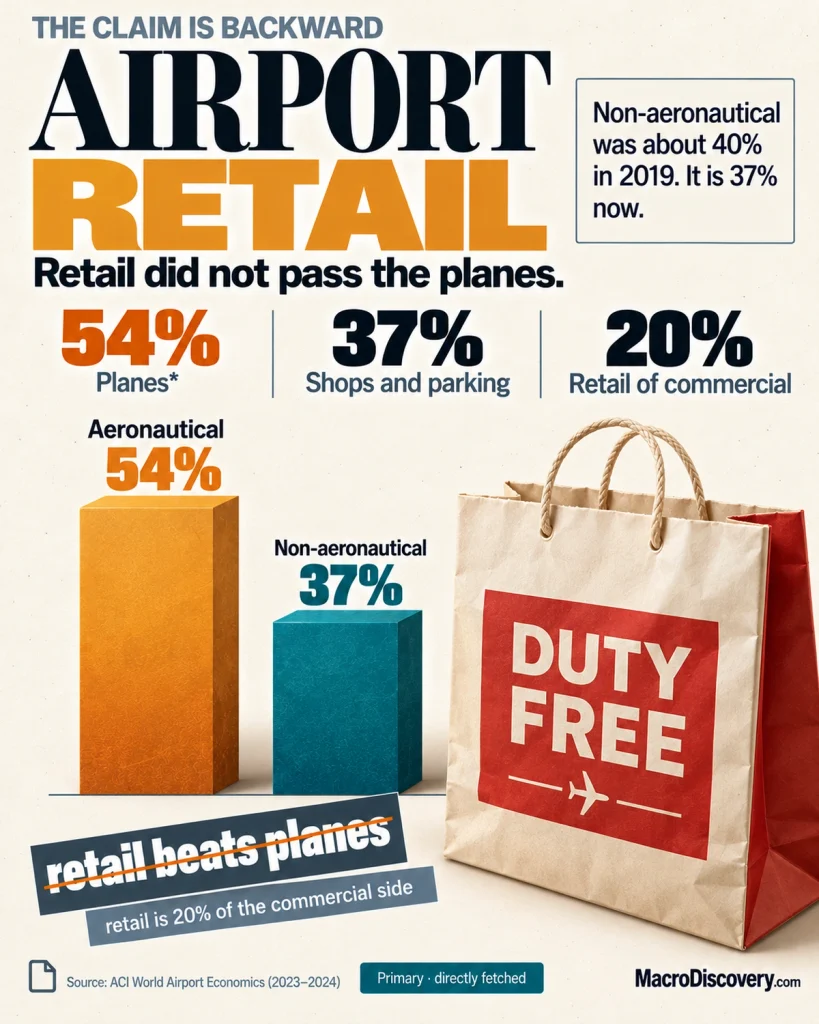
They do not. Aeronautical charges are about 54% of global airport revenue. Retail is a slice of the smaller line. Parking is as large.
Three numbers
- About 54% — aeronautical share of global airport revenue in 2024. Landing fees, passenger charges, airline rents. Source: Airports Council International.
- About 37% — non-aeronautical share. Shops, food, parking, property. Source: ACI.
- About 23% — retail concessions as a share of the non-aeronautical slice. Parking was about 24%. Source: ACI.
What the data shows
A common claim is that airports now make more money from retail than from planes. The fact is that the plane is still the larger line, and the shop is not even the largest piece of the smaller one. Airports Council International figures put aeronautical revenue — landing fees, passenger charges, and rents tied to airline operations — at about 54% of global airport revenue in 2024. Non-aeronautical revenue, the shops, food, parking, rental cars, and property, was about 37%, or 36.7% in one ACI reading. A non-operating slice makes up the rest. Calling the airport a mall that has overtaken the runway uses the smaller bar as the larger one.
Inside the commercial line, retail is not first. Retail concessions were about 23% of non-aeronautical revenue. Car parking was about 24%. Property was about 16%. Food and beverage was about 6%. Retail’s share of that slice had already fallen, from 27% in 2019 to 20% in 2023, while parking rose from 21% to 24%. In Asia Pacific, non-aeronautical revenue led in 2019 at 49% and fell behind aeronautical revenue by 2023, 42% against 52%. The duty-free wall is what a passenger walks past. The fee schedule is what the airline pays. They are not the same size.
The mall look is a margin story, not a revenue story. Aeronautical charges are often set to recover the cost of the airfield. Non-aeronautical revenue covered about 48% of industry costs in 2024 even though it was the smaller revenue line. That is why the shops are built. It is not why they out-earn the planes. Heathrow took £791 million in retail in 2025, about £9.36 a passenger, on total revenue of £3.6 billion. A large shop at one hub is not a global crossing of the two lines. The runway fee is still the bigger cheque.
Parking is about 24% of the non-aeronautical line. Retail is about 23%.
| Count | Figure | What it is |
|---|---|---|
| Aeronautical | about 54% | Planes. Still the larger line |
| Non-aeronautical | about 37% | Shops, food, parking, property |
| Retail of that slice | about 23% | Parking about 24% |
| Retail share, 2019 to 2023 | 27% to 20% | Of non-aeronautical. It fell |
| Heathrow retail, 2025 | £791 million | On £3.6 billion total |
How it was measured
Aeronautical revenue is money tied to the aircraft and the passenger charge. Non-aeronautical is everything else in the terminal and on the land. ACI compiles both from member airports. A 54% and a 37% do not sum to 100 because a non-operating slice sits beside them. Retail is a concession fee inside the non-aeronautical line, not a share of the whole airport.
A single hub can have a larger shop than a small airport has in total. Heathrow’s £791 million is one airport’s retail, not the world. Parking dominates the commercial line in the United States. Retail dominates it in other regions. The global average is the one that answers the claim.
What it means
It is settled that aeronautical charges are the larger line, at about 54%, and that retail is about 23% of the smaller commercial line. It is not settled that a given hub matches the global split. Use 54% for the planes. Use 37% for the commercial line. Use 23% for retail’s share of that line. Do not say retail out-earns the planes.
Common misreadings
- Aeronautical is about 54%. Non-aeronautical is about 37%. Planes are larger.
- Retail is about 23% of the commercial line. Parking is about 24%.
- Retail’s share of that line fell after 2019. It did not take over.
Where the numbers come from
How we built this
- Dataset: ACI global revenue split; ACI composition of non-aeronautical revenue; Heathrow retail as a single-hub check.
- Scope: Global shares. A hub’s shop kept apart from the world total. Parking kept visible inside the commercial line.
- Figures: 54% is aeronautical. 37% is non-aeronautical. 23% is retail’s share of that line. The claim that retail beats the planes is treated as reversed.