Hidden Cost of Free Delivery
Free shipping is not free. Here is who actually pays for it — and how much.
A typical 2026 residential parcel costs about $18.80. The merchant pays the carrier. The buyer pays in the price or the basket.
Three numbers
- $18.80 — all-in cost of a modeled 2026 residential parcel, 3 pounds, Zone 5. Source: rate model.
- $6.50 — the residential surcharge on that parcel, about 35% of the bill. Source: same model.
- 10 to 15% — share of revenue that shipping runs for many direct-to-consumer brands. Source: operator pattern.
What the data shows
A common claim is that free shipping is free, or that the carrier absorbs it as a promotion. The fact is that a carrier invoice still exists, and someone on the other side of the checkout pays it. A 2026 model of a 3-pound residential parcel to Zone 5 put the all-in cost at about $18.80. Base transport was $9.25. The residential surcharge was $6.50. Fuel was about $1.30. Dimensional weight, address fixes, and a slice of peak season made up the rest. The free label on the product page is a decision not to show that line. It is not a decision that the line is zero.
The merchant pays the carrier, then recovers the money. Many direct-to-consumer brands see shipping at 10 to 15% of revenue. A common free-shipping threshold sits near $45 to $49, often close to the average order. On a $75 order with a 60% contribution margin, absorbing a $15 parcel takes about $25 of revenue. The threshold works when it lifts the basket enough to cover that. When it does not, the cost sits in the product price. Either way the buyer pays: in a higher unit price, in extra items added to clear the bar, or in both.
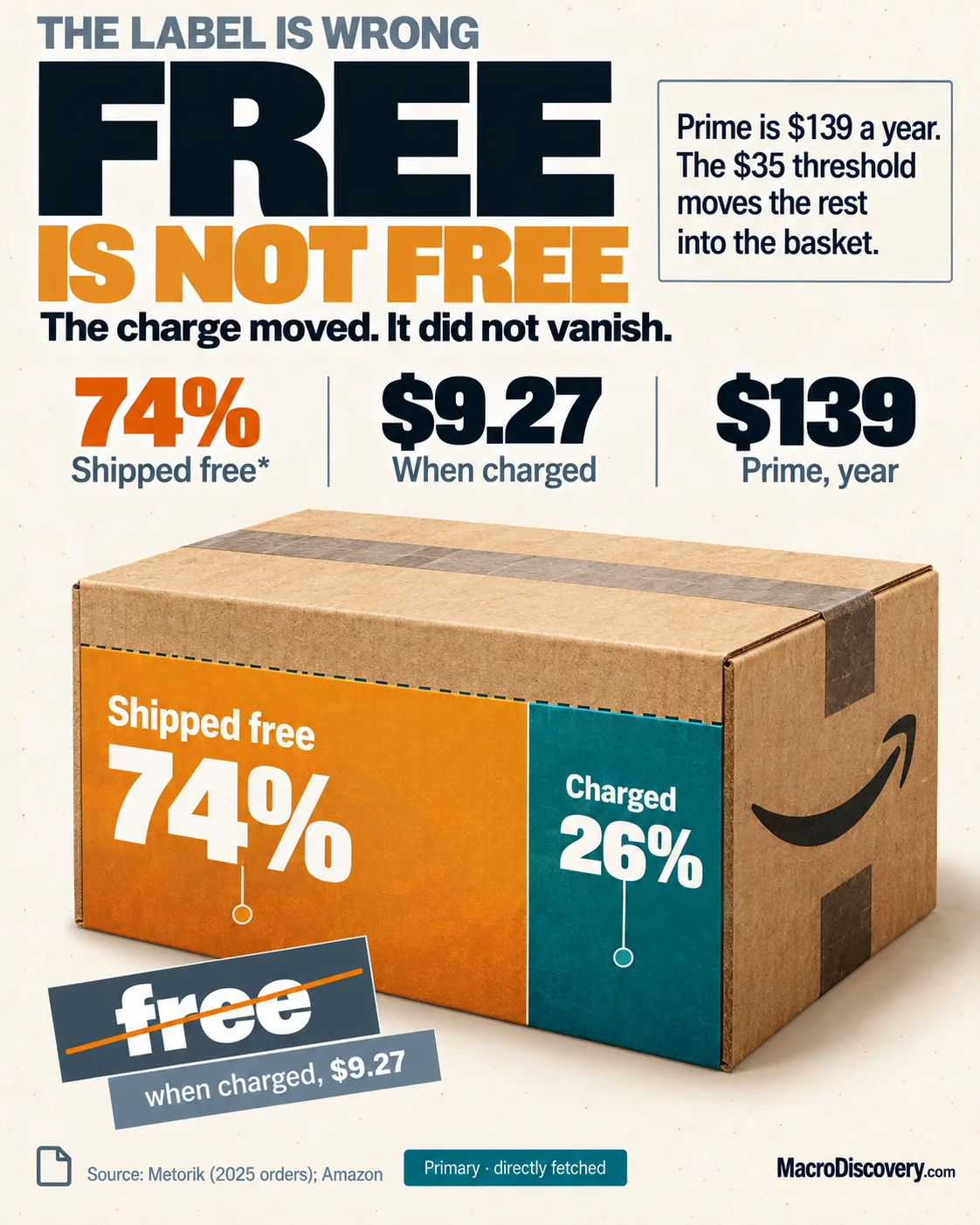
A marketplace does not erase the bill. Fulfillment by Amazon fees start at about $3.22 for a small standard unit and run to $8.15 and above for larger ones. The seller pays the fee. Amazon uses it to cover the outbound leg. A Prime buyer pays a membership on top. A seller who ships their own parcels pays the carrier directly, often $4.50 to $12 on ordinary USPS examples. The checkout can say free. The fee schedule does not.
The free label is the decision not to show this line. The carrier is still paid.
| Count | Figure | What it is |
|---|---|---|
| All-in parcel | $18.80 | 3 lb, Zone 5, residential, 2026 |
| Residential surcharge | $6.50 | About 35% of that bill |
| Base transport | $9.25 | The line people expect |
| Share of revenue | 10–15% | Shipping at many DTC brands |
| Small FBA fee | from $3.22 | Seller pays. Buyer may pay Prime |
How it was measured
The $18.80 figure is a model parcel, not an average of every box in the country. It uses a 2026 ground rate for 3 pounds to Zone 5, then adds the residential surcharge, fuel, and smaller accessorials. A lighter parcel to a nearer zone costs less. A heavy one to a far zone costs more. The point is the shape of the bill, not a single national price.
The 10 to 15% of revenue is an operator pattern among mid-size direct-to-consumer brands, not a census. A free-shipping threshold near the average order is a pricing choice. Fulfillment fees are a published schedule. A membership is a separate product. None of them is a zero.
What it means
It is settled that a typical residential parcel has a real carrier cost, that a residential surcharge is a large share of it, and that merchants recover the cost in price or basket size. It is not settled that $18.80 is every parcel. Use $18.80 for that model. Use $6.50 for the home-delivery fee. Use 10 to 15% for the revenue share at many brands. Do not read a free label as a carrier gift.
Common misreadings
- The carrier is paid. Free is a label, not a zero invoice.
- The residential surcharge can be a third of the bill. A house is not a loading dock.
- A marketplace fee or a membership is the same cost, moved.
Where the numbers come from
How we built this
- Dataset: A 2026 residential parcel model; operator patterns on revenue share; a published fulfillment fee schedule.
- Scope: The carrier invoice kept apart from the checkout label. Price, threshold, and membership kept as the recovery paths.
- Figures: $18.80 is the model parcel. $6.50 is the residential surcharge. 10 to 15% is the revenue share. Free is treated as a label.