The Economics of Free Trade
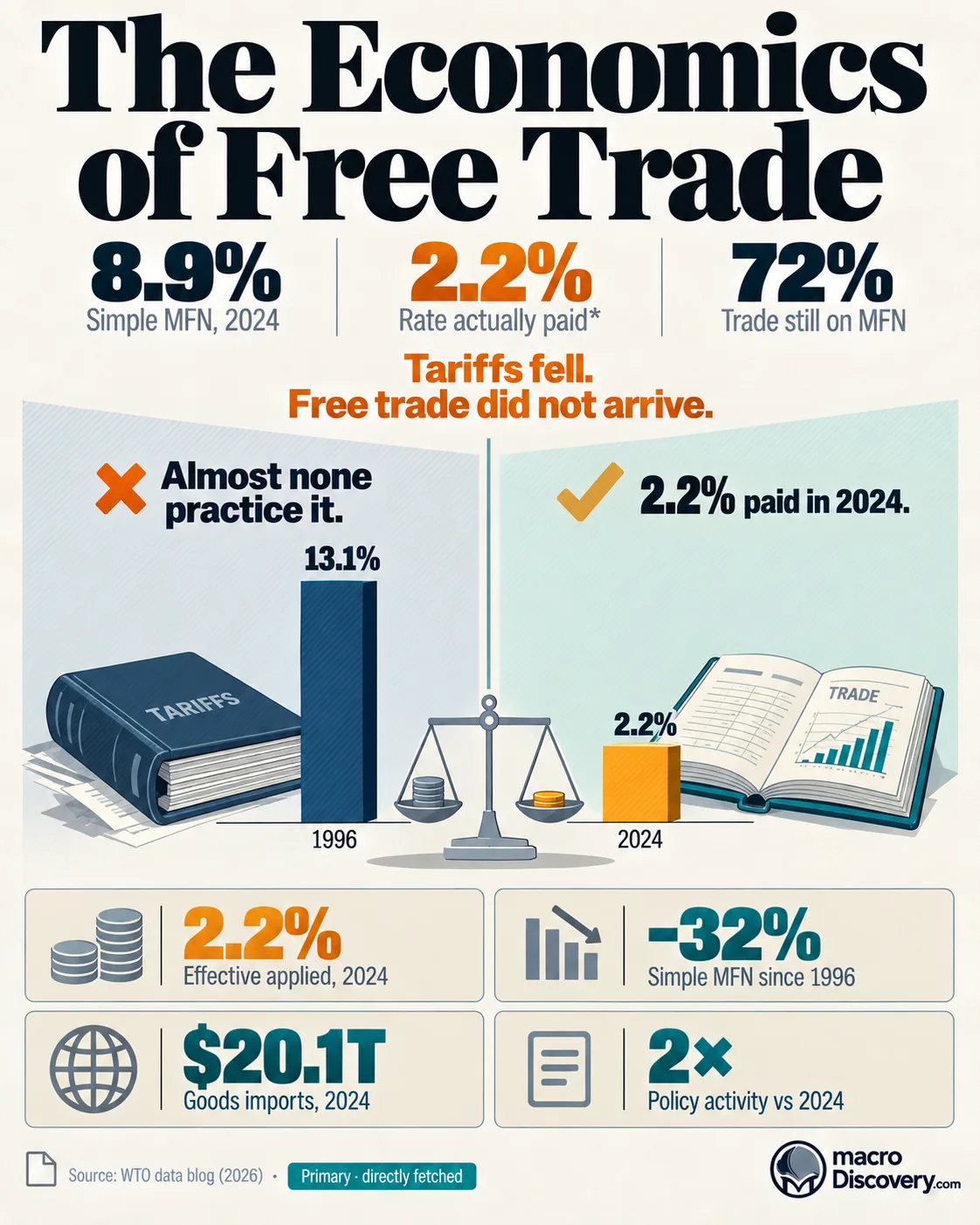
Every country says it believes in free trade. Almost none of them practice it.
Almost none have a zero tariff on every product. About 74% of world trade is still on equal terms. The larger friction is rules, not the slogan.
Three numbers
- 74% — share of global merchandise trade still on most-favoured-nation terms in May 2025. Same tariff for every partner. Source: WTO, ITC, UNCTAD.
- 23% — share of world imports in 2022 that could use a regional-deal preference. Up from about 17% in 2010. Source: WTO staff paper.
- Two-thirds — share of world trade regulated by technical measures. Compliance costs are generally higher than tariffs. Source: UNCTAD.
What the data shows
A common claim is that every country says it believes in free trade, and almost none practice it. The fact is that almost none have a zero tariff on every product, and most still trade on equal terms. World Tariff Profiles 2025, from the WTO, the International Trade Centre, and UNCTAD, finds that about 74% of global merchandise trade was conducted on most-favoured-nation terms as of May 2025. MFN means a country charges the same tariff to every partner, unless a deal says otherwise. That is the practice, not a speech.
Deals have multiplied. They have not taken over the tariff. A WTO staff paper found that imports between regional-agreement partners rose from 37% of world imports in 2010 to 52% in 2022. The share that could actually use a lower deal rate rose only from about 17% to 23%. About 80% of imports were not under those preferences. Much of that trade was already duty-free at the general rate, so a deal had nothing left to cut. Bound ceilings, the legal maximum, sit above the rates countries apply. The gap is room to raise a tariff, not a closed border.
The larger friction is not the average tariff line. UNCTAD’s 2024 trade-policy review says technical measures regulate about two-thirds of world trade, and sanitary and phytosanitary rules cover almost all agricultural products. Compliance costs of those measures are generally higher than tariffs. More than half of world trade is between partners in some preferential agreement, but a preferential partner is not a zero-tariff border. Agriculture stays more protected than industrial goods. A country can apply a low average and still block a farm product.
MFN is equal treatment, not a zero tariff. The 26% is the complement of the 74% MFN share, not a count of closed borders.
| Count | Figure | What it is |
|---|---|---|
| Trade on MFN terms | about 74% | May 2025. Same tariff for every partner |
| Possible deal preference | 23% | 2022 imports that could use an RTA rate |
| Imports between deal partners | 52% | 2022. Up from 37% in 2010 |
| Technical measures | about two-thirds | Share of world trade they regulate |
| Zero tariff on every product | almost none | The part of the claim that holds |
How it was measured
World Tariff Profiles compare bound ceilings with applied rates for more than 170 economies, as of the end of 2024, and estimate how much trade moves on MFN terms. The MFN share uses customs data and preference use, not a count of speeches. A duty-free MFN line and a preferential line are different. One is open to every partner. The other is a deal.
The WTO staff paper uses tariff-line imports for 157 customs territories from 2010 to 2022. “Potential preferential” means the import could have used a deal rate. It is not proof that every shipment did. UNCTAD counts non-tariff measures by the trade they cover. A rule on two-thirds of trade is not a tariff of two-thirds.
What it means
It is settled that almost no country has a zero tariff on every product, and that about 74% of merchandise trade was still on MFN terms in May 2025. It is not settled that almost none practice trade on equal terms. Use 74% for the MFN share. Use 23% for imports that could use a deal rate in 2022. Use two-thirds for technical rules. Do not use “almost none” as the trade share.
Common misreadings
- A missing zero tariff is not a closed border. Most trade still pays the same rate to every partner.
- A regional deal does not mean the shipment used the deal rate. Only 23% of 2022 imports could.
- The larger cost is often the rule, not the tariff. Technical measures cover about two-thirds of trade.
Where the numbers come from
How we built this
- Dataset: World Tariff Profiles 2025; WTO staff working paper ERSD-2025-03; UNCTAD trade-policy review 2024.
- Scope: Merchandise trade and border rules. Services barriers and speeches excluded. MFN is equal treatment, not a zero tariff.
- Figures: 74% is the May 2025 MFN share. 23% is potential preferential imports in 2022. Two-thirds is trade covered by technical measures.