The Economics of Space Colonization
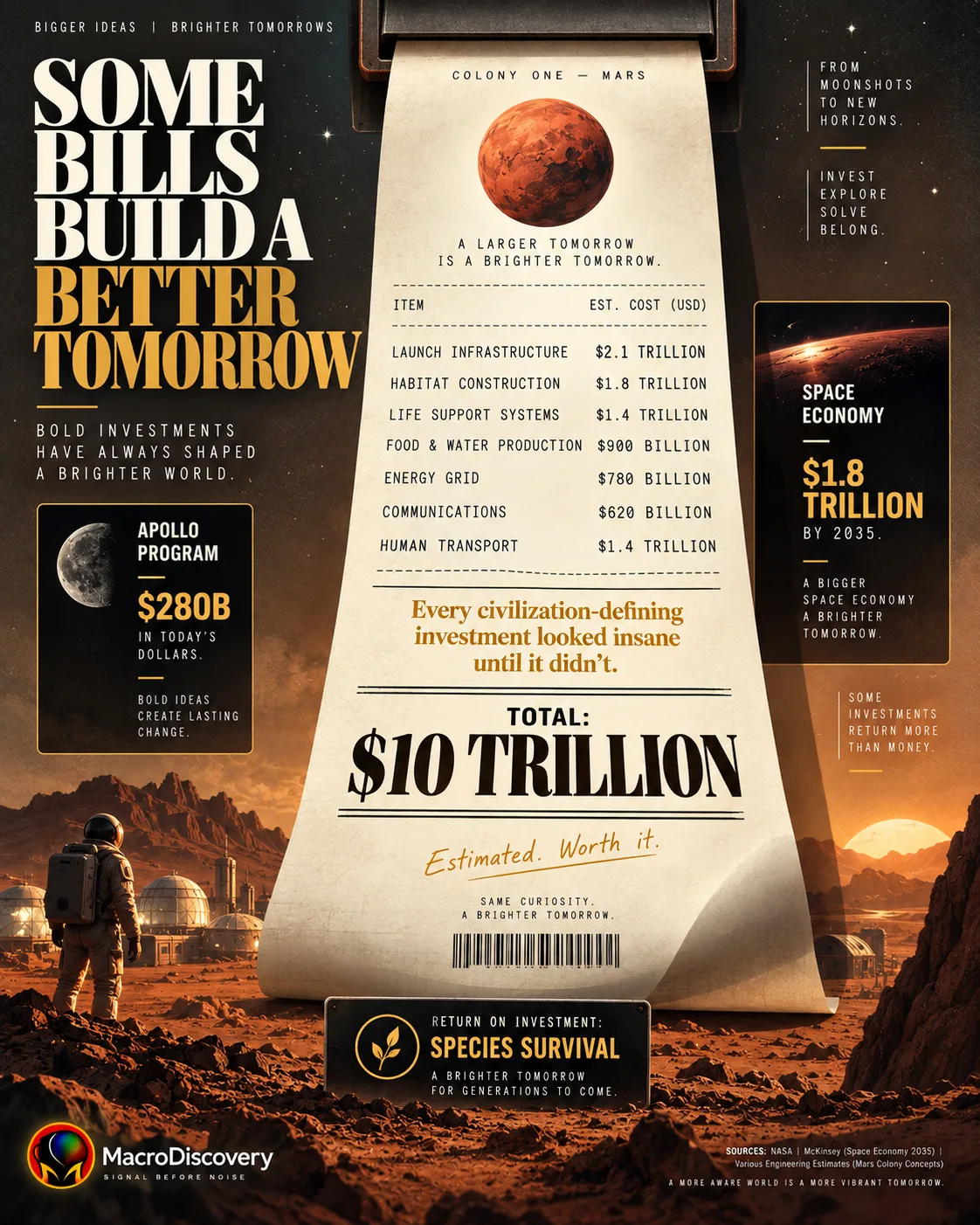
A Mars city has been guessed at $10 trillion. That number is not a NASA line item. It may not be “worth every dollar” either.
One ledger is a tweet. One ledger is the space station we already paid for. One ledger is satellites earning money this year. They do not add.
In August 2019 someone asked Elon Musk what a self-sustaining city on Mars would cost. He typed a range: between $100 billion and $10 trillion. The low end assumed about a million tons of cargo at $100,000 a ton. The high end was an order-of-magnitude shrug.
That range is the source of the headline. It is not an audited program. NASA has not published a $10 trillion colony budget. A later $10 trillion figure from investors is something else again — imagined yearly Starship revenue, not the cost of air on Mars.
So the honest sentence is smaller than the secondary title wants. A first city could cost something in that enormous band. Whether it is “worth every dollar” is a value judgment, not a spreadsheet cell.
Do not put a tweet, a station, and a market on one bar
The working space economy is already large — and almost all of it is in Earth orbit. The OECD’s 2026 glance at the sector puts global space-related revenues at about $550–600 billion in 2025. Satellites, launch, Earth observation, navigation. Not habitats on the Tharsis bulge.
The International Space Station is the most expensive object we have actually assembled off the ground. Public accounts often put the lifetime, multi-nation bill near $150 billion. A NASA inspector general tally of the U.S. share through the early 2020s sits around $118 billion. Annual U.S. station operations have run near $3 billion.
GAO’s latest major-project books say NASA plans to put at least $70 billion of life-cycle cost into the current portfolio of big missions — Moon hardware inside that, Mars still mostly a destination on the slide.
- —Mars city, high guess10,000Musk ’19
- —Mars city, low guess100Musk ’19
- —Space revenues, 2025~575OECD
- —ISS lifetime, oft-cited~150partners
- —NASA major projects book≥70GAO
Scores are billions of dollars. The top bar is not a contract. A 1% bar next to a 100% bar is the point.
Insurance for the species is not a cash-flow model
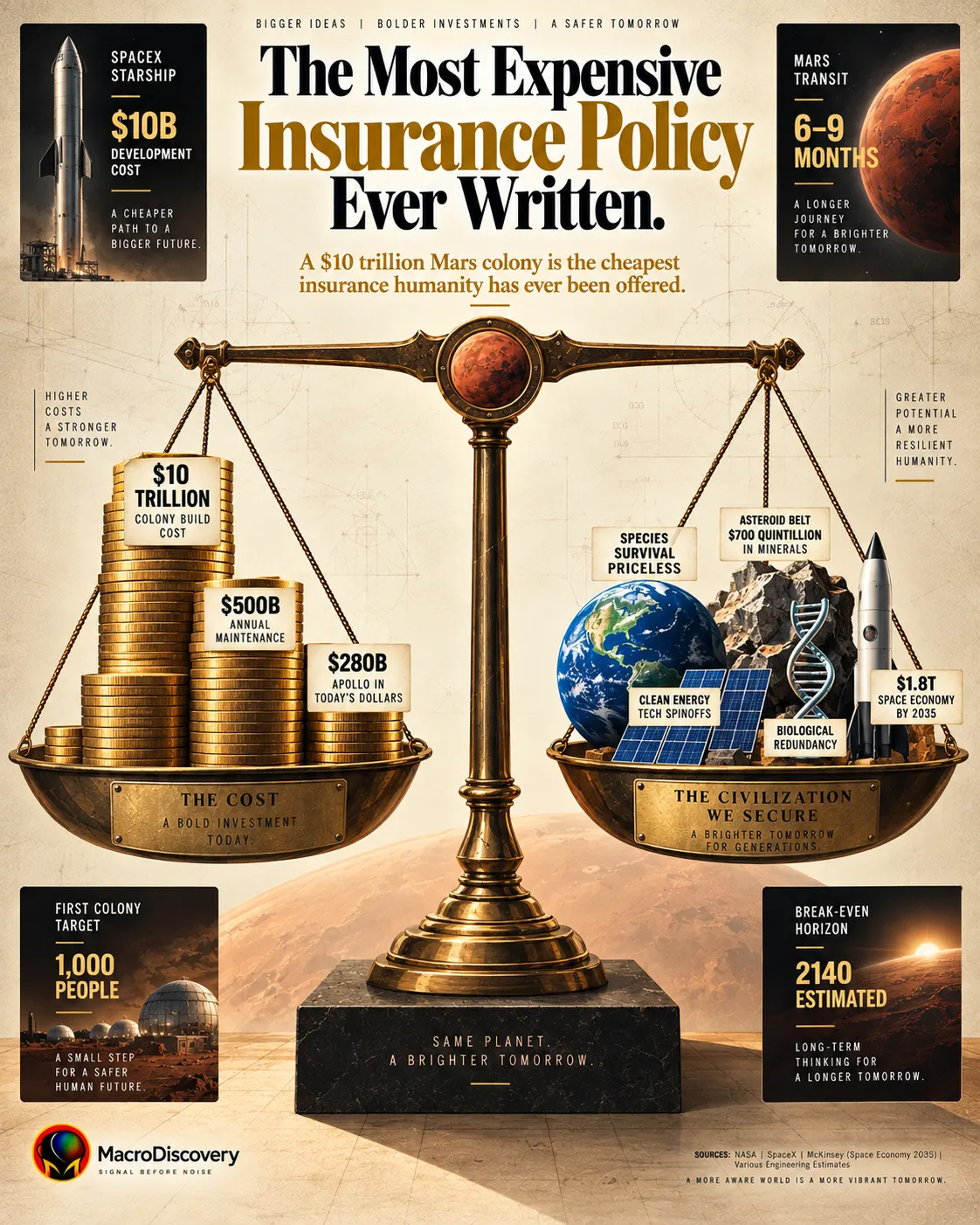
The case for a second home is not quarterly revenue. It is option value: a living population that survives a bad century on Earth. That argument does not need Mars to turn a profit in 2040. It does need the dollars to be real, sequenced, and not stolen from the climate and health budgets that keep this planet habitable long enough to launch.
Robert Zubrin’s Mars Direct school priced early expeditions in the tens of billions, not the tens of trillions — make fuel from Martian air, don’t drag it all from Florida. NASA-adjacent papers have put a human Mars campaign nearer “half a trillion.” A 2015 SpaceNews letter warned that a $1.5 trillion sketch could balloon toward $5–15 trillion once Washington’s usual overruns arrive. Those are all first-mission or program sketches. A city of a million people is a different animal: greenhouses, power, medicine, graves.
Cargo math, 2019
A million tons at $100k a ton. Order of magnitude, not a bid.
Same tweet
Ceiling for a self-sustaining city. Not Artemis. Not Starship ticket sales.
We already paid this
Low Earth orbit. Partners. Decades. The only colony-scale invoice on the books.
OECD glance 2026
This year’s economy. Mostly Earth-facing. This is the cash, not the dream.
A $10 trillion city is a dare. A $150 billion station is a receipt. Only one of those has astronauts in it tonight.Macro Discovery, stacking the three ledgers
The dollars get honest when you refuse to add them
“Worth every dollar” only works if you know which dollars. The high Musk number is a century-scale civilizational bet. The ISS number is what a partnership actually spent to keep a handful of people in a can. The OECD number is this year’s satellite business. Treat the first as a ceiling on a poster. Treat the second as proof that off-world living is already expensive when the planet is 400 kilometers away, not 225 million.
If launch gets cheap, the $100 billion floor moves. If life support and food stay Earth-like, the $10 trillion ceiling is not crazy — it is just unpaid. Worth is then a political choice: buy a backup planet, or buy resilience here. The article will not pretend that choice is a bargain bin.
Editorial reading of Musk 2019 comments, OECD Space Economy at a Glance 2026, GAO NASA assessments, and public ISS cost tallies. Those parties did not write this box.If you remember two things
$100 billion to $10 trillion for a city
A range, not a NASA appropriation. A different $10 trillion later described imagined Starship revenue. Do not staple.
The paid-for space economy is already huge — in orbit
$550–600 billion of 2025 revenue. An ISS bill on the order of $150 billion. That is colonization’s little sibling, already on the credit card.
Short answers
A range, a receipt, a market
- City cost range: Elon Musk, August 2019 — $100 billion to $10 trillion for a self-sustaining Mars city; low end tied to ~1 million tons at ~$100k/ton.
- Current market: OECD, The Space Economy at a Glance 2026 — global space-related revenues about $550–600 billion in 2025.
- ISS: widely cited multi-partner lifetime near $150 billion; NASA OIG U.S. investment tallies in the $118 billion region through the early 2020s; operations about $3 billion a year.
- NASA book: GAO assessments — at least ~$70 billion life-cycle cost across the current major-projects portfolio.
- Bars: dollars scaled to the $10 trillion ceiling so the real invoices look as small as they are.