The Global Gender Pay Gap
The global gender pay gap. One number, every country.
The 52-cent figure is all labour income. The 18% gap is an unadjusted earnings average. The 68.8% score is an index, not a wage.
Three numbers
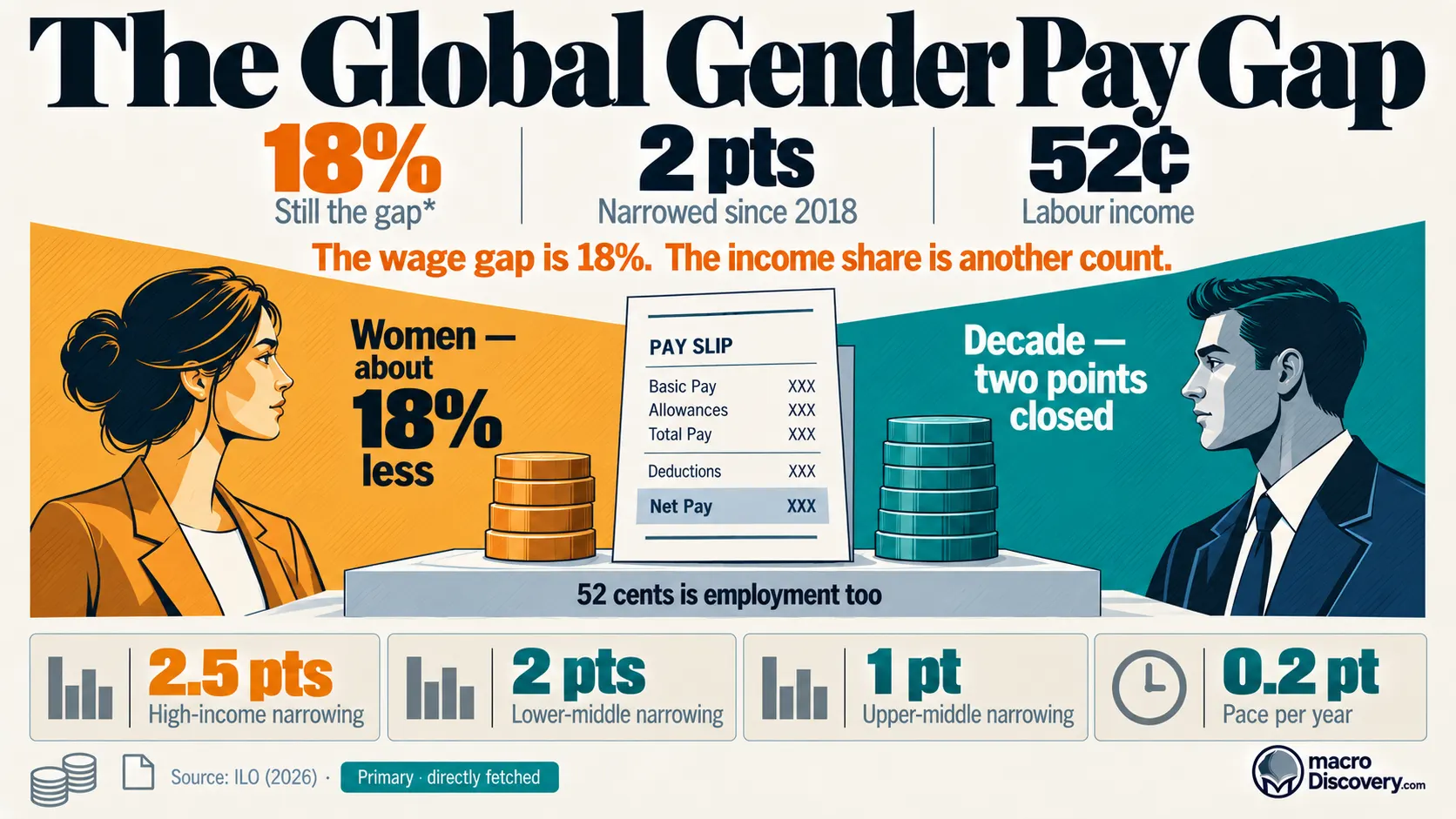
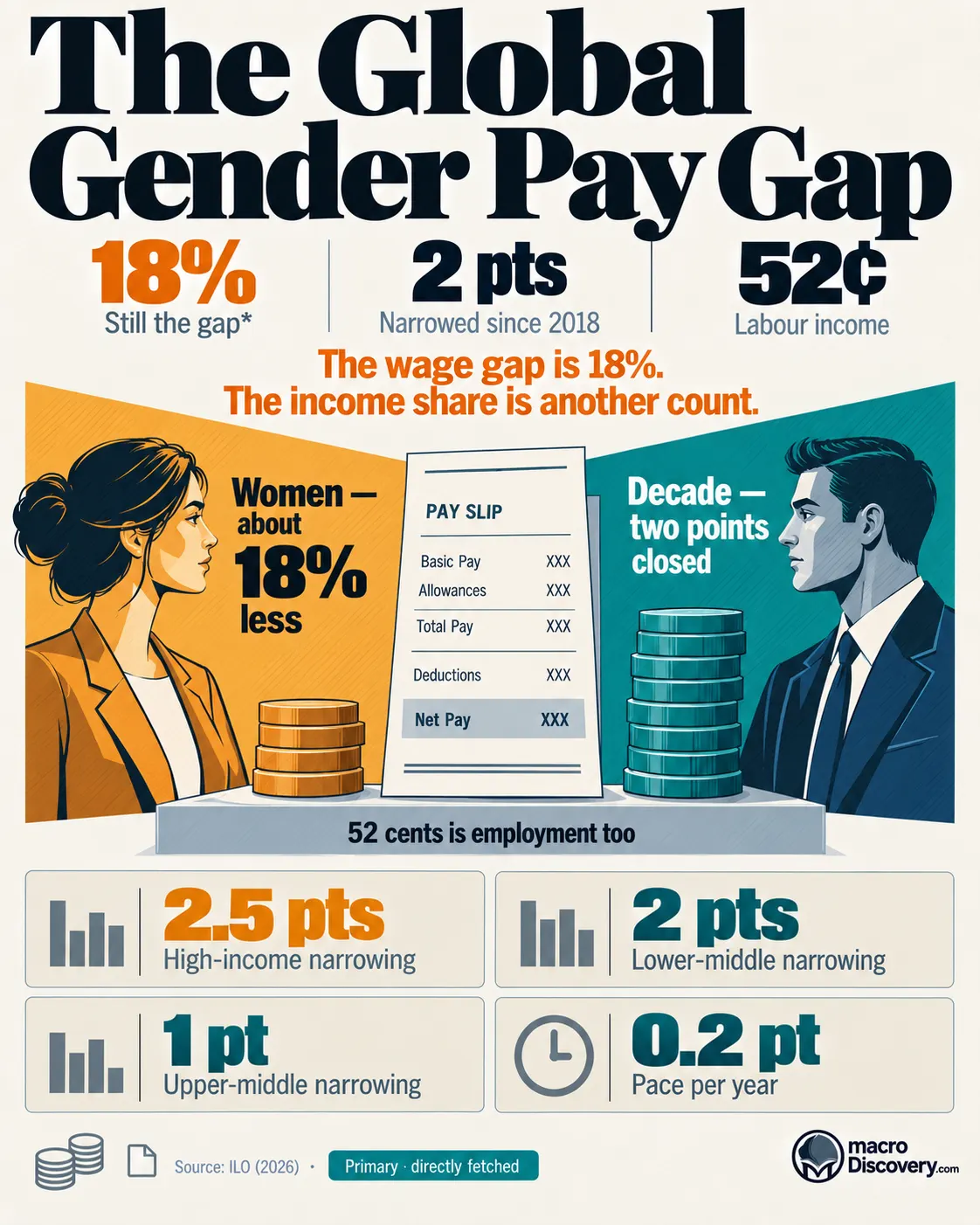
- 52 cents — women’s labour income per dollar of men’s in 2025. Includes hours and who works. Source: ILO.
- About 18% — women earn less than men on the ILO’s global earnings estimate, narrowed by two points since 2018. Source: ILO, September 2026.
- 68.8% — share of the World Economic Forum gender-gap index closed in 2025. Education, health, politics, and work. Not a wage. Source: World Economic Forum.
What the data shows
A common claim is that the global gender pay gap is one number, and that it is the gap for the same job. The fact is that the two ILO figures in circulation are different counts. In 2025 the ILO said women earned 52 cents for every dollar of labour income earned by men. Labour income is all pay from work. It includes who has a job, how many hours, and self-employment. A woman who is not in paid work pulls that average down. It is a real gap in income. It is not a quote for the same hour.
The earnings gap is the other number. ILO estimates released on 18 September 2026 put women at about 18% less than men globally, narrowed by two percentage points since the 2018 estimates. High-income countries narrowed by about 2.5 points over the decade, lower-middle-income countries by about two, upper-middle-income by about one. At about 0.2 point a year, the ILO called a close distant. The hourly series behind country charts is unadjusted. It compares average earnings of employees and does not hold education, experience, or occupation fixed. It leaves out the self-employed. A like-for-like gap is smaller than 18%, and it is not the 52-cent figure.
A third number is not a wage at all. The World Economic Forum’s 2025 index was 68.8% closed, the fastest annual gain since the pandemic, with full parity estimated at 123 years on that pace. The index mixes economic participation, education, health, and politics. Education and health were already above 95%. Women were 41.2% of the workforce and 28.8% of top leadership. Iceland was first, at 92.6%. Using 68.8% as the pay gap, or 52 cents as equal pay for equal work, swaps a composite and an income total for a wage.
The 68.8% Forum score is not on this chart. It is an index, not a wage.
| Count | Figure | What it is |
|---|---|---|
| Labour income, 2025 | 52 cents | All pay from work. Includes hours |
| Earnings gap, 2026 | about 18% | Unadjusted. Down 2 points since 2018 |
| Implied earnings | 82 cents | Not the 52-cent count |
| Forum index, 2025 | 68.8% closed | Four dimensions. Not a wage |
| Top leadership | 28.8% | Women. Workforce share 41.2% |
How it was measured
Labour income divides total pay from work. A lower employment rate or shorter week lowers the cents without a lower hourly rate. The earnings gap is the difference in average earnings as a share of men’s. The hourly version on country charts is unadjusted and covers employees only. National surveys differ, so a cross-country rank is rough.
The Forum index scores parity from 0 to 100 across four subindexes. A 68.8% close is not 68.8 cents on the dollar. The 123-year line assumes the latest pace holds. It is a projection of an index, not a payroll.
What it means
It is settled that ILO labour income in 2025 was 52 cents, that the earnings gap is about 18% and unadjusted, and that the Forum index was 68.8% closed. It is not settled that any of these is the gap for the same job. Use 52 cents for labour income. Use 18% for the unadjusted earnings gap. Use 68.8% only as the index. Do not swap them.
Common misreadings
- 52 cents is all labour income. It is not the same hour in the same job.
- 18% is an unadjusted average. It does not hold occupation fixed.
- 68.8% is a four-part index. It is not a wage.
Where the numbers come from
How we built this
- Dataset: ILO labour-income ratio; ILO 2026 earnings estimate; World Economic Forum 2025 index.
- Scope: The three counts kept apart. No like-for-like gap invented.
- Figures: 52 cents is labour income. 18% is the unadjusted earnings gap. 68.8% is the index. They are not swapped.