Home AI Technology Gaming Future Automobile Geography Top 10 Trending How To Discover
---Advertisement---

Ranked: The World’s Most Powerful Central Banks

Macro Discovery
On: August 12, 2026 7:51 AM
Follow Us:
---Advertisement---
World’s Most Powerful Central Banks , What is the most powerful central bank in the world? , What is the current Federal Reserve interest rate in 2026? , Which central bank has the largest balance sheet? , Why did the Bank of Japan raising rates cause a stock market crash? , Which country is leading in central bank digital currencies (CBDCs)? , most powerful central banks world ranked 2026 , central bank balance sheets 2025 2026 Federal Reserve ECB PBoC , what is Federal Reserve interest rate 2026 current FOMC decision July August September , dollar dominance global reserve currency 2025 2026 percentage IMF data declining , what is the most powerful central bank in the world and why , what is the current Federal Reserve interest rate July August 2026 , which central bank has the largest balance sheet ECB Fed PBoC 2026 , why did the Bank of Japan raising rates cause a stock market crash , which country is leading in central bank digital currencies CBDCs 2026 ,
Premium editorial infographic showing
a concentric power rings diagram
ranking the world's most powerful
central banks by global influence
rather than balance sheet size alone.
The innermost ring in deep institutional
navy represents the Federal Reserve
(#1 by influence), noting its policy
rate of 3.50-3.75% as of July 30,
2026, with Fed Chair Kevin Warsh,
and the dollar's 57.4% share of
global foreign exchange reserves.
Surrounding rings show the ECB ($7.13
trillion balance sheet, governing 20
nations), People's Bank of China
($6.62 trillion, e-CNY ¥7 trillion),
Bank of Japan (0.75% — highest since
1995), Bank of England (3.75%), and
Swiss National Bank. The centre shows
$31.4 trillion in total global central
bank assets. A callout notes the July
30, 2026 Fed hold vote of 9-3, with
three officials wanting to hike. Based
on BIS Q3 2025, IMF COFER Q3 2025,
and Federal Reserve primary data. World's Most Powerful Central Banks.
World’s Most Powerful Central Banks
Ranked: The World’s Most Powerful Central Banks — MacroDiscovery
MacroDiscovery
Global Finance & Monetary Policy · 5 min read · Fed Primary · July 29 2026 · BIS Q3 2025 · IMF COFER
Federal Reserve (PRIMARY · federalreserve.gov · directly fetched · July 29, 2026) · BIS Q3/Q4 2025 · IMF COFER Q3 2025 · World Gold Council 2024 · Atlantic Council CBDC Tracker March 2026
Monetary Power · Global Rankings

Ranked: The World’s Most
Powerful Central Banks

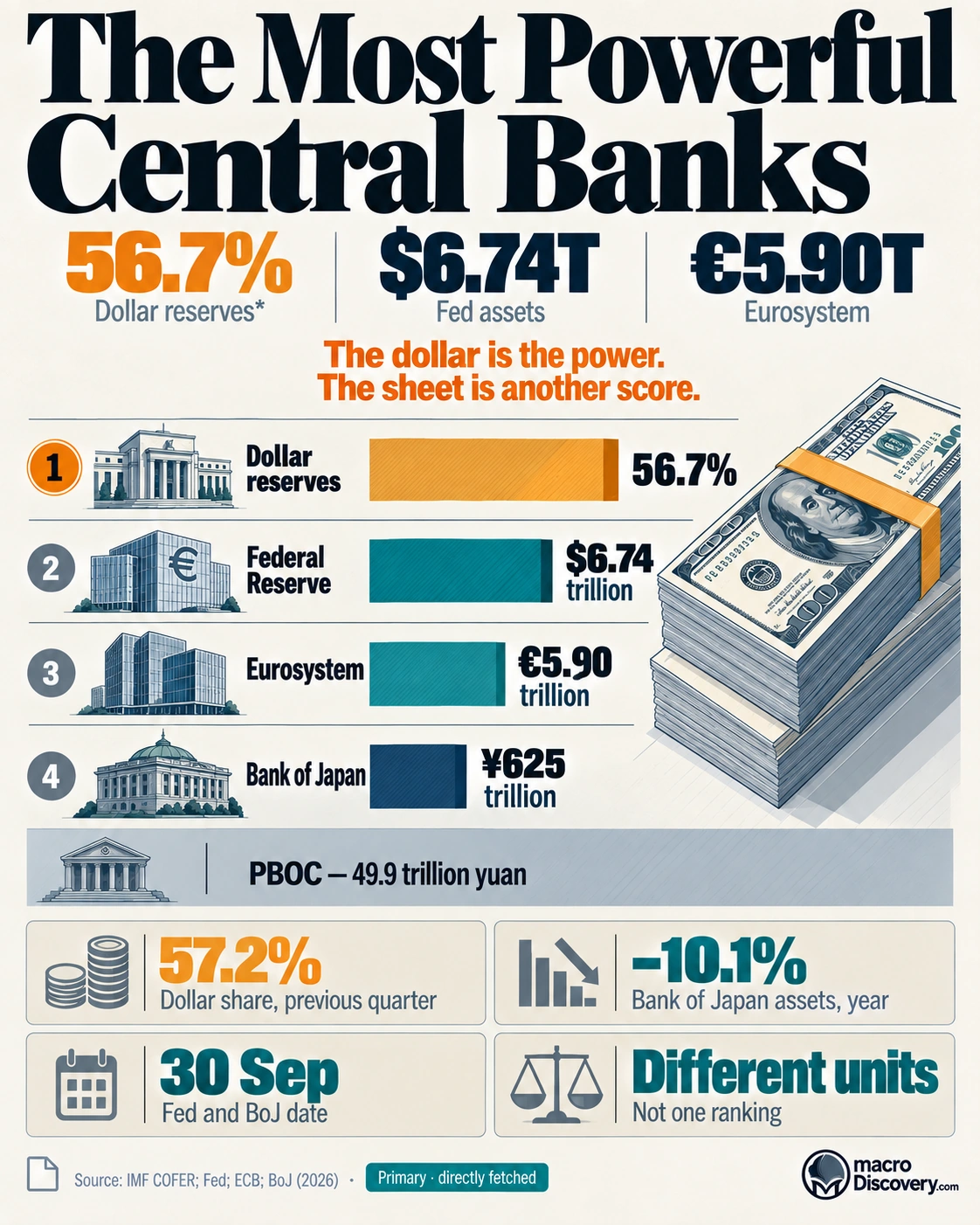
The Federal Reserve is third by balance sheet size — but first by global influence, because the dollar makes up 57.4% of all foreign exchange reserves on Earth. The ECB holds the world’s largest balance sheet at $7.13 trillion. The Bank of Japan just raised its rate to the highest level since 1995. The world’s central banks own $31.4 trillion in assets. Here is who holds the real monetary power.

By MacroDiscovery
Fed rate confirmed: 3.50–3.75% · July 30, 2026 · federalreserve.gov primary
Chair: Kevin Warsh · FOMC 9-3 hold · three dissenters wanted hikes
$31.4T
total global central bank assets · top 3 hold >50% · BIS Q3 2025
57.4%
of global FX reserves held in US dollars · IMF COFER Q3 2025 · down from ~70% in 2000
1,037T
tonnes of gold bought by central banks in 2024 · record · 2nd consecutive yr >1,000T
134
countries now exploring CBDCs · China’s e-CNY: ¥7T cumulative · Atlantic Council March 2026
Visualization 01 — The Power Matrix · Multi-Dimensional Ranking
Ranked: The World’s Most Powerful Central Banks

Power in central banking is multi-dimensional. Balance sheet size, currency dominance, policy reach, CBDC progress, and gold holdings all matter. A central bank that controls the world’s reserve currency outranks one with a larger balance sheet. Rankings below reflect overall monetary power, not just assets. Sources: Federal Reserve (primary · federalreserve.gov · July 29, 2026) · BIS Q3 2025 · IMF COFER Q3 2025 · World Gold Council 2024 · Atlantic Council CBDC Tracker March 2026 · FOMC Minutes June 2026.

# Central Bank Balance Sheet Policy Rate Currency Share CBDC Status
1
🇺🇸 Federal Reserve
United States · Chair: Kevin Warsh · Est. 1913
$6.59T
#3 by assets · BIS Q3 2025
3.50–3.75%
Held 9-3 · July 30 2026
57.4%
of global FX reserves
Research only
Dollar Dominant
2
🇪🇺 European Central Bank
20-nation Eurozone · President: Christine Lagarde · Est. 1998
$7.13T
#1 by assets · BIS Q3 2025
2.75%+
Hiking Jun 2026
~20%
of global FX reserves
Target: 2027-28
Multi-Nation
3
🇨🇳 People’s Bank of China
China · Governor: Pan Gongsheng · Est. 1948
$6.62T
#2 by assets · surpassed Fed 2024
3.10%
1-yr LPR · easing
~2.3%
of global FX reserves
e-CNY: ¥7T live
CBDC Leader
4
🇯🇵 Bank of Japan
Japan · Governor: Kazuo Ueda · Est. 1882
~$4.8T
>100% of Japan GDP
0.75%
Highest since Sep 1995
~5.8%
Yen share of reserves
Pilot phase
Historic Shift
5
🇬🇧 Bank of England
United Kingdom · Governor: Andrew Bailey · Est. 1694
~$1.1T
Post-QT reduction
3.75%
Highest G4 rate
~4.6%
Sterling share
Digital £ · design
Reserve Currency
6
🇨🇭 Swiss National Bank
Switzerland · President: Martin Schlegel · Est. 1907
~$850B
~120% of Swiss GDP
0.25%
Safe haven mandate
~2.4%
CHF share
wCBDC pilot
Safe Haven
Visualization 02 — The Rate Divergence Era · 2020 to 2026
From Zero to Divergence — How the World’s Central Banks Moved in and Out of Sync

For two years, every major central bank moved in the same direction. That era is over. Sources: Federal Reserve primary (federalreserve.gov · July 29, 2026) · ECB Statistical Data Warehouse · BOJ Monetary Policy Statements · maseconomics.com (April 2026) · statisticsoftheworld.com (June 2026).

2020–21
Zero
The Floor — Every Major Central Bank Near Zero. The Fed, ECB, BoJ and BoE All in Sync.
The pandemic sent every major central bank to the floor simultaneously. The Fed, ECB, Bank of England, and Bank of Japan all held rates near or at zero. The Bank of Japan had been there for two decades. The others were new to it. Central bank balance sheets exploded with emergency bond purchases. Total global central bank assets would peak above $31 trillion. The world had never seen coordinated monetary stimulus of this scale.
All G4 near zeroBalance sheets expandingCoordinated QE
2022–23
Hike
The Great Hiking Cycle — All G7 Economies Hit 40-Year Inflation Highs. All Hike Together. Except Japan.
Inflation hit 40-year highs across every G7 economy — peaking between 8% and 11% — driven by pandemic supply shocks, fiscal stimulus, and Russia’s energy war. The Fed hiked from near-zero to 5.25–5.50%, its fastest tightening cycle since the 1980s. The ECB, Bank of England, and Bank of Canada followed. One exception: the Bank of Japan held firm with negative rates, insisting Japan’s inflation was “transitory.” The divergence between BoJ and everyone else created the world’s largest carry trade since the 1990s.
Fed: 0% → 5.50%Inflation peaked 8-11%BoJ: held negative rates
2024–25
Cut
The Easing Cycle Begins — And Japan Finally Moves. The August 2024 Crash Signals Just How Much BoJ Matters.
The Fed began cutting in September 2024, trimming 175 basis points by end-2025. The ECB and Bank of England followed. Then in March 2024, the Bank of Japan made history: it ended its negative rate policy for the first time in eight years. It then raised to 0.50%, then to 0.75% by December 2025 — the highest rate since 1995. In August 2024, a surprise BoJ hike of just 25 basis points triggered a global equity flash crash as yen carry trades unwound. The message was clear: when the BoJ moves, the whole world feels it.
Fed: –175bps cut cycleBoJ ends negative ratesAug 2024: carry trade crash
Jun–Jul 2026
Diverge
The Hormuz Shock — Easing Consensus Shattered. ECB Hikes. Fed Paralysed. BoJ Still Tightening.
The Strait of Hormuz crisis pushed Brent crude above $125 per barrel and sent fertiliser prices up 80% year-on-year. The coordinated easing cycle that had defined monetary policy since mid-2024 was over. In June 2026, the ECB began hiking again. The Fed held at 3.50–3.75% in five consecutive meetings, with three of 12 FOMC members dissenting and wanting rate increases. New Fed Chair Kevin Warsh called inflation “a choice” and moved away from the forward guidance his predecessor had relied on. The most consequential monetary divergence since 2022 is now underway.
Hormuz: Brent >$125ECB hiking againFed 9-3 hold · 3 want hikesChair Warsh: new era
Aug 2026
Now
July 29, 2026: Fed Holds 3.50–3.75% for the Fifth Consecutive Meeting. Three Officials Wanted to Hike. Jackson Hole Next.
The FOMC voted 9-3 on July 29, 2026 to hold the federal funds rate at 3.50–3.75% — the first time since September 2016 that three policymakers dissented with a unified view on direction. Markets now price two 25-basis-point hikes in 2026, not cuts. Fed Chair Warsh is expected to speak at Jackson Hole in August. The next FOMC meeting is September 15–16. With inflation above 2% for five consecutive years, the question is not whether the Fed is done cutting — it may be whether it needs to hike again.
9-3 hold · July 29 2026Markets price 2 hikesJackson Hole: Aug 2026Next: Sept 15-16

Central bank power is not what it appears on a balance sheet. The Federal Reserve holds fewer assets than the ECB or the People’s Bank of China. But when the Fed sets its rate, mortgage payments change in São Paulo, bond yields shift in Seoul, and currencies reprice across Lagos. No other institution — public or private — moves more money with fewer words. That is what the dollar’s dominance actually means.

“Balance sheets built over 15 years cannot be unwound in 15 months.”

— BIS Annual Economic Report 2025 · Bank for International Settlements

The Bank of Japan’s Historic Shift — and Why It Shakes the Entire World

The Bank of Japan held rates near zero for over two decades. It experimented with negative rates from 2016 to 2024. It accumulated a balance sheet exceeding 100% of Japan’s GDP through relentless bond buying. During that time, global investors borrowed cheaply in yen and invested in higher-yielding assets everywhere else — a carry trade worth trillions. When the BoJ finally began raising rates in 2024, those trades began to unwind. In August 2024, a single 25-basis-point BoJ hike triggered a global equity flash crash in a single session. Japan’s central bank moves last — but when it moves, the entire world notices.

Why it matters: the BoJ is the world’s most systemically significant rate-setter relative to market impact per basis point — because decades of zero rates created a global carry trade that is still unwinding.
World Gold Council Annual Survey 2024 · Primary · Central Bank Gold Demand
1,037T
Central banks bought a record 1,037 tonnes of gold in 2024 — the second consecutive year above 1,000 tonnes. It is the clearest signal yet that reserve managers are quietly diversifying away from dollars.
The gold-buying trend is concentrated in emerging market central banks — China, Russia, India, Turkey, Poland, and others — that are actively reducing dollar exposure. The US still holds the world’s largest gold reserve at approximately 8,133 tonnes. But the pace of accumulation by others signals something structural: a slow, deliberate effort to reduce dependence on a reserve system built around a single country’s currency. Central banks are not abandoning the dollar. They are hedging it.
Source: World Gold Council — Annual Survey on Central Bank Gold Reserves 2024 (primary · gold.org · 1,037 tonnes · 2nd consecutive year >1,000T) · BIS Quarterly Review Dec 2025 (de-dollarisation context)

The CBDC Race — China’s Head Start, Europe’s Ambition, and America’s Constitutional Problem

Central bank digital currencies may be the biggest structural change to money since the end of the gold standard. China’s e-CNY is the most advanced major-economy CBDC in the world, having processed ¥7 trillion in cumulative transactions. The ECB is targeting a digital euro by 2027 to 2028. India and Brazil have active pilots. The United States Federal Reserve cannot issue a retail CBDC without Congressional authorisation — a political constraint that no other major central bank faces. The country that invented the financial internet may be the last to launch a digital currency. Whether that matters depends on whether CBDCs become a tool for undermining dollar dominance or simply a more efficient payment rail.

Why it matters: the CBDC race is not just about payment technology — it is about whether digital currencies can erode the dollar’s structural advantage by enabling trade settlement in alternative currencies without touching the US financial system.
Atlantic Council CBDC Tracker · March 2026 · PBoC Reports
¥7T
China’s e-CNY has processed ¥7 trillion in cumulative transactions — more than any other major-economy CBDC in the world. The ECB targets 2027–2028. The Fed needs an Act of Congress.
134 countries are now exploring central bank digital currencies, according to the Atlantic Council CBDC Tracker as of March 2026. Three have fully launched: the Bahamas Sand Dollar (2020), Nigeria’s eNaira (2021), and Jamaica’s JAM-DEX (2022). China’s e-CNY is live in dozens of cities and integrated into WeChat Pay and Alipay. In a world where 57.4% of reserves are in dollars, a successful digital yuan used in cross-border trade could eventually chip away at that dominance — not through confrontation, but through convenience.
Source: Atlantic Council CBDC Tracker (March 2026 · primary · atlanticcouncil.org/cbdctracker) · businesstats.com (March 14, 2026 citing Atlantic Council and PBoC) · Federal Reserve: “won’t issue retail CBDC without Congressional authorisation” (confirmed)
Key Numbers at a Glance
Gold · Central Bank Demand
1,037T
Tonnes of gold bought by central banks in 2024 — a record for the second consecutive year. Driven by EM reserve diversification away from dollars.
World Gold Council Annual Survey 2024
CBDC · China e-CNY
¥7T
Cumulative transactions processed by China’s e-CNY — the world’s most advanced major-economy CBDC. 134 countries now exploring digital currencies.
Atlantic Council CBDC Tracker Mar 2026
Fed · July 29, 2026
9-3
FOMC vote to hold at 3.50–3.75%. Three regional presidents dissented and wanted to hike — the most divided Fed since September 2016.
federalreserve.gov (primary · directly fetched)
Frequently Asked Questions
What is the most powerful central bank in the world?
The Federal Reserve — despite ranking third by balance sheet size. The US dollar accounts for 57.4% of all allocated global foreign exchange reserves (IMF COFER Q3 2025), giving the Fed unmatched global reach. Every Fed rate decision affects the cost of dollar-denominated debt held by governments, corporations, and households in 190 countries. The ECB holds the world’s largest balance sheet ($7.13T, BIS Q3 2025) but the Fed controls the world’s reserve currency.
What is the current Federal Reserve interest rate in 2026?
3.50–3.75% as of July 30, 2026 — confirmed by the Federal Reserve’s official Implementation Note (federalreserve.gov, July 29, 2026, directly fetched). The FOMC voted 9-3 to hold, with three regional bank presidents dissenting in favour of a hike — the most divided Fed since September 2016. This was the fifth consecutive meeting at this rate. The next decision is September 16, 2026. Fed Chair is Kevin Warsh.
Which central bank has the largest balance sheet?
The ECB (European Central Bank) holds the world’s largest consolidated central bank balance sheet at $7.13 trillion as of Q3 2025, according to BIS data. The People’s Bank of China is second at $6.62T, and the Federal Reserve is third at $6.59T. The top three together hold more than 50% of all global central bank assets. Total global central bank assets stand at $31.4 trillion.
Why did the Bank of Japan raising rates cause a stock market crash?
Because of the yen carry trade. For decades, investors borrowed in cheap yen (near-zero rates) and invested in higher-yielding assets globally — equities, bonds, currencies. When the Bank of Japan raised rates in August 2024, the yen strengthened and those trades unwound simultaneously. In a single session, global equities fell sharply as carry traders liquidated positions worldwide. It demonstrated that the BoJ — despite being only the world’s fourth-largest central bank by assets — has extraordinary systemic influence because of the scale of yen-funded positions built over 25 years.
Which country is leading in central bank digital currencies (CBDCs)?
China — the People’s Bank of China’s e-CNY has processed ¥7 trillion in cumulative transactions, making it the most advanced major-economy CBDC in the world. 134 countries are now exploring CBDCs (Atlantic Council CBDC Tracker, March 2026). The ECB targets a digital euro by 2027–2028. The United States Federal Reserve cannot issue a retail CBDC without Congressional authorisation — a legislative constraint that no other major central bank faces.
Sources
  • Federal Reserve — Implementation Note issued July 29, 2026 (PRIMARY · directly fetched · federalreserve.gov/newsevents/pressreleases/monetary20260729a1.htm · “Effective July 30, 2026, the FOMC directs the Desk to maintain the federal funds rate in a target range of 3-1/2 to 3-3/4 percent” · IORB: 3.65% · Primary credit rate: 3.75%)
  • FOMC Minutes — June 16-17, 2026 (PRIMARY · federalreserve.gov · “all members agreed to maintain the target range for the federal funds rate at 3-1/2 to 3-3/4 percent” · “inflation remained elevated relative to the Committee’s 2 percent goal” · Confirms no easing bias in June 2026 statement)
  • CNBC / Advisor Perspectives — July 29, 2026 FOMC recap (citing Fed primary · 9-3 vote · dissenters: Hammack, Kashkari, Logan · “fifth consecutive meeting” at this rate · markets price two 25bps hikes in 2026 · Fed Chair Kevin Warsh · first time since Sept 2016 that three dissented in a unified direction · next meeting Sept 15-16)
  • Bank for International Settlements (BIS) — Central Bank Assets Q3/Q4 2025 (PRIMARY · bis.org · cited by Voronoi/Visual Capitalist Jan 2026 · ECB/Eurosystem: $7.13T · PBoC: $6.62T · Fed: $6.59T · total global CB assets: $31.4T · “top 3 hold >50% of world’s CB assets” · “scale of central bank balance sheets remains historically high”)
  • IMF COFER — Currency Composition of Official Foreign Exchange Reserves Q3 2025 (PRIMARY · imf.org · USD: 57.4% of allocated reserves · Total global FX reserves: $12.4T · EUR: ~20% · CNY: ~2.3% · confirmed by businesstats.com March 14, 2026 citing IMF primary)
  • World Gold Council — Annual Survey on Central Bank Gold Demand 2024 (PRIMARY · gold.org · 1,037 tonnes purchased in 2024 · 2nd consecutive year >1,000T · US holds ~8,133 tonnes · EM central banks leading: China, India, Turkey, Poland)
  • Atlantic Council CBDC Tracker — March 2026 (PRIMARY · atlanticcouncil.org/cbdctracker · 134 countries exploring CBDCs · 3 fully launched: Bahamas Sand Dollar 2020, Nigeria eNaira 2021, Jamaica JAM-DEX 2022 · China e-CNY: ¥7T cumulative · ECB targets 2027-2028 · Fed: “won’t issue retail CBDC without Congressional authorisation”)
  • maseconomics.com — “Central Bank Divergence in 2026” (April 6, 2026 · citing ECB/Fed/BoJ primary sources · Fed cut 175bps total 2024-2025 · BoJ: 0.75% “highest since September 1995” · 8-1 March vote with Takata dissenting · “true dawn” of BoJ normalisation · 300bps spread BoE vs BoJ · G4 policy divergence analysis)
  • statisticsoftheworld.com — “Central Bank Super Week June 2026” (June 3, 2026 · citing Fed, ECB, BoJ, BoE primary sources · Hormuz crisis: Brent >$125/barrel · fertiliser +80% YoY · FAO food index highest since Feb 2023 · ECB hiking · Fed paralysed with 4-8 dissent in June · easing consensus shattered)
  • businesstats.com — “Central Banks Statistics & Facts 2026” (March 14, 2026 · citing ECB Statistical Data Warehouse, BOJ Accounts, BOE APF, IMF COFER Q3 2025, BIS Quarterly Review Dec 2025, World Gold Council 2024, Atlantic Council CBDC Tracker · policy rates as of March 2026: Fed 3.50-3.75%, ECB 2.75%, BOJ 0.75%, BOE 3.75%)
  • BIS — Annual Economic Report 2025 (PRIMARY · bis.org · verbatim: “Balance sheets built over 15 years cannot be unwound in 15 months” · QT timeline analysis · global monetary policy normalisation overview)
Macro Discovery

Sukh Dhaliwal

Sukh Dhaliwal is the founder of Macro Discovery, an independent digital publication covering AI, technology, science, future trends, and global innovation through visual storytelling and data-driven analysis.

Join WhatsApp

Join Now

Join Facebook

Follow us

Leave a Comment