Home AI Technology Gaming Future Automobile Geography Top 10 Trending How To Discover
---Advertisement---

Visualized: The Global Antibiotic Crisis

Macro Discovery
On: August 11, 2026 7:07 AM
Follow Us:
---Advertisement---
Global Antibiotic Crisis , What is antibiotic resistance and why is it a crisis? , How many people die from antibiotic resistance? , Which countries or regions have the worst antibiotic resistance? , Why are so few new antibiotics being developed? , What is being done to fight antibiotic resistance? , antibiotic resistance global crisis statistics deaths 2025 2026 WHO data , ow many people die from antibiotic resistant infections per year , antibiotic pipeline crisis why no new antibiotics being developed , what is the antibiotic resistance crisis and why is it so dangerous , how many people die from antibiotic resistance every year worldwide , which countries have the worst antibiotic resistance problem , why are pharmaceutical companies not developing new antibiotics 2026 , what will happen if antibiotic resistance is not stopped by 2050 ,
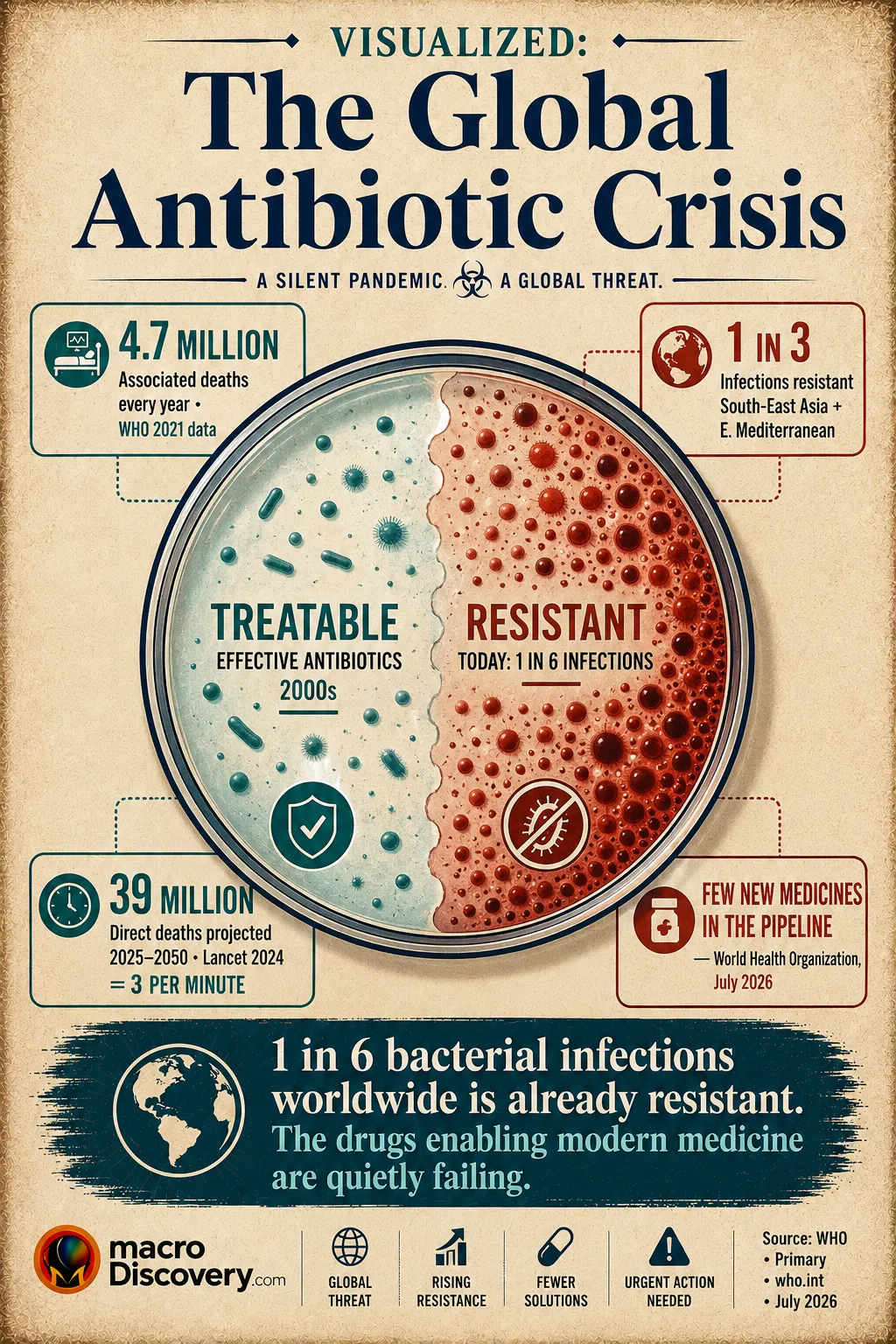
Premium editorial infographic showing
a flat-vector petri dish divided into
two zones: the left zone in clinical
teal represents treatable infections
(5 in 6 bacterial infections globally),
while the right zone fills progressively
with red dots representing resistant
infections — currently 1 in 6 globally
and 1 in 3 in South-East Asia and the
Eastern Mediterranean. Four callout
boxes surrounding the dish show the
key statistics: 4.7 million deaths
associated with AMR annually, 39 million
direct deaths projected 2025-2050
(3 per minute), and the WHO's July
2026 statement that "few new medicines"
are in the pipeline. Based on WHO
primary data (who.int, July 16, 2026)
and Lancet GRAM 2024. Part of
MacroDiscovery's "Visualized: The
Global Antibiotic Crisis."
Global Antibiotic Crisis
Visualized: The Global Antibiotic Crisis — MacroDiscovery
MacroDiscovery
Global Health · 5 min read · WHO July 2026 · GLASS 2025 · Lancet 2024 · Primary
WHO AMR Fact Sheet (Primary · who.int · directly fetched · July 16, 2026) · WHO GLASS Report 2025 · Lancet GRAM 2024 (Sep 28, 2024) · CGD Apr 2025 · WHO GAP-AMR 2026-2036 adopted May 25, 2026
Antimicrobial Resistance · Global Health Crisis

Visualized: The Global
Antibiotic Crisis

One in six bacterial infections worldwide is already resistant to antibiotics. The drugs that enable surgery, chemotherapy, and childbirth are losing their power — quietly, steadily, and faster than governments are responding. AMR kills more than one million people a year. By 2050, it will kill 39 million more. That is three deaths every minute.

By MacroDiscovery
Sources: WHO (primary · who.int · July 16, 2026) · WHO GLASS 2025 · Lancet GRAM 2024 · CGD Apr 2025
Policy: WHO GAP-AMR 2026–2036 adopted May 25, 2026
1 in 6
bacterial infections worldwide resistant to antibiotics · 2023 · WHO GLASS 2025 primary
>1M
die every year directly from AMR · “associated with 4.7M” in 2021 · WHO primary
39M
direct deaths projected from AMR 2025–2050 · = 3 per minute · Lancet GRAM 2024
$412B
cost to treat resistant infections by 2035 + $443B in productivity losses · WHO
Visualization 01 — The State of Resistance · 2023–2024
How Far Resistance Has Already Spread

Current antibiotic resistance prevalence and trends. Source: WHO AMR Fact Sheet (primary · who.int · directly fetched · July 16, 2026) citing WHO GLASS Global Antibiotic Resistance Surveillance Report 2025 (WHO primary · 23+ million bacteriologically confirmed cases · 110 countries reporting 2016–2023).
Crisis — alarm level
Warning — worsening rapidly
New policy response
Progress — children improving
🌍 Global bacterial infections resistant1 in 6 · 2023
WHO GLASS 2025 (primary): 1 in 6 laboratory-confirmed bacterial infections worldwide were resistant to antibiotics in 2023 · between 2018 and 2023, resistance rose in over 40% of monitored pathogen-antibiotic combinations · average annual increase of 5–15%
17%resistant · global
🇸🇦 South-East Asia & Eastern Mediterranean1 in 3 · worst region
WHO primary: resistance is highest in these two regions — 1 in 3 infections are resistant · double the global rate · lowest capacity to diagnose or treat resistant pathogens · drug-resistant E. coli and K. pneumoniae driving sepsis and organ failure
33%resistant · worst
💊 “Watch” antibiotics share of global useTarget failing
WHO primary (2022 data): “watch” antibiotics — those carrying higher risk of resistance — make up 45% of global human antibiotic use · exceeded 70% of use in nearly one-third of countries · global target: at least 70% of use should be “access” antibiotics by 2030
45% “watch”vs 30% target
🦠 Ciprofloxacin resistance · gonorrhoea75% resistance
WHO primary: ciprofloxacin resistance in gonorrhoea is very high at 75% globally · ceftriaxone resistance (last-resort) is rising in some regions · a sexually transmitted infection becoming untreatable in some settings
75%ciprofloxacin
🫁 Drug-resistant TB (MDR-TB) · new casesRising
WHO TB Report 2025: 3.2% of new TB cases had drug-resistant TB in 2024 · 16% of re-treatment cases · MDR-TB requires longer, more toxic, and more expensive regimens with lower cure rates
3.2% new16% re-treat
📋 WHO GAP-AMR 2026–2036 adoptedNew · May 2026
World Health Assembly adopted updated Global Action Plan on AMR on May 25, 2026 · target: 10% reduction in AMR-associated deaths in humans from 2019 baseline by 2030 · also aims to reduce agricultural antimicrobial use
−10%target by 2030
👶 AMR deaths in children under 5Down 50% since 1990
Lancet GRAM 2024: direct AMR deaths in children under 5 fell 50% between 1990 and 2021 · improved access to basic healthcare and vaccines driving this progress · BUT by 2050, 65.9% of AMR deaths will be in people aged 70+
−50%progress · under 5
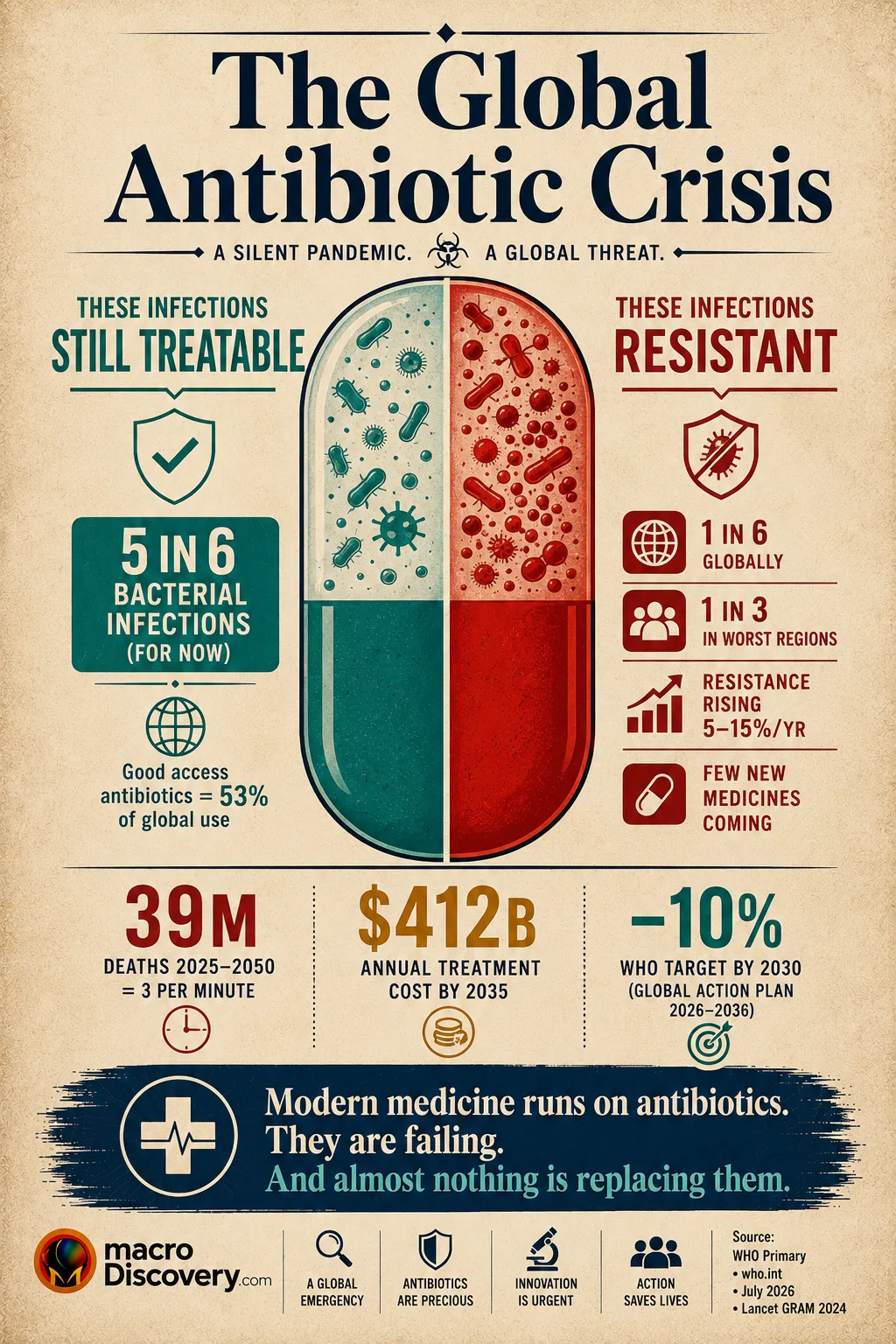
Premium editorial infographic showing a large flat-vector antibiotic capsule split vertically into two halves: the left half in clinical teal shows that 5 in 6 infections remain treatable (though only 53% of antibiotic use is the safer "access" class), while the right half in alarm red shows that 1 in 6 bacterial infections globally — and 1 in 3 in the worst regions — are now resistant, with resistance rising 5-15% per year. Below the capsule, three bold callouts show: 39 million deaths projected 2025-2050, $412 billion annual treatment cost by 2035, and the WHO Global Action Plan 2026-2036 target of 10% reduction in AMR deaths by 2030. Based on WHO primary data (who.int, July 2026). Global Antibiotic Crisis.
Global Antibiotic Crisis
Visualization 02 — The AMR Death Toll · 1990 to 2050
From a Background Threat to a Projected Catastrophe

The scale of AMR deaths has been consistently underestimated. Each new study has been worse than the one before. Source: Lancet GRAM 2024 (primary · directly cited by WHO · Sep 28, 2024 · 204 countries) · WHO fact sheet (primary · who.int · July 16, 2026).

1990–2010
Silent
AMR Deaths: Over 1 Million Per Year — Barely Measured
More than one million people died every year from 1990 onward from infections resistant to antibiotics. But the burden was not comprehensively measured. It was attributed to the underlying illness rather than to the resistance. Carbapenem resistance alone — the most dangerous category — grew from 127,000 deaths in 1990 to 216,000 by 2021. The problem was growing invisibly.
>1M deaths/year consistentlyLargely unmeasured
2019
Measured
Lancet 2022: 1.27 Million Direct Deaths in 2019 — Comparable to HIV and Malaria Combined
The 2022 Lancet study — the first comprehensive global measurement — found that in 2019, 1.27 million people died directly from drug-resistant bacterial infections. A further 4.95 million deaths were associated with AMR. 74.3% of those deaths were in low- and middle-income countries. The comparison to HIV and malaria made global headlines. The world began to take notice.
1.27M direct deaths (2019)= HIV + malaria combined74% in LMICs
2021
Updated
GRAM 2024: 1.14M Direct + 4.7M Associated Deaths in 2021 · Children Improving; Elderly Worsening
The updated GRAM study — cited by WHO as the primary reference — confirmed more than one million direct deaths and 4.7 million associated deaths in 2021. But the demographic story was striking: AMR deaths in children under 5 fell 50% since 1990. Among people over 70, they rose by more than 80%. As populations age, AMR is becoming an old-age crisis at accelerating speed.
1.14M direct · 4.7M associatedUnder 5: –50% ✓Over 70: +80% ↑
2023–2026
Accelerating
WHO GLASS 2025: 1 in 6 Infections Now Resistant · Resistance Rising 5–15% Per Year in Most Combinations
The WHO GLASS 2025 report — the most comprehensive global surveillance dataset — found that by 2023, one in six bacterial infections worldwide was resistant to antibiotics. In South-East Asia and the Eastern Mediterranean, the figure was one in three. Between 2018 and 2023, resistance rose in over 40% of pathogen-antibiotic combinations at 5–15% per year. Only 53% of antibiotic use globally is “access” class — well below the 70% target for 2030.
1 in 6 globally · 1 in 3 worst regionsResistance: +5-15%/yrOnly 53% access antibiotics
2025–2050
Projection
39 Million Direct Deaths Projected — 3 Per Minute — If Current Trends Continue
The Lancet GRAM 2024 study — covering 204 countries — projected 39 million direct AMR deaths and 169 million associated deaths between 2025 and 2050 if current trends continue. By 2050, 1.91 million people will die every year directly from drug resistance — a 67.5% increase from 2021. South Asia and Latin America face the worst projections. But 92 million of those deaths could be prevented with better care and new antibiotics.
39M direct deaths 2025-20503 per minute92M preventable with action

Antibiotics are the infrastructure of modern medicine. Without them, routine surgery carries lethal infection risk. Chemotherapy cannot proceed. Childbirth becomes dangerous again. Organ transplants fail. The drugs that made the 20th century’s greatest medical achievements possible are losing their power — and almost nothing is replacing them. That is what the global antibiotic resistance crisis actually means.

WHO AMR Fact Sheet · Primary · who.int · Directly Fetched · July 16, 2026
1 in 6
Approximately 1 in 6 laboratory-confirmed bacterial infections worldwide were resistant to antibiotics in 2023. In South-East Asia and the Eastern Mediterranean, it is 1 in 3.
Between 2018 and 2023, antibiotic resistance rose in over 40% of the pathogen-antibiotic combinations monitored globally, at an average annual increase of 5–15%. Drug-resistant gram-negative bacteria — especially E. coli and K. pneumoniae — are becoming more dangerous worldwide, driving sepsis and organ failure in countries least equipped to respond.
Source: WHO AMR Fact Sheet (primary · directly fetched · who.int · July 16, 2026) citing WHO GLASS Global Antibiotic Resistance Surveillance Report 2025 (primary · 23+ million bacteriologically confirmed cases · 110 countries reporting)

“The world faces an antimicrobial research and development crisis, with few new medicines in the pipeline.”

— World Health Organization, AMR Fact Sheet · July 16, 2026

The Pipeline Crisis — We Are Running Out of Antibiotics and Not Making New Ones

Here is the core structural problem. Bacteria evolve resistance to every antibiotic eventually. That has always been true. What changed is that the pharmaceutical pipeline — the process of discovering and developing new antibiotics — has nearly stopped. Since 2017, public and philanthropic investment in AMR R&D has reached $13.75 billion annually. But experts say an additional $250–400 million per year is needed just to sustain development. The financial returns on antibiotics are too low to attract private investment. New antibiotics are used sparingly to preserve them — which makes them commercially unattractive. The result: fewer treatments for more resistant infections.

Why it matters: every decade without new antibiotics means resistance outpaces our ability to treat it — and the infections that become untreatable first will not be rare ones. They will be the common ones.
WHO · Lancet GRAM 2024 · IHME/WOAH Sep 2024 · CGD Apr 2025
39M
The Lancet projects 39 million direct deaths from antibiotic resistance between 2025 and 2050 — three per minute. Without action, annual deaths will rise 67.5% by 2050.
The same study found 92 million of those deaths are preventable with better healthcare access, infection prevention, and new antibiotics. Investing in action returns $28 for every $1 spent (IHME/WOAH 2024). If global GDP losses from AMR reach $1.7 trillion annually by 2050, the cost of inaction will dwarf the cost of prevention by a factor of hundreds.
Source: GBD 2021 Antimicrobial Resistance Collaborators — “Global burden of bacterial AMR 1990–2021: systematic analysis with forecasts to 2050” (Lancet, September 28, 2024 · 204 countries · directly cited by WHO primary) · IHME/WOAH EcoAMR Series (September 2024) · CGD “Forecasting the Fallout from AMR” (April 2025)

The Economics of Doing Nothing

Treating drug-resistant infections already costs $66 billion globally per year. Without action, the WHO projects that cost will reach $412 billion annually just for treatment by 2035 — plus an additional $443 billion in lost productivity. If resistance spreads from livestock to humans at scale, it could cost up to $5.2 trillion more. By 2050, annual global GDP losses could reach $1.7 trillion. And it could jeopardise the food security of more than 2 billion people. The economics of the antibiotic crisis are not uncertain. Every year of inaction makes the eventual cost larger.

Why it matters: AMR is not a future health crisis with future costs — it has present costs that are accelerating, and every year the pipeline stays dry, the bill grows.
WHO Global Action Plan 2026–2036 · Adopted May 25, 2026
−10%
The World Health Assembly adopted the updated Global Action Plan on AMR (2026–2036) on May 25, 2026 — targeting a 10% reduction in AMR-associated deaths from the 2019 baseline by 2030.
The target of 10% reduction by 2030 is the floor, not the ceiling. It also aims to reduce antimicrobial use in agriculture, minimise environmental pollution from resistant microbes, and improve equitable access to antibiotics where they are needed. With $28 in return for every $1 invested, the economic case for aggressive action has never been clearer — but governments are moving far slower than the bacteria.
Source: WHO — “The World Health Assembly adopts updated Global Action Plan on Antimicrobial Resistance (2026–2036)” (primary · who.int · May 25, 2026) · WHO AMR Fact Sheet (primary · directly fetched · July 16, 2026)
Key Numbers at a Glance
Global · Now
1 in 6
Bacterial infections worldwide resistant to antibiotics in 2023. In SE Asia and the Eastern Mediterranean: 1 in 3.
WHO GLASS 2025 (primary · who.int)
Deaths · Projected
39M
Direct deaths from AMR projected between 2025 and 2050 — 3 per minute. 92 million could be prevented with action.
Lancet GRAM 2024 (primary · cited WHO)
Economy · 2035
$412B
Annual cost to treat resistant infections by 2035 — plus $443B more in productivity losses per year. $66B today.
WHO citing OECD (primary · who.int · July 2026)
Policy · Target
−10%
Target reduction in AMR-associated deaths by 2030 — set by the WHO Global Action Plan 2026–2036, adopted May 25, 2026.
WHO GAP-AMR 2026-2036 (primary · May 25, 2026)
Frequently Asked Questions
What is antibiotic resistance and why is it a crisis?
Antibiotic resistance occurs when bacteria evolve to survive the drugs designed to kill them. When this happens, infections become harder or impossible to treat. In 2023, 1 in 6 bacterial infections worldwide was resistant to antibiotics. AMR is already associated with more than 4.7 million deaths annually. The WHO calls it “a major global health threat.” Source: WHO AMR Fact Sheet (primary · who.int · July 16, 2026).
How many people die from antibiotic resistance?
More than 1 million people die directly from drug-resistant bacterial infections every year. In 2021, bacterial AMR was associated with 4.7 million deaths globally, according to the GBD 2021 study cited by WHO as the primary reference. The Lancet GRAM 2024 projects 39 million direct deaths between 2025 and 2050 — three per minute — if current trends continue. Source: WHO primary (who.int · July 16, 2026) · Lancet Sep 28, 2024.
Which countries or regions have the worst antibiotic resistance?
South-East Asia and the Eastern Mediterranean have the highest rates — where 1 in 3 reported infections are resistant, double the global average of 1 in 6. These regions also have the lowest capacity to diagnose and treat resistant pathogens. By 2050, South Asia and Latin America are projected to have the highest AMR mortality rates. Source: WHO AMR Fact Sheet (primary · who.int · July 16, 2026) citing WHO GLASS 2025.
Why are so few new antibiotics being developed?
The financial incentives are broken. New antibiotics are used sparingly to preserve effectiveness — which makes them commercially unattractive to develop. Since 2017, $13.75 billion per year has been invested in AMR R&D, but experts say an additional $250–400 million per year is still needed. The WHO calls the pipeline situation “a research and development crisis, with few new medicines in the pipeline.” Source: WHO AMR Fact Sheet (primary · July 16, 2026) · WHO/G7 Pipeline Report (October 2024).
What is being done to fight antibiotic resistance?
The World Health Assembly adopted the updated Global Action Plan on AMR (GAP-AMR 2026–2036) on May 25, 2026, targeting a 10% reduction in AMR-associated deaths from the 2019 baseline by 2030. It also aims to reduce agricultural antibiotic use, improve access to effective antibiotics, and fund new drug development. The IHME/WOAH found that for every $1 invested in action, $28 is returned in economic benefit. Source: WHO primary (who.int · May 25, 2026 and July 16, 2026).
Sources
  • WHO — “Antimicrobial resistance” Fact Sheet (PRIMARY · directly fetched · who.int/news-room/fact-sheets/detail/antimicrobial-resistance · July 16, 2026 · “Bacterial AMR was estimated to be associated with more than 4.7 million deaths globally in 2021” · “approximately 1 in 6 laboratory-confirmed bacterial infections worldwide were resistant to antibiotics in 2023” · “world faces an antimicrobial research and development crisis, with few new medicines in the pipeline” · “$412 billion annually up to 2035, with additional productivity losses of $443 billion per year” · 1 in 3 in SE Asia + E. Mediterranean · 40%+ combinations rising at 5-15%/yr · only 53% access antibiotics used · ciprofloxacin resistance 75% gonorrhoea · MDR-TB 3.2% new / 16% re-treatment · GAP-AMR 2026-2036 adopted May 25, 2026)
  • GBD 2021 Antimicrobial Resistance Collaborators — “Global burden of bacterial antimicrobial resistance 1990–2021: a systematic analysis with forecasts to 2050” (PRIMARY · The Lancet, September 28, 2024, Vol 404(10459):1199-1226 · GRAM Project / IHME / Wellcome Trust · directly cited by WHO primary · 204 countries and territories · 1.14M direct deaths in 2021 · 4.71M associated deaths in 2021 · 39M direct deaths 2025-2050 = 3/minute · 169M associated 2025-2050 · 1.91M/year by 2050 (+67.5%) · children under 5: -50% · people 70+: +80% · 92M preventable with action · South Asia + Latin America highest by 2050)
  • WHO GLASS — “Global antibiotic resistance surveillance report 2025” (PRIMARY · who.int/publications/i/item/9789240116337 · 23+ million bacteriologically confirmed cases · 110 countries reporting 2016-2023 · 104 countries reporting 2023 · 1 in 6 infections resistant globally 2023 · adjusted global/regional estimates for 93 infection type-pathogen-antibiotic combinations)
  • WHO — “Global Action Plan on Antimicrobial Resistance (GAP-AMR) 2026–2036” adopted May 25, 2026 (PRIMARY · who.int/news/item/25-05-2026 · World Health Assembly · target: 10% reduction in bacterial AMR-associated deaths from 2019 baseline by 2030 · Six strategic objectives including surveillance, prevention, access, R&D, governance)
  • IHME / WOAH — EcoAMR Series “Health and Economic Impacts of AMR in Human and Food-Producing Animals” (PRIMARY · healthdata.org · September 25, 2024 · 204 countries · $1.7 trillion annual GDP losses by 2050 · food security: >2 billion at risk · $5.2 trillion livestock-to-human resistance cost · $28 return per $1 invested · 30% livestock reduction = $120B GDP gain · 110M deaths preventable)
  • CGD — “Forecasting the Fallout from AMR: Economic Impacts of Antimicrobial Resistance in Humans” (PRIMARY · cgdev.org · April 2025 · $66B/year current direct healthcare costs · rising to $159B/year by 2050 without action · $3.3B per new antibiotic · 10 needed per decade · $2.2B/year additional R&D needed · costs = 0.0036% of GDP for high-income countries)
  • WHO / Global AMR R&D Hub — “G7 Report on Antibiotic Pipeline” (PRIMARY · who.int/news/item/14-10-2024 · October 14, 2024 · since 2017: $13.75B/year invested · additional $250-400M/year needed · pipeline “sparse, with lengthy and costly development and little innovation”)
  • Lancet 2022 — Murray et al. “Global burden of bacterial antimicrobial resistance in 2019: a systematic analysis” (foundational primary study · Lancet Feb 12, 2022 · 1.27M direct AMR deaths in 2019 · 4.95M associated · 74.3% in LMICs · comparable to HIV/AIDS + malaria combined)
Macro Discovery

Sukh Dhaliwal

Sukh Dhaliwal is the founder of Macro Discovery, an independent digital publication covering AI, technology, science, future trends, and global innovation through visual storytelling and data-driven analysis.

Join WhatsApp

Join Now

Join Facebook

Follow us

Leave a Comment