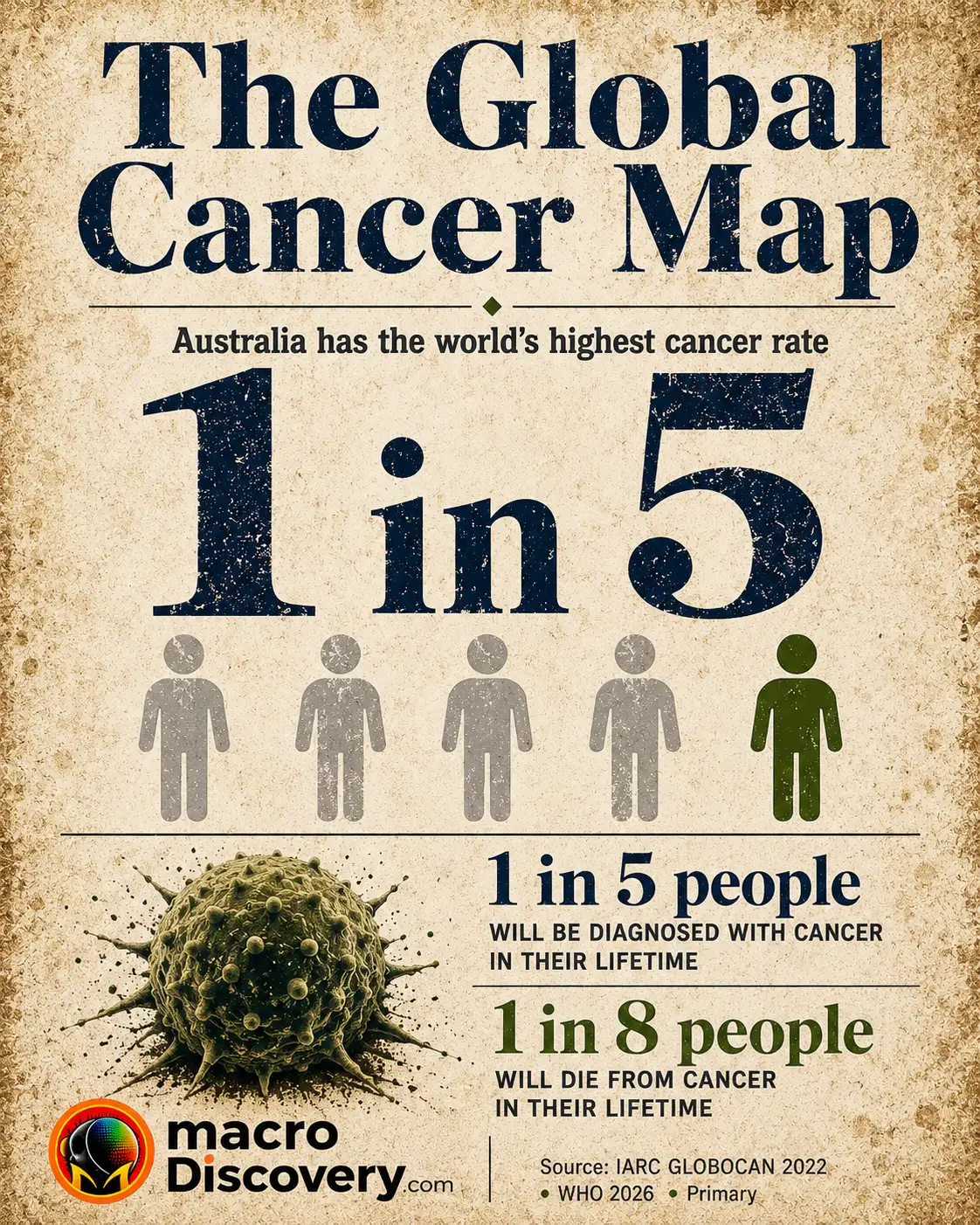
The Global Cancer Map —
Incidence, Survival, and Geography
Almost 20 million people were diagnosed with cancer in 2022 — and 9.7 million died from it. Australia has the world’s highest cancer incidence rate per capita, not because it has poor healthcare but because it has an aging population, extreme UV exposure, and screening systems that find what other countries miss. Meanwhile, a woman in a low-income country is more likely to die of breast cancer despite being less likely to be diagnosed with it. The geography of cancer is a mirror of global inequality — in both detection and survival.
| Cancer / Category | Global scale (2022) | Key geography | Notable pattern |
|---|---|---|---|
| 💥 Lung cancer | 2.5M cases 12.4% of all cancers |
Highest in Eastern Asia, Eastern Europe. #1 in 33 countries for men. Highest national rate: Türkiye (men). | ▲ Leading cause of death (18.7%) |
| 💉 Breast cancer | ~2.3M cases 11.6% of all cancers |
Most common in women in 158 countries. 70% of deaths in LMICs. In high-HDI: 1 in 12 diagnosed, 1 in 71 die. Low-HDI: 1 in 27 diagnosed, 1 in 48 die. | Survival gap: >85% vs <45% by income |
| 🧟 Colorectal cancer | ~1.9M cases 9.6% / #2 cause of death |
Higher rates in Northern and Western Europe, Australia, New Zealand. Rising rapidly in Eastern Europe. Diet, sedentary lifestyle, obesity as drivers. | Rising in emerging economies |
| 🌜 Melanoma (skin) | ~332K cases Worldwide (GLOBOCAN 2022) |
Australia: 36.6–37/100K ASR — world’s highest. 2–3× higher than Canada, US, UK. Queensland: ~64.3/100K (highest state). 2 in 3 Australians diagnosed with skin cancer before age 70. | 🇦🇺 Australia: world #1 |
| 📈 Overall incidence rate | Highest: Australia ASR globally |
Australia, New Zealand, Ireland, US, Canada have highest overall cancer incidence rates. Sub-Saharan Africa (except South Africa) has the lowest. Rates lowest in low-income countries partly due to under-detection and early death from other causes. | High incidence = wealth + detection |
| 🇮🇳 India exception | Oral cancers #1 cause of cancer death |
India stands out globally: oral cancers are the leading cause of cancer death, driven by tobacco use including smokeless tobacco (gutka, paan). Unique cancer profile distinct from all other major countries. | Tobacco/smokeless tobacco driven |
Source: GLOBOCAN 2022, IARC (Bray F et al., primary, doi:10.3322/caac.21834, April 2024). Australia melanoma: IARC estimate via Cancer Council Australia (cancer.org.au). Breast cancer survival gap: WHO (July 8–10, 2026, Nature Medicine & Euronews). India oral cancer: UICC citing GLOBOCAN 2022.
Why Does Australia Have the World’s Highest Cancer Rate?
Australia’s world-leading cancer incidence is the product of three simultaneous forces. First, UV radiation: Australia sits beneath one of the world’s largest ozone gaps and has a predominantly fair-skinned European-descended population that evolved under far weaker sun. The result is a melanoma rate of 36.6 per 100,000 — the world’s highest — two to three times higher than rates in Canada, the US, or the UK. Second, demographics: an aging population means more people reach the ages where cancer most commonly strikes. Third, and critically, excellent screening systems find cancers that less well-resourced systems miss. Australia’s high incidence rate is partly a success story in detection.
Why it matters: a country’s cancer incidence rate reflects its healthcare system’s ability to find cancer as much as cancer’s actual prevalence.
Why High Cancer Incidence Is Often a Sign of Wealth, Not Poverty
The counterintuitive truth in the GLOBOCAN 2022 data is that high cancer incidence rates are concentrated in wealthy countries — Australia, New Zealand, Ireland, the US — while the lowest reported rates are in sub-Saharan Africa and South Asia. This does not mean affluent populations are sicker. It means three things: richer countries have older populations (age is the single largest cancer risk factor); they have screening programmes that detect cancers that would go unfound elsewhere; and in low-income countries, many people die of infectious diseases, malnutrition, or complications of childbirth before reaching cancer-prone ages. Low reported incidence in poor countries conceals enormous undiagnosed burden, not better health.
Why it matters: comparing cancer rates between rich and poor countries without accounting for detection capacity and population age produces deeply misleading conclusions.
Why the Same Cancer Kills Far More in a Poor Country Than a Rich One
The survival gap is the sharpest measure of global cancer inequality. Five-year survival rates for breast cancer and childhood cancer exceed 85% in high-income countries but fall below 45% in low-income ones (WHO, July 2026). A woman in a low-HDI country is less likely to be diagnosed with breast cancer — only 1 in 27 versus 1 in 12 in high-HDI countries — yet far more likely to die from it: 1 in 48 versus 1 in 71. The mechanism is late diagnosis: screening is absent, symptoms are ignored or misattributed, and by the time cancer is confirmed it has often spread beyond the point where treatment can succeed. Cervical cancer is almost entirely preventable and treatable — yet it kills overwhelmingly in low-income countries.
This is a pattern GLOBOCAN data makes visible: different countries have different cancer profiles driven by different dominant risk factors. The global pattern — lung cancer as the leading cause in most countries — is driven by tobacco combustion. But tobacco use takes different forms in different cultures, with radically different cancer consequences. Where smoking dominates: lung cancer dominates. Where smokeless tobacco dominates: oral cancer dominates. Where obesity, sedentary lifestyle, and processed food dominate: colorectal and breast cancer rise. Cancer geography is risk-factor geography.
Source: GLOBOCAN 2022 (IARC, primary) · UICC · Cancer Council Australia.
Why it matters: the survival gap between rich and poor countries is not a gap in biology — it is a gap in screening, early diagnosis, and access to treatment.
What Does the Cancer Burden Look Like by 2050 — and Where Is It Growing?
Cancer epidemiologist Freddie Bray — Head of the Cancer Surveillance Branch at IARC and lead author of GLOBOCAN 2022 — and his team project that new cancer cases will reach 35 million annually by 2050, up from 20 million in 2022. The growth is not evenly distributed. Low-HDI countries face a projected 96% increase in cancer cases by 2040 compared to 32% in very-high-HDI countries (WCRF, citing GLOBOCAN data). Cancer mortality in low-income countries will increase 98.4% by 2040. This is driven by population growth, urbanisation, adoption of Western diets and sedentary lifestyles, and ageing — without the screening infrastructure that makes cancer survivable in wealthy nations. The 2022 WHO survey found only 39% of countries covered basic cancer management in their national health benefit packages.
Why it matters: the cancer crisis of 2050 will not be in Australia or the US — it will be in countries that will face it with the least capacity to respond.
- Nearly 20 million new cancer cases were diagnosed globally in 2022, with 9.7 million deaths — projected to reach 35 million new cases by 2050 (GLOBOCAN 2022, IARC primary).
- Lung cancer is the world’s most common cancer (12.4% of all cases, 2.5 million) and the leading cause of cancer death (18.7%).
- Australia has the world’s highest melanoma rate at 36.6–37 per 100,000 — two to three times higher than the US, Canada, or UK.
- High cancer incidence is partly a detection story: wealthy countries with strong screening systems find more cancers, not just more cancer.
- Five-year breast cancer survival exceeds 85% in high-income countries but falls below 45% in low-income countries (WHO, July 2026).
- India is the only major country where oral cancer is the #1 cause of cancer death, driven by widespread smokeless tobacco use.
- Low-income countries face a 96% increase in cancer cases by 2040 — nearly triple the 32% rise projected for high-income nations.
Australia’s world-leading cancer rate is not a failure — it is a consequence of longevity, sunlight, and the ability to detect what other countries miss. The real cancer crisis is not where the incidence rates are highest. It is where they are hidden: in countries where most cancers are never diagnosed, where treatment is unavailable, and where the same diseases that are survivable in Sydney or Stockholm are death sentences in Kinshasa or Dhaka. By 2050, the global cancer burden will be 75% larger. Nearly all of that growth lands where detection systems are weakest.
- Bray F, Laversanne M, Sung H, Ferlay J, Siegel RL, Soerjomataram I, Jemal A — “Global cancer statistics 2022: GLOBOCAN estimates of incidence and mortality worldwide for 36 cancers in 185 countries” (primary · CA: A Cancer Journal for Clinicians · April 4, 2024 · doi:10.3322/caac.21834 · ~20M new cases · 9.7M deaths · 1 in 5 lifetime risk · lung #1 at 12.4% · 35M by 2050 · India oral cancer exception)
- IARC — “New report on global cancer burden in 2022 by world region and human development level” (primary · directly fetched · iarc.who.int · April 2024 · GLOBOCAN 2022 · 185 countries · 36 cancer types · Freddie Bray, Head, Cancer Surveillance Branch, IARC, lead author)
- Cancer Council Australia — Skin Cancer Incidence and Mortality (primary · cancer.org.au · “IARC estimates that in 2020, Australia had the highest age-standardised melanoma incidence rate (36.6 per 100,000, standardised to World Standard Population)” · “equal 6th highest mortality rate (2.4 per 100,000)” · 2–3× higher than Canada, US, UK · 2/3 Australians diagnosed skin cancer before age 70)
- WHO — “First global breast cancer survival estimates show wide regional and income disparities” (primary · July 8, 2026 · Nature Medicine · high-HDI: 1 in 12 diagnosed / 1 in 71 die · low-HDI: 1 in 27 diagnosed / 1 in 48 die · 70% breast cancer deaths in LMICs · 8M women living with breast cancer mostly in high-income countries)
- Euronews citing WHO — “Cancer cases to soar by 2050 amid deep global inequalities, WHO warns” (July 10, 2026 · “5-year survival for breast and childhood cancer is over 85% in high-income countries but drops below 45% in low-income countries” · 20.6M cases in 2024 · cancer #2 cause of death globally · only 39% of countries cover cancer basics in health benefit packages)
- World Cancer Research Fund — “Differences in Cancer Incidence and Mortality Across the Globe” (citing GLOBOCAN · low-HDI countries: 96% increase in cases by 2040 vs 32.2% in very high HDI · mortality in LMICs: +98.4% vs +42.5% in very high HDI · age the most significant risk factor)
- IARC — Cancer Today / GLOBOCAN Database (primary · gco.iarc.who.int/today · 185 countries · 36 cancer types by sex and age group · GLOBOCAN 2022 estimates · interactive tools for maps and visualizations)