The Future of Electric Vehicles —
Who Is Leading the Global Transition
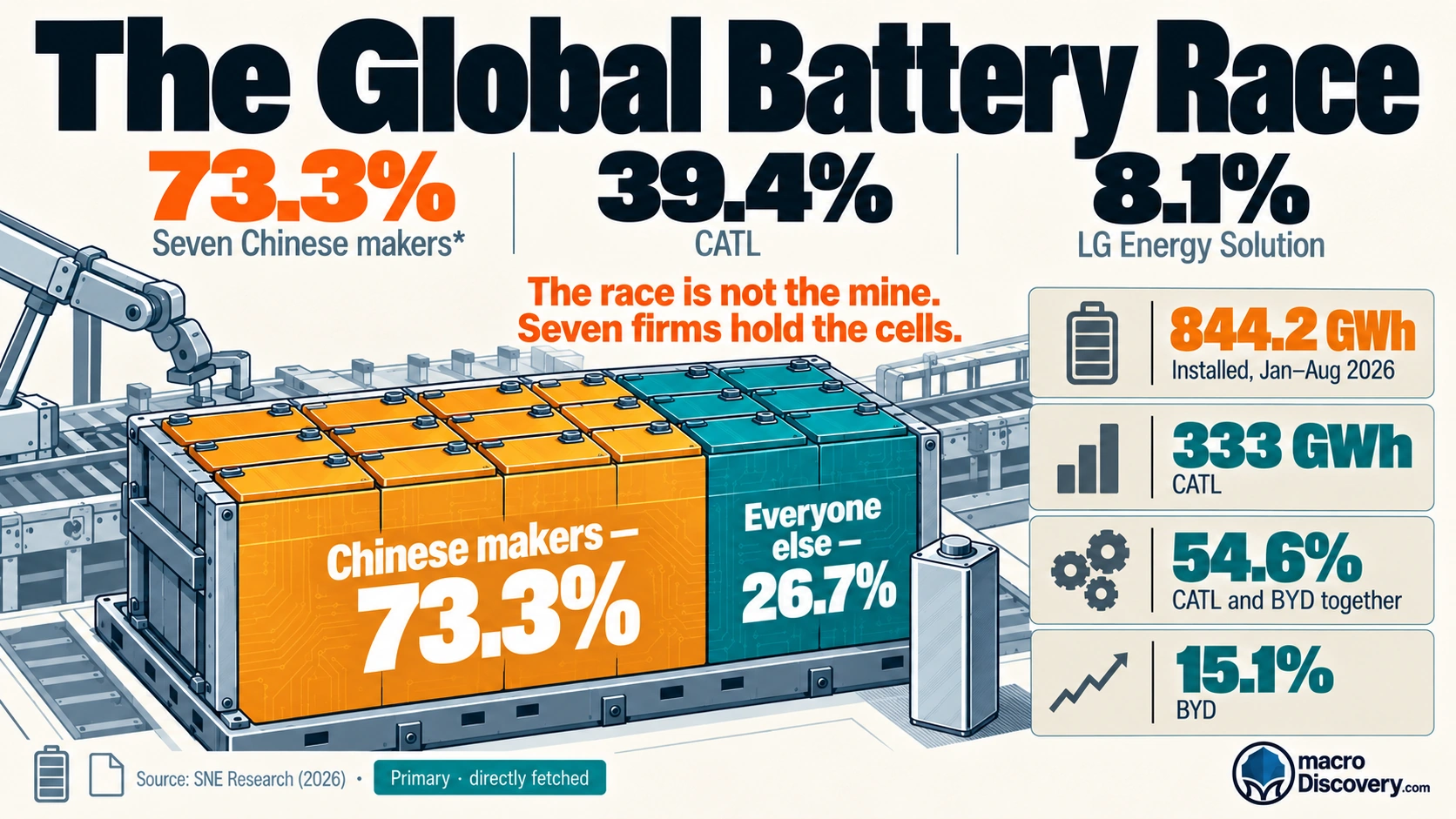
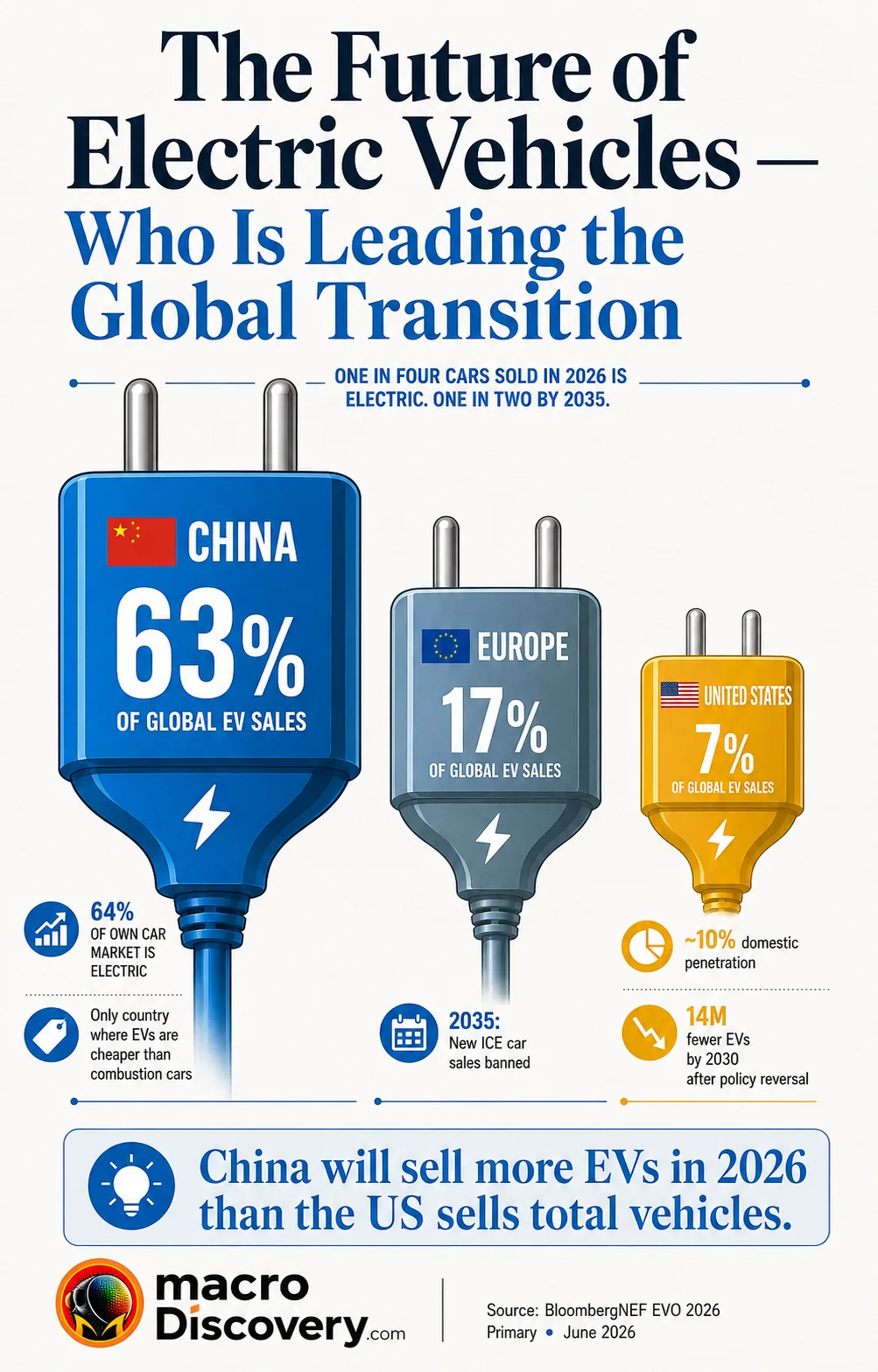
China sells 63% of the world’s electric vehicles. Europe is second at 17%. The United States — home to Tesla — is third at just 7%. One in four cars sold globally in 2026 is electric. But this is as much a story about battery chemistry and supply chains as it is about cars: China controls approximately 75% of global battery cell manufacturing, and its battery packs cost 44% less than those made in North America.
| Country / Region | Global EV share | Domestic EV penetration | Scale | Direction |
|---|---|---|---|---|
| 🇨🇳 China | 63% | 64% of domestic sales | ▲ Dominant | |
| 🇪🇺 Europe | 17% | ~25% of domestic sales | ▲ Growing | |
| 🇺🇸 United States | 7% | ~10% of domestic sales | ▼ Policy reversal | |
| 🇳🇴 Norway | ~1% | 95.9% of domestic sales | ▲ Mission complete | |
| 🇸🇬 Singapore | Small market | ~50% of domestic sales | ▲ Rising fast | |
| 🇹🇭 Thailand | Emerging market | 27% of domestic sales | ▲ Chinese-led |
Sources: China 63% global share and 64% domestic: BNEF EVO 2026 (primary, directly fetched, June 16, 2026). Europe 17%, US 7%: BNEF EVO 2025 (primary, June 18, 2025). US domestic ~10%: IEA Global EV Outlook 2025 (primary). Norway 95.9%: CAAM/SQMagazine citing IEA (January 2026). Singapore ~50%, Thailand 27%: BNEF EVO 2026 (primary).
Why China Sells 63% of the World’s Electric Vehicles
China’s EV dominance is structural, not accidental. The government has subsidised electric vehicles, built charging infrastructure, and mandated EV production quotas since 2009. BYD — now the world’s largest EV manufacturer by sales volume — sold over 4 million vehicles in 2024 alone. China is the only large market where an EV is, on average, already cheaper to buy than a comparable combustion car (BNEF EVO 2026, primary). Battery pack prices in China sit at approximately $84 per kWh — 44% below North American levels. By 2026, China will sell more electric vehicles than the United States sells total vehicles of any kind.
Why it matters: China’s price advantage in EVs is now structural, not temporary — built on a decade of manufacturing scale, not just subsidies.
Why the Battery Is the Real Story — and Why China Controls It
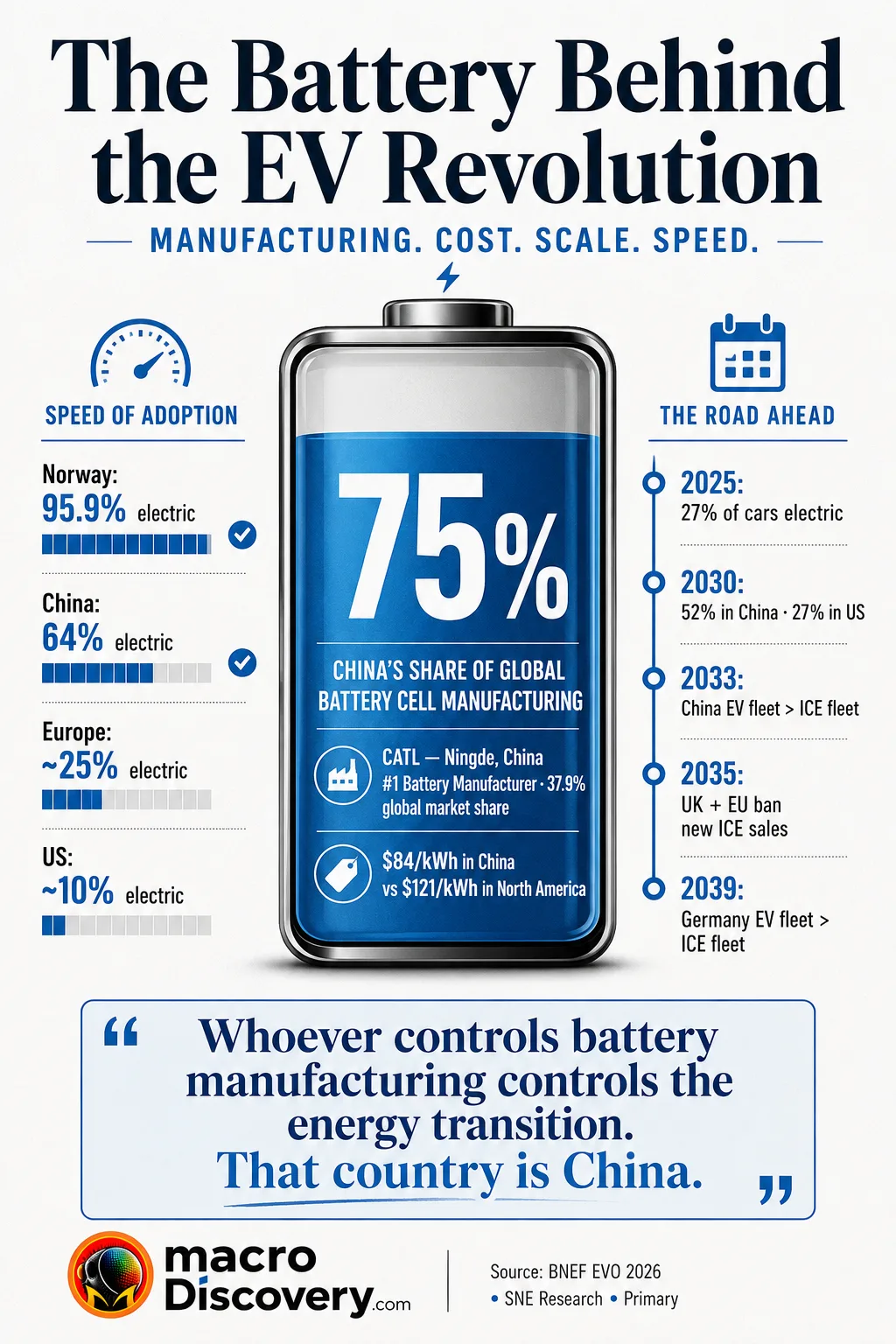
The EV transition is a battery transition. Whoever controls battery manufacturing controls the shift away from oil. CATL — Contemporary Amperex Technology Co., Limited, headquartered in Ningde, Fujian province, China — is the world’s largest battery manufacturer, holding approximately 37.9% of the global EV battery market in 2024 (SNE Research via CnEVPost). Six Chinese companies together account for 68.9% of all EV battery installations worldwide. China supplies approximately 75% of global lithium-ion cell output and 85% of anode material processing capacity. The global average battery pack price fell to $108 per kWh in 2025 — below the $100/kWh threshold widely considered the crossover point for EV-ICE price parity in mainstream markets.
Why it matters: the country that builds the battery wins the transition — and that country, right now, is China.
Why the United States Is Falling Behind — and What Policy Did to the Numbers
The US held enormous early EV promise: Tesla built the world’s most valuable car company, and the Inflation Reduction Act created a $7,500 EV tax credit that drove record adoption in 2024. Then the policy reversed. The Trump administration rolled back federal fuel-economy standards, phased out the EV tax credit, and the US Senate voted in May 2025 to revoke California’s ability to set its own stricter emissions rules. BNEF’s US EV outlook fell from a projected 47.5% domestic share in 2030 to just 27% — a swing of 14 million cumulative fewer vehicles. The US now sits at 7% of global EV sales and ~10% of its own domestic car market, below Thailand and Vietnam by domestic penetration rate.
Why it matters: the US policy reversal is the single largest downward revision in BNEF’s global EV outlook history — removing 14 million vehicles from projected demand.
What 2035 Actually Looks Like — and Which Countries Have Already Committed
BNEF’s EVO 2026 (primary) projects that 52% of all new passenger vehicles sold globally will be electric by 2035. Norway has already achieved near-total electrification organically, reaching 95.9% battery-electric share by end-2025 through sustained incentives rather than a single legislative ban. The UK and EU have both set 2035 deadlines for ending new combustion engine car sales. Norway’s EV fleet is projected to surpass its ICE fleet in total size by 2030; China’s by 2033; Germany’s by 2039. Over 1 billion combustion-engine cars will still be on global roads in 2040 — the transition is a new-sales story, not an overnight fleet replacement.
Thailand: 27% of new cars sold in 2025 are electric. 88% of those EVs are Chinese brands, led by BYD. Thailand’s government offered import duty exemptions for EV makers who commit to domestic production.
Vietnam: 39% of new cars sold in 2025 are electric, driven by domestic producer VinFast alongside Chinese imports.
Turkey: 22% of new cars sold are electric — doubled in one year. Drive toward energy independence and openness to Chinese automakers drove the shift.
Brazil: Chinese automakers now have a major EV presence. BYD has opened a factory in Baía state. EV sales grew 40% YoY in Q1 2025.
The pattern: countries open to Chinese automakers, with EV-centric industrial policies or oil import independence goals, are leapfrogging the US in EV adoption regardless of income level. Source: BNEF EVO 2026 (primary) · BNEF EVO 2025 (primary).
Why it matters: EV adoption is no longer following the rich-to-poor diffusion curve — it is following wherever Chinese automakers can compete freely.
- China accounted for 63% of all electric cars sold globally in 2025, with EVs making up 64% of its own domestic car market (BNEF EVO 2026, primary).
- 27% of all new cars sold globally in 2026 are electric — up from 9% just five years ago (BNEF EVO 2026, primary).
- CATL (Ningde, China) holds 37.9% of the global EV battery market — the world’s largest battery manufacturer for eight consecutive years.
- China controls ~75% of global lithium-ion cell output and its battery packs cost 44% less than those produced in North America.
- US policy reversal removed 14 million projected EVs from US demand by 2030 — BNEF’s largest-ever single-market downgrade.
- Norway reached 95.9% battery-electric share of new cars by end-2025 — effectively completing its transition through incentives alone.
- Thailand (27%) and Vietnam (39%) now have higher EV penetration than the United States (~10%) by domestic market share.
The electric vehicle transition is happening faster than almost any forecast predicted — and slower in the one country that once claimed to lead it. China is not just winning the EV market. It is winning the battery market, the charging infrastructure market, and the emerging-market export race simultaneously. The transition will reach 52% of all new cars by 2035 with or without American policy support. The question is not whether combustion engines will be replaced. It is which countries will own the supply chain when they are.
- BloombergNEF — Electric Vehicle Outlook 2026 (primary · directly fetched · June 16, 2026 · 23.3M sales 2026 · China 63% global 2025 · 64% domestic · 27% global share 2026 · 52% by 2035 · 35.4M by 2030 · Singapore ~50% · Vietnam 39% · Thailand 27% · BEV premium over ICE fell to 17% in Europe)
- BloombergNEF — Electric Vehicle Outlook 2025 (primary · June 18, 2025 · nearly 22M sales 2025 · China 65%/67% global share · Europe 17% · US 7% · 14M fewer cumulative US EVs vs prior forecast · US 2030 share 27% vs prior 47.5% · Norway fleet ICE crossover 2030 · China 2033 · Germany 2039 · battery demand 8% lower)
- BloombergNEF — EVO 2026 Executive Summary PDF (primary · China 63% of 2025 sales · battery price $84/kWh China vs 44% higher N.America · US 2030 at 20% IEA basis · 367 TWh EV electricity demand 2025 → 2,700 TWh 2040 · public charging revenue $10B 2025 → $220B 2040)
- CnEVPost citing SNE Research — Global EV Battery Market Share 2024 (February 11, 2025 · CATL 37.9% #1 · BYD 17.2% #2 · LG Energy Solution 10.8% #3 · total 894.4 GWh · CATL 339.3 GWh · “only supplier with 30%+ share globally”)
- Carbon Credits citing SNE Research — China EV Battery Dominance 2025 (May 2026 · 6 Chinese companies = 68.9% of global installations Jan–Oct 2025 · 644.4 GWh combined · 35.2% YoY increase in global battery installations)
- HighStar citing SNE Research — China Battery Cell Manufacturing (April 2026 · “China supplies roughly 75% of worldwide lithium-ion cell output and 85% of anode material processing capacity” · CATL Shenxing 4C LFP battery · China battery market $38.75B 2025)
- SQMagazine citing IEA + BNEF — EV Statistics 2025 (April 2026 · Norway 95.9% BEV end-2025 · 179,550 registrations · battery price $108/kWh 2025 · China packs $84/kWh · ultra-fast charging +50% in Europe and US in 2025 · 6.7M connectors worldwide)