The World’s Largest Religions —
Population, Growth, and Geography
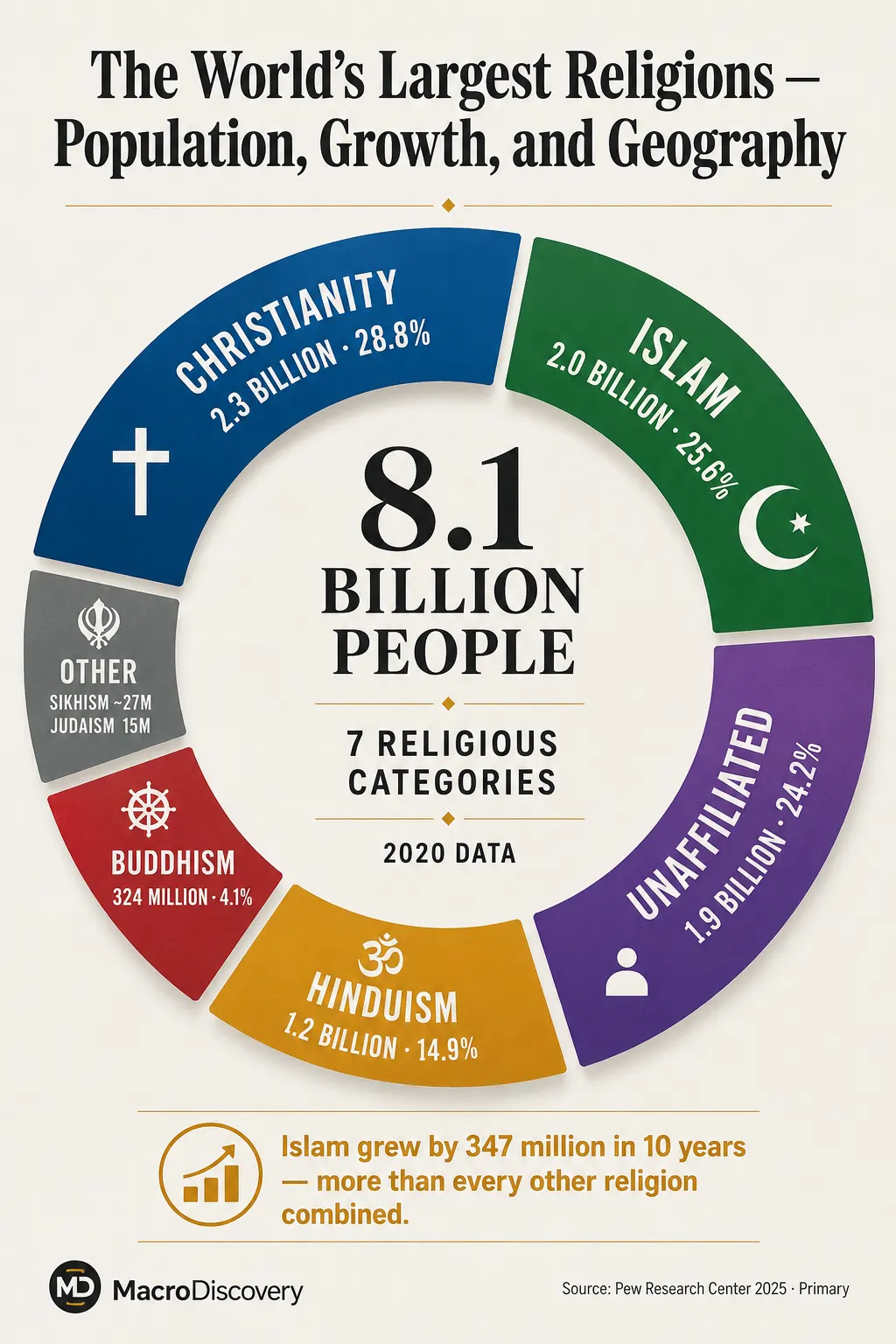
Christianity and Islam together represent 55% of humanity. But the fastest-growing religious category in the world is the unaffiliated — people with no religious identity — driven by mass switching out of Christianity in Europe and North America. Islam grew by 347 million between 2010 and 2020, more than every other religion combined. Buddhism is the only major faith that actually shrank. And by 2070, Islam is projected to equal Christianity in global share — not through conversion, but through demography.
| Religion | Population (2020) | % World | Size | Change 2010–2020 | Trend |
|---|---|---|---|---|---|
| ✍ Christianity | 2.3 billion | 28.8% | +122M · share ↓ from 31% | ↓ Share falling | |
| ▶ Islam | 2.0 billion | 25.6% | +347M · most of any religion | ↑ Fastest growing | |
| ◯ Unaffiliated | 1.9 billion | 24.2% | +270M · share ↑ ~1 point | ↑ 2nd fastest | |
| ☯ Hinduism | 1.2 billion | 14.9% | +126M · pace = world avg | → Stable share | |
| ▶ Buddhism | 324 million | 4.1% | −19M · only religion to shrink | ↓ Only shrinking | |
| ▲ Sikhism | ~26–28M | ~0.36% | 5th largest organized religion | ⓘ Not in Pew | |
| ✡ Judaism | 15 million | 0.2% | +6% · from 14M in 2010 | → Modest growth |
Sources: Pew Research Center — “How the Global Religious Landscape Changed From 2010 to 2020” (primary · June 9, 2025 · doi:10.58094/fj71-ny11). All figures 2020 data. Sikhism (†): not tracked as a standalone category by Pew; grouped within “Other religions.” Sikhism figure from World Religion Database (cited within Pew) and Wikipedia, confirmed range 25–30 million (most cited: ~26–28M). ⓘ = data source differs from other rows.
Why Islam Grew by 347 Million in One Decade — More Than Every Other Religion Combined
The explanation is almost entirely demographic. Conrad Hackett, senior demographer at Pew Research Center and lead author of the 2025 report, stated plainly: “Muslims are having children at a greater number than Muslims are dying. Very little of the change in Muslim population size is a result of people becoming Muslim as adults or leaving Islam as adults.” Muslim women average approximately 2.9 children, the highest fertility of any religious group, against a world average of 2.2. Roughly one-third of all Muslims are under age 15 — the largest youth cohort of any religion — meaning the future growth pipeline is already alive. This is not a conversion story. It is a birth-rate story.
Why it matters: the religious future of the world will be determined not by persuasion but by demography — specifically by where young people are being born.
Why the “Nones” Are the World’s Fastest-Growing Category Despite Having the Fewest Children
The religiously unaffiliated grew by 270 million between 2010 and 2020, reaching 1.9 billion — the world’s third-largest religious category. This is paradoxical: unaffiliated people have the second-lowest fertility rate of any group (1.7 children per woman), and an older age structure. They grow primarily through religious switching — a dynamic the 2025 Pew report tracked globally for the first time. For every adult raised with no religion who joined one, approximately 3.2 adults left their childhood faith. Christians are the primary source of this outflow, driven by secularisation in Europe, North America, Australia, and New Zealand. In North America alone, the unaffiliated share rose 13 percentage points to 30.2% between 2010 and 2020.
Why it matters: secularisation in wealthy countries is producing the world’s second-fastest-growing demographic category without a single conversion.
Why Buddhism Is the Only Major Religion Whose Population Actually Shrank
Buddhism lost approximately 19 million adherents between 2010 and 2020 — the only major religion to record an absolute decline. The cause is concentrated in East Asia: Japan and South Korea are experiencing rapid religious disaffiliation, with more people leaving Buddhism than joining. Buddhists also have the lowest fertility rate of any major religious group (1.6 children per woman) and the oldest median age (34), meaning deaths are beginning to outpace births. Two-thirds of the world’s religiously unaffiliated people live in China, which historically houses much of the world’s Buddhist population — and that population is secularising rapidly alongside economic modernisation.
Why it matters: Buddhism’s decline is the clearest case study of what happens when a religion is concentrated in ageing, low-fertility, rapidly secularising societies.
When Will Islam Surpass Christianity — and What Will Actually Drive the Shift?
Pew’s 2015 projection, extended beyond its 2050 baseline, finds the Muslim and Christian shares of world population converging at roughly 32% each around 2070 — and Muslims surpassing Christians by 2075. By 2100, the gap widens to approximately 35% Muslim versus 34% Christian. Both groups will continue growing in absolute numbers; the shift is a share story, not a shrinkage story. The driver is sub-Saharan Africa: a continent projected to double its population by 2050, with both Islam and Christianity deeply embedded there. Christianity will also grow significantly — sub-Saharan Africa will account for 4 in 10 Christians worldwide by 2050. The 2070 crossover is a demographic inevitability if current fertility and retention patterns hold, not a theological contest.
Most Muslims are not in the Middle East. 62% of the world’s Muslims live in Asia-Pacific. Only about 20% live in the Middle East and North Africa. Indonesia, Pakistan, Bangladesh, and India together hold more Muslims than all Arab countries combined.
Most Christians no longer live in Europe or North America. Sub-Saharan Africa has surpassed Europe as the region with the most Christians — 697 million in 2020, versus 505 million in Europe (which fell 9%). In North America, the Christian population shrank by 11%. Christianity is now predominantly a Global South religion.
67% of the world’s unaffiliated live in China. China has approximately seven times more “nones” than the United States. The rise of secularism is not primarily a Western story — it is an East Asian story dominated by one country.
95% of Hindus live in India. No major religion is more geographically concentrated. Sikhism is similarly concentrated: approximately 83–90% of the world’s 26–28 million Sikhs live in India, with the highest national Sikh proportion outside India in Canada (approximately 2.1%).
Source: Pew Research Center (primary, June 2025) · Conrad Hackett, “Many Religions Are Heavily Concentrated in a Few Countries” (December 2025).
Why it matters: the 2070 crossover is not a story about Islam converting the world — it is a story about which populations are young, fertile, and retaining their faith.
- Christianity remains the world’s largest religion at 2.3 billion (28.8%), but its global share fell from 31% in 2010 to 28.8% in 2020.
- Islam added 347 million people from 2010 to 2020 — more than all other religions combined — almost entirely through births, not conversions.
- The religiously unaffiliated reached 1.9 billion (24.2%) — the world’s third-largest category — growing through switching, despite low fertility.
- Buddhism is the only major religion that shrank in absolute numbers, losing 19 million adherents due to East Asian secularisation and low fertility.
- By 2070, Islam and Christianity are projected to be equal at roughly 32% each of the world’s population (Pew 2015 projection, still current).
- 67% of the world’s unaffiliated live in China — the rise of “nones” is primarily an East Asian phenomenon, not a Western one.
- Sikhism has approximately 26–28 million followers — ~0.36% of the world — making it the 5th largest organized religion; 83–90% live in India.
The religious map of the world is being redrawn by demography, not theology. The religions growing fastest are those with the youngest populations and the highest fertility. The religion shrinking fastest has the oldest population and the lowest birth rate. The 2070 projection in which Islam equals Christianity is not a forecast about persuasion. It is an arithmetic consequence of where children are being born today — and it will arrive on schedule unless fertility rates change dramatically.
- Pew Research Center — “How the Global Religious Landscape Changed From 2010 to 2020” (primary · directly fetched · June 9, 2025 · doi:10.58094/fj71-ny11 · Conrad Hackett et al. · 2,700+ sources · Christians 2.3B 28.8% · Muslims 2.0B 25.6% +347M · Unaffiliated 1.9B 24.2% +270M · Hindus 1.2B 14.9% · Buddhists 324M 4.1% −19M · Jews 15M 0.2% · switching ratio 3.2:1 · N.America nones 30.2% · Europe 25.3%)
- Pew Research Center — “The Future of World Religions: Population Growth Projections, 2010–2050” (2015 · 2070 projection: Muslim share = Christian share at ~32% each · by 2075 Muslims outnumber Christians · by 2100: Muslims 35% Christians 34% · Muslim fertility 3.1/woman · 1/3 Muslims under 15)
- Pew Research Center — “The Changing Global Religious Landscape” (2017 · “Muslims are expected to reach parity with Christians in 2070. By 2075, Muslims are expected to outnumber Christians” · PRIMARY QUOTE confirmed)
- Pew / Conrad Hackett — “Many Religions Are Heavily Concentrated in a Few Countries” (December 2025 · 95% of Hindus in India · 67% of nones in China · 62% of Muslims in Asia-Pacific · Christians most spread out · doi:10.58094/cxqn-2j55)
- NPR / Religion News Service — “Islam is the fastest growing religion in the world, Pew study says” (June 10, 2025 · Hackett quote confirmed: “Muslims are having children at a greater number than Muslims are dying” · “Very little of the change is a result of people becoming Muslim as adults” · Conrad Hackett title: “senior demographer at Pew Research Center”)
- Wikipedia — “Sikhs” (updated July 2026 · 25–30 million worldwide · 0.3%–0.4% of world pop · 5th largest organized religion · 83–90% in India · Canada highest national proportion 2.1% · Pew groups Sikhs in “Other religions” category)