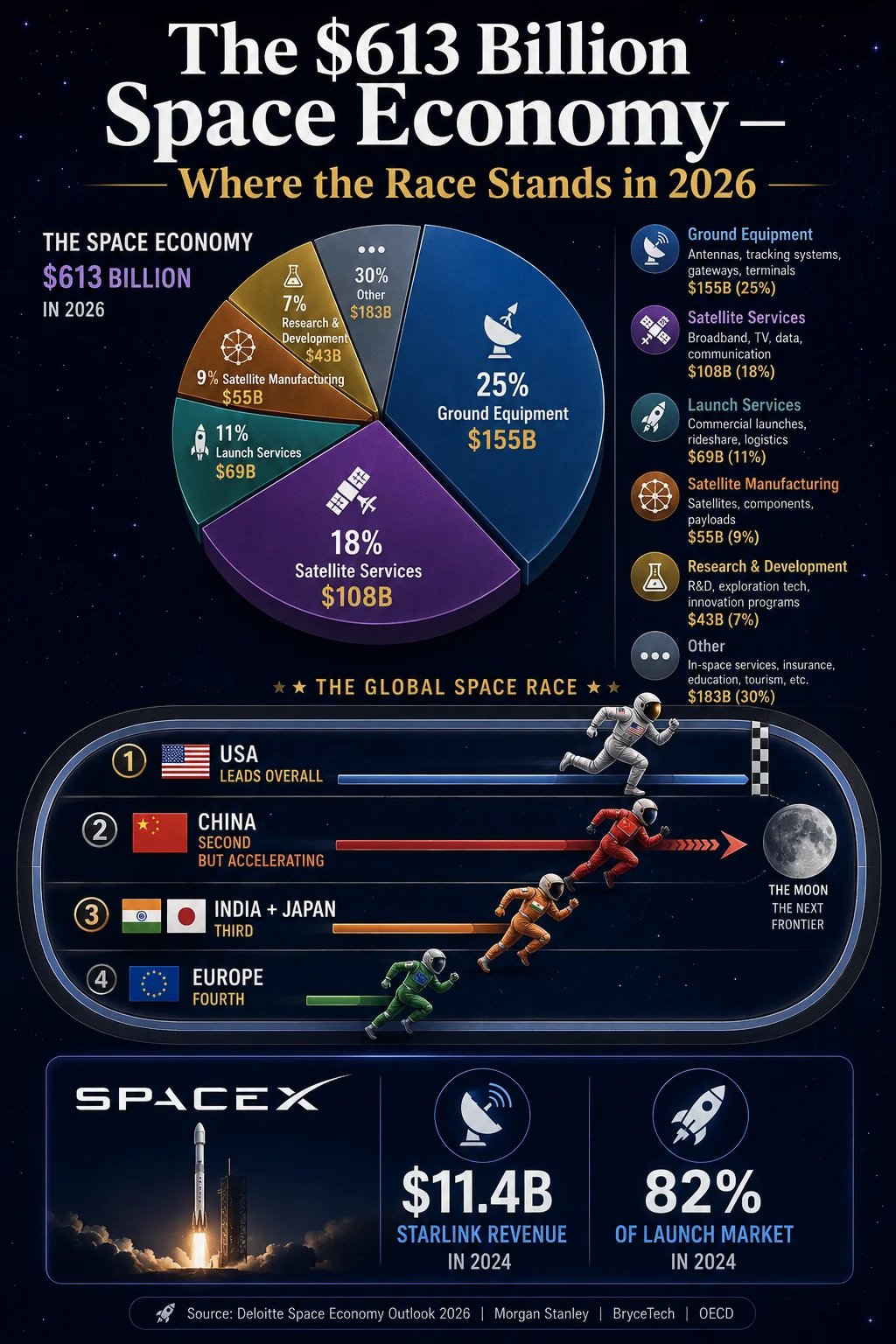
The Space Economy —
Who Owns the Race Beyond Earth
The space economy hit $613 billion in 2024 and is heading for $1 trillion by 2032. A rocket now launches into orbit every 28 hours — a cadence that would have seemed impossible a decade ago. SpaceX’s Starlink alone generated $11.4 billion in revenue in 2025, more than NASA’s proposed budget for 2026. China plans to land astronauts on the Moon by 2030, is deploying two satellite megaconstellations that would rival Starlink in scale, and launched more rockets last year than any other nation. The United States is simultaneously the world’s dominant space power and the country most at risk of losing that lead — as NASA faces its sharpest proposed budget cuts in decades and a commercial sector that is rapidly outpacing the government that created it.
- The space economy is no longer primarily about rockets and exploration — it is about satellite internet, and one company dominates it. SpaceX’s Starlink generated $11.4 billion in 2025 revenue with a 63% EBITDA margin — making it more profitable per dollar of revenue than most technology companies. As of Q1 2026, Starlink had 10.3 million subscribers across 155 countries, growing from 2.3 million in 2023. Its 61% share of SpaceX’s total revenue in 2025 — rising to 69% in Q1 2026 — means SpaceX has fundamentally transformed from a rocket company into a subscription internet provider that builds its own rockets for structural cost advantage. Sources: SpaceX S-1 IPO filing (primary · June 2026 · via Globe Newswire).
- The launch cadence of 2025 would have been unimaginable a decade ago. In the first half of 2025, the world achieved a rocket launch to orbit every 28 hours — six hours faster than the annual record set in 2024. SpaceX accounted for 81 of 149 total orbital launches in H1 2025, more than half the world combined. Across all of 2025, 329 orbital launch attempts were made globally, with 4,517 satellites deployed — 87% owned by commercial entities. This cadence is the product of SpaceX’s reusable Falcon 9 reducing launch costs by approximately 95% over the past decade. Sources: Space Foundation The Space Report 2025 Q2 (primary · directly fetched) · Jonathan McDowell / Payload (launch data).
- China has quietly become the world’s second space power — and in some metrics, it is already competing for first. China launched more than 60 orbital missions in 2025 — more than any other country — permanently crews its own Tiangong space station (operational since 2022), has achieved lunar sample returns from the Moon’s far side (Chang’e 6, June 2024, a world first), and is planning two satellite megaconstellations (Guowang at ~13,000 satellites and Qianfan/Thousand Sails at ~14,000) that would collectively match or exceed Starlink’s current satellite count. Its target of a crewed Moon landing by 2030 is four years away. Sources: CNSA programme data via Orbital Radar · SpaceNexus · Sentinel Mission 2026.
- The US is cutting NASA’s budget at the moment it can least afford to. NASA’s proposed FY2026 “skinny budget” cuts funding from approximately $25.4 billion to $18.9 billion — a reduction of approximately $6.5 billion, including a proposed 47% cut to the Science Mission Directorate from $7.25 billion to $3.89 billion. More than 40 NASA missions face cancellation, shutdown, or postponement. Critics describe it as a “historic step backward” at precisely the moment China is accelerating toward the Moon. The paradox: the US commercial sector led by SpaceX is the most advanced in the world, yet US civil science and international leadership are being simultaneously scaled back. Sources: NASA FY2026 proposed budget · Planetary Society · analysis via Shutter to the Stars (May 2025).
- Space has permanently shifted from a government monopoly to a commercial industry — and the transition is accelerating. In 2024, 87% of satellites deployed were owned by commercial entities. The downstream services those satellites provide — satellite television, broadband internet, Earth observation, navigation — now generate over $263 billion annually (satellite services $108 billion + ground equipment $155 billion, per Satellite Industry Association data). Low Earth Orbit (LEO) constellations now account for 58% of all active satellites, up from less than 10% a decade ago. With the International Space Station retiring around 2030, commercial successors including Axiom Space, Vast, and Blue Origin’s Orbital Reef are being funded to replace it. Sources: Space Foundation (primary) · Satellite Industry Association · SpaceNexus 2026.
Source: Space Foundation — The Space Report 2025 Q2 (primary · directly fetched · July 22, 2025 · spacefoundation.org). Directly confirmed from primary: $531B (2022, revised) · $570B (2023) · $613B (2024, +7.8% YoY) · commercial = 78% · government = 22% · government spending $132B · US $77B · “Space Foundation projects the global space economy could cross the $1 trillion mark as soon as 2032.” *2025 estimate from Novaspace (via Orbital Radar) — not yet a Space Foundation primary figure. 2035 McKinsey/WEF projection includes broad space-enabled revenues. Bar lengths are illustrative; 2032 and 2035 bars are forecasts, not confirmed revenue.
| Segment | 2024 Revenue | % of economy | Growth trend | Key players |
|---|---|---|---|---|
📡 Ground equipmentTerminals, GNSS receivers, hardware |
$155.3B | ~25% of total | Steady growth | Consumer satellite terminals, GNSS receivers, satellite TV dishes, cellular infrastructure. Largest single segment by revenue. Growth driven by Starlink terminal rollout and GPS-enabled devices. |
📻 Satellite servicesTV, broadband, Earth obs, mobility |
$108.3B | ~18% of total | Mixed: broadband fast, TV declining | Satellite TV ($72B, declining). Satellite broadband (fastest growing; Starlink $11.4B alone). Earth observation ($8B). Maritime/aviation connectivity. LEO broadband projected $40B by 2030. |
🍂 Government space spendingCivil + military combined |
$132B | 22% of total | +6.7% in 2024 | US $77B (NASA $25B + DoD/Space Force $52B). China ~$14–20B est. ESA €7.68B. India $1.6B. Japan ~$2–3B. Defence space now ~$74B globally (56% of govt total). |
🐠 Satellite manufacturingSpacecraft production |
~$20B | ~3% of total | 15–18% CAGR | Fastest-growing upstream segment. Driven by LEO constellation builds: 4,517 satellites deployed in 2025 alone. Cost fallen from $100,000/kg to ~$1,000/kg for Starlink sats. Largest manufacturers: SpaceX, Airbus D&S, Boeing, Lockheed, Northrop. |
🚀 Launch servicesRockets to orbit |
$9.3B | ~2% of total | Fast growth in cadence | SpaceX: 82% commercial market share. Falcon 9: 165 orbital flights in 2025. Launch costs fallen 95% last decade. SpaceX external launch revenue: ~$4.1B (2025 S-1). Competitors: Blue Origin New Glenn, Arianespace, Rocket Lab, ISRO, JAXA H3. |
🪧 Space tourismFastest-growing by CAGR |
Small but growing | <1% currently | 9.8% CAGR (fastest) | Blue Origin: New Shepard suborbital tourism. SpaceX: Inspiration4, Polaris Dawn crewed missions. ISS commercial crew visitors. Axiom Space missions. Market growing from tiny base but fastest percentage growth of any segment. |
Sources: Space Foundation — The Space Report 2025 Q2 (primary · July 22, 2025 · directly fetched · $613B total · commercial 78% · government $132B · US $77B). Satellite Industry Association (SIA) State of the Satellite Industry Report (ground equipment $155.3B · satellite services $108.3B · launch services $9.3B). SpaceX S-1 (June 2026 · Starlink $11.4B · launch $4.1B · subscribers 10.3M). Satellite manufacturing ~$20B from SpaceNews/SIA. Space tourism CAGR from SNS Insider (May 2026). Click column headers to sort.
| Country / Agency | Annual budget (est.) | Key programmes | Status 2026 |
|---|---|---|---|
🇺🇸 United StatesNASA + DoD + Space Force |
$77B (2024) | NASA $25.4B (2024-25). Artemis lunar programme. James Webb Space Telescope. Commercial Crew (SpaceX/Boeing). Space Force $30B+. DoD ISR, missile warning, communications. Total US govt space: $77B. | NASA cut proposed |
🇨🇳 ChinaCNSA + PLA + CASC |
~$14–20B est. | Tiangong space station (permanently crewed since 2022). Chang’e lunar programme. Tianwen Mars missions. BeiDou navigation (44+ sats). Guowang + Qianfan megaconstellations. Crewed Moon landing planned 2030. | Accelerating |
🇪🇺 European Space Agency22 member states |
€7.68B ($8.2B) | Copernicus Earth observation (world-leading). Galileo navigation. Ariane 6 launch vehicle. JUICE (Jupiter Icy Moons Explorer). Orion Service Module (Artemis partner). Record multi-year envelope: ~€26B (2026–2028). | Record funding |
🇮🇳 IndiaISRO |
~$1.6B | Chandrayaan-3: first soft landing near lunar south pole (2023). Gaganyaan crewed mission (uncrewed tests 2025–26; crewed 2027). GSLV/LVM3 rockets. NavIC navigation. Mangalyaan Mars orbiter. Highest mission-value-per-dollar in global space. | Strong growth |
🇯🇵 JapanJAXA |
~$2–3B | SLIM: precision lunar landing January 2024. Hayabusa series: asteroid sample return. H3 launch vehicle. MMX (Martian Moons eXploration). ISS Kibo module. QZSS regional navigation. Key Artemis Accords partner. | High quality science |
🇷🇺 RussiaRoscosmos |
Declining | ISS operations (partnership under strain post-Ukraine war). Soyuz crewed transport (historic workhorse). Luna-25 failed (2023). Geopolitical isolation has slowed international partnerships. Declining capacity and budget post-sanctions. | Declining post-2022 |
Sources: Space Foundation — The Space Report 2025 Q2 (primary · US $77B total govt space 2024 · govt total $132B 2024 · directly fetched). NASA FY2024-25 budget $25.4B from Wikipedia/NASA. NASA proposed FY2026 $18.9B skinny budget from Shutter to the Stars (May 2025). ESA budget €7.68B from ESA press release 2025. ESA multi-year €26B from Orbital Radar 2026. India ISRO budget ₹13,415 crore (~$1.6B) from Apollo11Space citing India Budget 2025-26. China budget estimated $14–20B from Wonderslist (April 2026) · Apollo11Space · Grokipedia (multiple citing analysts) — China does not publish full breakdown. Japan JAXA budget from Apollo11Space citing ¥trillion fund context. Click column headers to sort.
How Did SpaceX Go From Rocket Company to the World’s Most Profitable Satellite Internet Provider?
When SpaceX launched its first Starlink satellite in 2019, the idea that a rocket company’s internet service would become its primary revenue driver within six years seemed implausible. In 2025, Starlink generated $11.4 billion in revenue — 61% of SpaceX’s total $18.7 billion — with a 63% EBITDA margin that makes it more profitable per dollar of revenue than most technology companies. By Q1 2026, Starlink had 10.3 million active subscribers across 155 countries, growing from 2.3 million in 2023. The subscriber base roughly doubled every year from 2023 to 2025, and analysts at Quilty Space project it will reach 16.8 million by end-2026. The SpaceX S-1 IPO filing (June 2026) discloses that in the first quarter of 2026 alone, Starlink generated $3.26 billion in revenue and $1.19 billion in operating income.
The structural source of this profitability is the same structural advantage SpaceX has over every competitor: it launches its own satellites on its own rockets. Every Starlink competitor — Amazon’s Project Kuiper, Eutelsat OneWeb, Telesat Lightspeed — must buy launches from third parties, including in some cases from SpaceX itself. When a competitor satellite costs $10–40 million on a third-party launch, and SpaceX’s marginal cost per Starlink satellite launch is dominated by Falcon 9 economics it controls, the unit-economics gap is structural. SpaceX has built the only vertically integrated satellite internet business in the world — and that integration means its cost of capital is permanently lower than anyone trying to compete with it.
The February 2026 merger of SpaceX with Elon Musk’s AI company xAI, creating a combined entity initially valued at approximately $1.25 trillion, adds a further strategic dimension: the integration of satellite connectivity with AI infrastructure. SpaceX’s June 2026 IPO targeted a valuation of $1.5–2 trillion — making it potentially the most valuable company in the world at listing. Whether that valuation is justified depends primarily on whether Starlink can sustain its subscriber growth and pricing power against an eventually deployed Amazon Kuiper constellation — which plans to launch 3,236 satellites for broadband internet, with initial deployments beginning in 2025–2026.
Total revenue 2025: $18.7 billion
Starlink: $11.4 billion (61% of total) · growing ~50% YoY
Launch services (external): ~$4.1 billion
Starshield (military): ~$1.8 billion (80% YoY growth)
Starlink metrics:
· Subscribers Q1 2026: 10.3 million (155 countries)
· Q1 2026 revenue: $3.26 billion · Operating profit: $1.19 billion
· EBITDA margin: 63% (vs ~20% for legacy satellite operators)
· Adding approximately 22,000 new customers per day (end-2025 rate)
· 10,000th Starlink satellite launched October 2025
Launch dominance:
· 165 Falcon 9 orbital flights in 2025 — more than all other global launch vehicles combined
· 82% commercial global launch market share
· Falcon 9 cost after reuse: $20–30 million (vs $62M+ new) — no competitor matches this
Valuation:
· December 2025: ~$800 billion (insider share sale)
· February 2026: ~$1.25 trillion combined with xAI
· June 2026 IPO target: $1.5–2 trillion
Sources: SpaceX S-1 (June 2026 · primary) · Globe Newswire / Yahoo Finance (June 2, 2026 · directly fetched) · SpaceXChart (S-1 basis · May 2026) · Sacra (S-1 analysis).
Is China Winning the New Space Race — and What Does That Mean?
China’s space programme in 2026 is not the secondary competitor it was in 2010. It permanently crews its own Tiangong space station — assembled across 2021–2022 with three operational modules and crew rotations every six months via Shenzhou spacecraft. In June 2024, China’s Chang’e 6 mission returned samples from the Moon’s far side — a feat no country had ever accomplished — following Chang’e 4’s first-ever far-side landing in 2019 and Chang’e 5’s sample return from the near side in 2020. China launched more than 60 orbital missions in 2025, surpassing the United States in launch frequency. Its BeiDou navigation satellite system provides global coverage with accuracy comparable to GPS. And its two planned megaconstellations — Guowang (~13,000 satellites) and Qianfan/Thousand Sails (~14,000 satellites) — would collectively put approximately 27,000 satellites into orbit, matching or exceeding the full planned Starlink constellation in scale.
The US-China space race differs from the Cold War space race in one crucial respect: the US and Soviet Union were racing primarily for symbolic prestige. The current race is also about strategic infrastructure. Satellite constellations provide communications, intelligence, surveillance, navigation, and potentially anti-satellite capabilities. The Moon is not just a scientific destination — it is a potential staging point for cislunar operations, and the south polar region (where both NASA’s Artemis and China’s Chang’e programmes are targeting) contains water ice that could be converted to rocket propellant, enabling a permanent presence. The country that establishes a sustainable cislunar infrastructure first gains strategic advantages that compound over decades.
The structural challenge for the United States is not technological — it is institutional. The Wolf Amendment, passed in 2011, prohibits NASA from cooperating with China in space, which has left China developing its own independent space station and lunar programme rather than working within a US-led international framework. When the ISS retires around 2030, China’s Tiangong will be the only continuously crewed space station in orbit. Meanwhile, the proposed NASA FY2026 budget cuts of approximately $6.5 billion from $25.4 to $18.9 billion, including a 47% proposed cut to the Science Mission Directorate, threaten the US science missions that provide both practical knowledge and the international credibility that underpins US-led space coalitions like the Artemis Accords.
China’s programme:
· Chang’e 4: First far-side landing (2019) ✓
· Chang’e 5: Lunar sample return (2020) ✓
· Chang’e 6: Far-side sample return (June 2024) ✓ — world first
· Chang’e 7 + 8: Lunar research station preparation
· Crewed Moon landing: target 2030 ← 4 years from now
· Partner: Russia (International Lunar Research Station)
NASA Artemis programme:
· Artemis I: Uncrewed lunar flyby (2022) ✓
· Artemis II: Crewed lunar flyby (planned 2025–26)
· Artemis III: First crewed landing in 50 years (planned 2026–27)
· Lunar Gateway space station: long-term cislunar presence
· Commercial lunar landers: Intuitive Machines, Astrobotic
· SpaceX Starship: Artemis lander (~$90M/launch vs SLS $4B/launch)
· Proposed budget cut threatens Lunar Gateway and SLS after Artemis III
The cost comparison that matters: SLS costs approximately $4 billion per launch. SpaceX Starship is designed to cost approximately $90 million — a 44-fold difference. NASA’s pivot toward Starship for Artemis reduces costs dramatically but increases SpaceX dependency. If NASA’s budget is cut and China lands first, it would be the first time since 1969 that the US was not first to a landmark human spaceflight milestone. Sources: NASA · CNSA via Orbital Radar · SpaceNexus · Shutter to the Stars (May 2025) · SpaceX S-1 (June 2026).
Why Did Launch Costs Fall 95% — and What Does That Change About Everything?
The single most important fact in the commercial space economy of the past decade is not a satellite milestone or a company valuation — it is the reduction in the cost of reaching orbit. Launch costs per kilogram to low Earth orbit fell approximately 95% between 2010 and 2025, driven almost entirely by SpaceX’s development and operationalisation of the reusable Falcon 9. In 2010, reaching orbit cost approximately $54,500 per kilogram via the Space Shuttle. The Falcon 9 initially offered about $2,700 per kilogram. After multiple iterations of booster reuse, the effective cost per kilogram has fallen further. TrendForce has estimated that fully operational Starship could push costs below $100 per kilogram to low Earth orbit — a reduction that would “fundamentally alter aerospace programme economics globally.”
The practical consequence of this cost reduction is that space has become accessible in a way it was not before. In 2025, 4,517 satellites were deployed globally — 87% owned by commercial entities. Low Earth Orbit now accounts for 58% of all active satellites, up from less than 10% a decade ago. The busiest first half-year of launches in history occurred in H1 2025, with 149 orbital launches reaching a pace of one every 28 hours, six hours faster than the previous annual record. What launch-cost reduction has done is transform space from a government monopoly — accessible only to nations with massive dedicated space programmes — into a commercial market accessible to private companies, startups, universities, and small nations.
The implication for the future is equally transformative. When SpaceX’s Starship becomes fully operational for commercial payloads — targeted for H2 2026 with Starship Block 3 — the cost per launch is expected to fall from the Falcon 9’s current $20–30 million range toward $10 million or below for reusable heavy-lift missions. This would make today’s economics look expensive by comparison. Amazon’s Project Kuiper, AST SpaceMobile’s direct-to-cell satellites, Telesat Lightspeed, and hundreds of Earth observation and communications startups are all building business models on the assumption that launch costs will continue to fall. The companies and governments that design their space programmes around the cost structures of five years ago will find themselves economically obsolete within a decade.
What Happens When the International Space Station Retires in 2030?
The International Space Station has been continuously occupied since November 2, 2000 — over 25 years of unbroken human presence in low Earth orbit. It has hosted more than 270 people from 22 countries, conducted over 3,000 scientific experiments, and served as the primary symbol of US-Russia space cooperation through multiple geopolitical crises. Its planned retirement around 2030 will end all of that simultaneously and create the first gap in continuously crewed orbital habitation in a quarter-century — unless commercial successors are ready in time.
NASA has funded multiple commercial space station development programmes through its Commercial Low Earth Orbit Destinations (CLD) programme, targeting Axiom Space (a modular station attaching initially to the ISS), Vast (planning Haven-1 as the first commercial space station module, with SpaceX as launch provider), and Blue Origin’s Orbital Reef (with Sierra Space). The transition is not a certainty — commercial stations face significant technical and financial challenges, and the timeline is tight. The most concerning gap is that China’s Tiangong station will almost certainly be the only continuously crewed orbital outpost in the world from 2030 until US commercial successors are fully operational. This would represent a symbolic and strategic shift in human spaceflight leadership that no administration has explicitly addressed.
The broader ISS retirement also signals the final end of US-Russia space cooperation that survived the Cold War, the 1990s enlargement, and decades of geopolitical friction. Russia’s Roscosmos, once the essential partner for crewed access to the ISS (providing Soyuz launches when NASA had no crewed launch capability), has seen its international partnerships collapse following the 2022 Ukraine invasion. Commercial Crew (SpaceX Dragon and Boeing Starliner) ended the dependency on Soyuz — arguably at the right moment. Roscosmos’s declining capacity and post-sanctions budget constraints mean Russia is no longer a primary space power in the sense it was through the ISS era.
India (ISRO): Chandrayaan-3 achieved the world’s first soft landing near the lunar south pole in August 2023 — a milestone that cost approximately $75 million, less than many Hollywood films. Gaganyaan crewed mission targeting 2027. Budget: ~$1.6 billion. ISRO represents the highest mission-value-per-dollar in the global space economy. Private sector growing rapidly (Skyroot Aerospace, Agnikul Cosmos).
Japan (JAXA): SLIM achieved the world’s first precision lunar landing in January 2024 — landing within 55 metres of its target. Hayabusa2 returned asteroid samples in 2020. H3 launch vehicle (replacing H-IIA). Key Artemis Accords partner and Moon Gateway contributor.
Europe (ESA): €7.68 billion budget, record multi-year envelope of ~€26 billion (2026–2028). World-leading Earth observation via Copernicus (climate monitoring). Galileo navigation. Ariane 6 restoring European independent launch access. JUICE mission to Jupiter. ESA is the most significant space organisation not building a crewed space vehicle of its own.
United Arab Emirates: Hope Probe to Mars orbit (2021) — only the fifth country/organisation to reach Mars. EMM (Emirates Mars Mission) produced a comprehensive atmospheric dataset. Moon mission planned. The same diplomatic skill that drove UAE passport power is being applied to space.
Commercial new entrants: Rocket Lab (New Zealand/US) — second most frequent launcher globally. Relativity Space (3D-printed rockets). AST SpaceMobile (direct-to-cell satellite broadband without a phone). Axiom Space (commercial astronaut missions). The democratisation of launch costs is enabling a long tail of smaller space players.
Sources: Orbital Radar · SpaceNexus · Wonderslist (April 2026) · Apollo11Space (March 2025).
What Does the Space Economy Mean for Life on Earth — and What Comes Next?
The $613 billion space economy of 2024 generates economic value that extends far beyond the space industry itself. GPS navigation — originally a US military satellite system — now underpins global logistics, financial transaction timing, autonomous vehicles, and precision agriculture. Weather satellites reduce the economic damage of extreme weather events by enabling earlier warnings. Earth observation satellites track deforestation, monitor crop health, assess insurance risk, and provide the data infrastructure for climate monitoring. Satellite broadband is extending internet connectivity to the 2.6 billion people who currently lack reliable access, with Starlink already operating in remote regions across Africa, Latin America, and the Pacific that fibre infrastructure will never economically reach.
The next decade of the space economy — with the economy projected to reach $1 trillion by 2032 and potentially $1.8 trillion by 2035 if broadly space-enabled revenues are included — will be shaped by three converging developments. First, the deployment of multiple competing LEO broadband constellations (Starlink V3, Amazon Kuiper, Telesat Lightspeed) will extend internet access globally and drive satellite broadband revenue from approximately $42 billion today toward $40 billion by 2030 in this segment alone (Gartner LEO satcom estimate). Second, the continued reduction of launch costs via Starship and future reusable heavy-lift vehicles will open in-space manufacturing, lunar resource utilisation, and potentially point-to-point Earth transport as viable commercial opportunities. Third, space-based AI — combining satellite connectivity with on-orbit computing and AI inference — is being positioned by the SpaceX/xAI merger as the next major commercial space frontier.
The central geopolitical question for the space economy of the 2030s is who sets the rules. The Artemis Accords — bilateral agreements coordinated by NASA establishing norms for lunar exploration — currently have 50 signatories, but China and Russia are not among them. If China establishes a permanent lunar presence under a different normative framework, the result will be two competing governance systems for the Moon and cislunar space, mirroring the fractures visible in terrestrial geopolitics. Space has always reflected the world below it. The world below it is currently more fragmented than at any point since the Cold War — and the space economy of the 2030s will reflect that fragmentation in ways that are only beginning to become visible.
Science Mission Directorate: $7.25B → $3.89B proposed (-47%). More than 40 missions face cancellation, shutdown, or postponement. These include Earth observation satellites tracking climate, weather, and agriculture; Mars missions; outer planets science; and the Hubble Space Telescope support programme.
Lunar Gateway: Potentially cancelled or indefinitely deferred. The Gateway is the orbital outpost that enables sustained lunar presence — without it, Artemis missions would be “flags and footprints” rather than a sustainable infrastructure.
SLS after Artemis III: Proposed to be phased out in favour of commercial (SpaceX Starship) launch. This reduces cost dramatically — SLS ~$4B per launch vs Starship ~$90M — but creates dependency on a single commercial provider and accelerates the loss of NASA’s internal launch capability.
What this means competitively: China’s space programme (estimated $14–20B annually) is accelerating. ESA has committed a record €26B for 2026–2028. India is increasing ISRO funding. At the moment the international community is investing more in space, the US is proposing to invest significantly less in its civil science and exploration programmes — while leaning more heavily on a commercial sector whose primary goal is subscriber revenue, not scientific discovery or international leadership. Sources: NASA FY2026 proposed budget · Planetary Society · Shutter to the Stars (May 2025) · Space Foundation primary (July 2025).
- Space Foundation — “The Space Report 2025 Q2 Highlights Record $613 Billion Global Space Economy for 2024” (primary · directly fetched · July 22, 2025 · $613B total 2024 · +7.8% YoY · commercial 78% · government 22% · $132B govt · US $77B · 149 launches H1 2025 · every 28 hours · SpaceX 81 of 149 · $1T by 2032 · CEO Heather Pringle quote)
- Globe Newswire / Yahoo Finance — “Starlink Now Drives the Majority of SpaceX’s Revenue” (June 2, 2026 · S-1 basis · directly fetched · Starlink $11.4B 2025 revenue · 61% of SpaceX $18.7B total · Q1 2026 69% share · 2.3M→4.4M→8.9M→10.3M subscribers 2023–Q1 2026 · 155 countries)
- SpaceXChart — “Starlink: Subscribers, Revenue, Unit Economics & Margin” (May 2026 · S-1 basis · 10.3M subscribers $11.4B FY25 $4.4B operating profit · Q1 2026 $3.26B revenue $1.19B operating income · 63% EBITDA margin · Starshield ~$1.8B FY25)
- Sacra — SpaceX Revenue, Valuation & Funding (July 2026 · S-1 analysis · Starlink 9M+ end-2025 · 10M Feb 2026 · ARPU $81/month · valuation $800B Dec 2025 · xAI merger $1.25T · launch $4.1B 2025 · Starlink subscriber growth 2021–2026)
- Sentinel Mission — “Space Industry Statistics (2026)” (March 2026 · Space Foundation basis · $531B→$570B→$613B trajectory · 329 orbital launches 2025 · 4,517 satellites deployed · 87% commercial · McKinsey/WEF $1.8T 2035 · SpaceX 10,000th Starlink Oct 2025)
- Orbital Radar — “The Global Space Economy 2026” (July 2026 · live data · $626B 2025 Novaspace est. · $1.01T by 2034 Novaspace · McKinsey/WEF $1.8T 2035 · commercial 78% · govt 22% · SpaceX $10.4B Starlink est. · defence space $74B 2025)
- Orbital Radar — CNSA Profile (2026 · live data · China 60+ orbital missions 2025 · Tiangong permanently crewed since 2022 · Chang’e 4/5/6 confirmed · Guowang + Qianfan constellations · crewed Moon landing 2030 · Mars sample return 2031)
- Space Foundation — The Space Report 2024 Q2 (July 2024 · primary · $570B 2023 confirmed · $531B 2022 revised · commercial $445B · government $125B · military space $57B 2023)
- Shutter to the Stars — “The NASA Skinny Budget and the U.S.-China Space Race” (May 2025 · NASA $18.9B proposed FY2026 · Science -47% $3.89B · China $14.15B est. · SLS $4B vs Starship $90M per launch · Wolfowitz Amendment explained · 40+ missions at risk)
- SpaceNexus — “Space Industry Market Size: $1.8 Trillion by 2035” (February 2026 · $670B 2026 est. · satellite services $193B · ground equipment $152B · govt $95B defence + $48B civil · manufacturing $22B · launch $10B · Starlink 9M subscribers · ISS 2030 commercial successors)