Why Some Brands Keep Their
Customers Forever
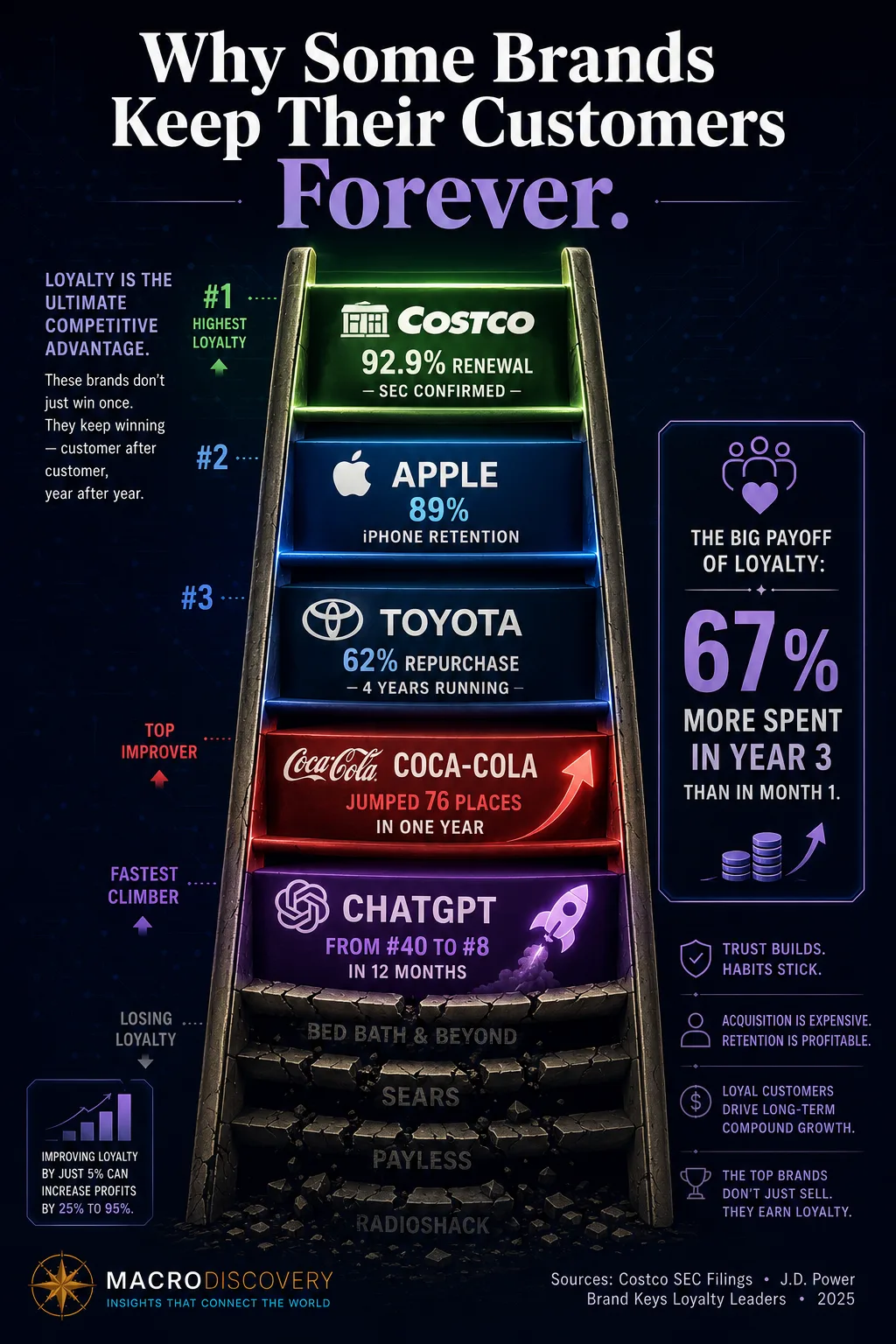
Costco has a 92.9% membership renewal rate — confirmed in its own SEC filings. Apple retains 89% of iPhone users when they upgrade. Amazon holds 90% of its e-commerce customers year on year. These numbers are not accidents. They are the result of deliberate strategies that the data now allows us to map and understand.
- Costco’s 92.9% US/Canada membership renewal rate — confirmed in the company’s own SEC filings — is one of the highest verified loyalty figures for any major retailer in the world. It raised its membership fee in September 2024 for the first time in seven years. Renewal rates barely changed.
- Brand loyalty is economically transformative. A 5% increase in customer retention increases profits by 25–95%, according to research cited by Harvard Business Review. Loyal customers spend 67% more in their third year of patronage than in their first six months.
- In the 2025 Brand Keys US loyalty rankings (77,608 assessments, 1,485 brands, 145 categories), Amazon reclaimed the top spot from Apple. The most dramatic move was Coca-Cola — from #81 to #5 in a single year, the biggest gain in the survey’s 17-year history.
- ChatGPT debuted in the Brand Keys top 10 in 2025 at #8 — up from #40 the previous year. It is the first AI tool to achieve top-10 loyalty status, compressing the years-to-loyalty timeline that previously applied only to established consumer brands.
- Loyalty is not universal across categories. The same brand can lead in one category and fall sharply in another. Amazon ranks #1 for Online Retail and #31 for Video Streaming. Apple ranks #4 for Smartphones and #93 for Tablets (down 63 spots in one year). Loyalty is earned product by product.
| Brand | Loyalty Metric | Score / Rate | Source Type | Source | Rate |
|---|---|---|---|---|---|
🏪 Costco |
Membership renewal (US/Canada) | 92.9% | SEC Filing | Costco 8-K FY2024 Q4 (Sept 2024). Raised fee same month — renewals held steady. | |
🏪 Costco |
Membership renewal (worldwide) | 90.5% | SEC Filing | Costco 8-K FY2024 Q4. 76.2M paid memberships globally. | |
🍎 Apple |
iPhone repurchase retention | ~89% | CIRP Study | Consumer Intelligence Research Partners, 12 months ending mid-2025. Down from ~94% pre-2024. | |
🛒 Amazon |
E-commerce retention rate | ~90% | Research Est. | Capital One Shopping composite research. 200M+ Prime members globally. | |
🚗 Toyota |
Automotive repurchase loyalty | 62.0% | J.D. Power | J.D. Power 2025 US Auto Brand Loyalty Study. Mass market cars, #1 for 4th consecutive year. | |
🏎 Porsche |
Automotive repurchase loyalty | 58.2% | J.D. Power | J.D. Power 2025. Premium cars, #1 for 4th consecutive year. | |
⚡ Tesla |
Net Promoter Score (NPS) | 70–80 | NPS Range | CustomerGauge benchmark database. World-class range. Varies by product/region/year. | |
🏪 Costco |
Net Promoter Score (NPS) | 70–80 | NPS Range | CustomerGauge benchmark database. World-class range — among highest for any retailer. | |
🛒 Amazon |
Net Promoter Score (NPS) | 60–70 | NPS Range | CustomerGauge benchmark database. Excellent range. | |
🍎 Apple |
Net Promoter Score (NPS) | ~61 | NPS Est. | CustomerGauge 2024–25. Peak was 72 in 2022. Tech industry avg: ~59. | |
👟 Nike |
Net Promoter Score (NPS) | ~60s | NPS Range | CustomerGauge benchmark. Strong loyalty particularly in direct-to-consumer segment. |
Sources: Costco Wholesale Corporation Form 8-K, Q4 FY2024 Supplemental Information (SEC EDGAR, September 2024) — primary · J.D. Power 2025 US Automotive Brand Loyalty Study (October 2025) — primary · CIRP iPhone loyalty data (Consumer Intelligence Research Partners, 2025) · CustomerGauge NPS Benchmark Database (2025) — largest independently tracked NPS database · Capital One Shopping research composite. NPS figures are ranges/estimates from CustomerGauge’s aggregated database, not exact proprietary company scores. Click column headers to sort.
| # | Brand | Category Measured | 2024 Rank | Change | Why It Moved |
|---|---|---|---|---|---|
| 1 | 🛒 Amazon | Online Retail | #2 | ↑ 1 | Reclaimed top spot for Online Retail. Prime ecosystem, convenience, price. Led list for 5 years before Apple’s 3-year run. |
| 2 | Search Engines | #25 | ↑ 23 | Surged as its traditional search is threatened by AI — consumers doubled down on the familiar. | |
| 3 | 🖥 Microsoft | Computers | #32 | ↑ 29 | Copilot AI integration into Office ecosystem accelerated engagement and loyalty. |
| 4 | 🍎 Apple | Smartphones | #1 | ↓ 3 | Fell from 3-year reign at #1. Still #4 overall. Apple Tablets fell 63 spots to #93 separately. |
| 5 | 🥤 Coca-Cola | Beverages | #81 | ↑ 76 | Biggest gain in survey history. Digital personalization (Memory Maker) + nostalgia rediscovery among younger consumers. |
| 6 | 📱 Samsung | Consumer Electronics | — | — | Android ecosystem leader. Consistent quality across devices maintains solid loyalty position. |
| 7 | 📺 Paramount+ | Video Streaming | Outside top 50 | ↑ 67 | Second-biggest gain in 2025. Streaming loyalty is highly volatile — consumers switch services frequently. |
| 8 | 🤖 ChatGPT | AI Tools | #40 | ↑ 32 | First AI tool ever in the top 10. Debuted faster than any brand in survey history — including social media platforms. |
| 9 | 🎵 TikTok | Social Media | #3 | ↓ 6 | Fell from #3. Potential US ban uncertainty may have affected consumer confidence in the platform. |
| 10 | 👖 Levi Strauss | Apparel | Outside top 10 | ↑ | Heritage brand benefiting from denim revival and brand authenticity perception among younger shoppers. |
Source: Brand Keys Customer Loyalty Engagement Index (CLEI) 2025 — 17th annual. Conducted August 2025 · 77,608 consumer assessments · 1,485 brands · 145 product/service categories · US consumers aged 16–65 who self-selected the categories in which they are actual buyers. Brands are ranked by how well they meet or exceed the consumer’s “ideal” for their specific category. A brand can appear in multiple categories with different ranks. This is a US-only survey. Sources: Brand Keys press release (October 6, 2025) · MediaPost · HomePageNews · RetailCustomerExperience.
Source: Capital One Shopping — “Brand Loyalty Statistics 2026” (composite of multiple research studies, published June 2026). These are aggregate figures from multiple studies — individual studies may show different results depending on category, methodology, and geography.
Why Is Costco’s Renewal Rate the Most Reliable Loyalty Figure in Business?
Most brand loyalty statistics come from consumer surveys — self-reported, potentially biased, and methodologically inconsistent. Costco’s membership renewal rate is different: it is disclosed in the company’s own quarterly SEC filings, audited, and expressed as a simple percentage of members who renew their paid membership. There is no room for methodology disputes.
In its Q4 FY2024 filing, Costco reported a worldwide membership renewal rate of 90.5% and a US/Canada renewal rate of 92.9%. In the same quarter, it announced a membership fee increase — the first in seven years — effective September 1, 2024. By Q1 FY2025, the worldwide rate had moved to 90.4% and US/Canada to 92.8%. More than 77 million households paid to shop at Costco, then paid again when the fee went up, and kept renewing. The renewal rate did not materially change.
What makes Costco’s loyalty so durable? The answer is structural, not emotional. Members who pay an annual fee are motivated to find enough value to justify it — which means they shop more frequently and more deliberately than non-members. Each visit reinforces the value of membership. The fee is not a barrier; it is a commitment device that filters for the most engaged customers and then keeps them engaged. It is one of the most elegant loyalty systems in retail.
How Does Apple Retain 89% of iPhone Users Despite Higher Prices?
Apple’s iPhone retention rate of approximately 89% — measured by CIRP for the 12 months ending mid-2025 — is remarkable given that premium Android devices now match or exceed iPhone specifications at lower prices in many markets. The retention is not primarily about hardware. It is about the cost of leaving.
When an iPhone user switches to Android, they lose: their iMessage conversations, their iCloud photos and storage, their App Store purchases, their Apple Watch compatibility, their AirPods full functionality, their Continuity features with Mac, and the intuitive switching between devices they have spent years learning. 79% of iOS users report staying in the Apple ecosystem because of its seamless integration — not because any individual product is irreplaceable, but because the system as a whole is. This is ecosystem lock-in operating at its most effective.
Apple’s NPS of approximately 61 (CustomerGauge, 2024–25) sits above the technology industry average of 59 — but it has fallen from a peak of 72 in 2022. The loyalty is real and durable, but not immune to pressure. The EU’s Digital Markets Act is forcing Apple to open its App Store and allow third-party payment systems — reducing some switching costs. The American Customer Satisfaction Index scores Apple and Samsung tied at 81 in 2025. The loyalty moat is narrowing, even if it remains formidable.
Why Did Coca-Cola Jump 76 Places in the Loyalty Rankings?
The most striking finding in the Brand Keys 2025 Loyalty Leaders survey was not that Amazon returned to the top or that ChatGPT broke into the top 10. It was that Coca-Cola — a 139-year-old beverage brand — jumped from #81 to #5 in a single year. Brand Keys founder Robert Passikoff identified two causes.
First, nostalgia rediscovery. For younger consumers who have grown up in the social media era, Coca-Cola’s “Have a Coke and smile” heritage is not tired advertising — it is something they have never seen before. Legacy brand assets become fresh again for new generations who encounter them without the baggage of overexposure. Second, and more importantly, digital personalization. Coca-Cola’s “Memory Maker” campaign allowed consumers to personalise Coke cans and create personalised video content — making them feel seen and included rather than marketed at. “Personalization deepens emotional connection,” Passikoff said, “and in a socially networked world, it amplifies attachment.”
The Coca-Cola case is instructive because it demonstrates that brand loyalty is not fixed. A brand ranked 81st in consumer loyalty engagement can move to 5th in twelve months — not by changing its product, but by changing its relationship with consumers. Loyalty is a moving target, and the brands that treat it as dynamic rather than static are the ones that move fastest.
How Did ChatGPT Build Top-10 Loyalty Faster Than Any Brand in History?
ChatGPT debuted in the Brand Keys top 10 at #8 in 2025 — up from #40 the previous year. To understand how remarkable this is, consider that Coca-Cola took 139 years to reach #5. Amazon took years of Prime investment to dominate the top of the list. Most social media platforms — TikTok, Instagram, YouTube — took years to build deep loyalty. ChatGPT entered the top 10 in approximately two years of consumer availability.
The speed is explained by the nature of the product. AI tools that become a person’s thinking partner — helping them write, research, code, and plan — embed themselves in daily cognitive routines in a way that few other products do. The relationship is intimate and habitual in a way that streaming services or retail platforms are not. Brand Keys president Passikoff described this as AI brands “compressing the years-to-loyalty timeline” — and predicted that AI platforms that learn a user’s preferences, context, and history will generate loyalty not just for a season but potentially for a generation.
The entry of ChatGPT into the loyalty rankings alongside Coca-Cola and Levi Strauss is, in microcosm, the story of the current moment in brand strategy: heritage and algorithm are competing for the same customer attention with remarkably similar loyalty outcomes — when both get the fundamentals right.
Why Is Toyota the Most Loyal Automotive Brand — Four Years Running?
In the J.D. Power 2025 US Automotive Brand Loyalty Study, Toyota ranked #1 for mass-market car loyalty for the fourth consecutive year at 62.0% repurchase rate. Honda ranked #1 for mass-market SUVs at the same 62.0% rate. The study measures actual transaction data — whether customers who traded in a vehicle bought the same brand again — across September 2024 to August 2025.
2025 was a particularly revealing year because tariff volatility introduced by US trade policy created significant disruption in new-vehicle shopping behaviour. Prices moved. Model availability changed. Incentive structures shifted. J.D. Power’s analysis was direct: “Brands with strong reputations — such as Toyota and Honda — continue to retain loyal customers” even in conditions of market stress. Overall automotive loyalty fell to 49% in 2025, below the 50% threshold for the first time in two years. Toyota and Honda bucked that trend.
The automotive loyalty lesson is straightforward but slow to execute: reliability over decades builds a reputation that survives disruption. Toyota’s quality record, its reliability data in consumer reports, and its residual value retention create a rational case for repurchase that emotional branding alone cannot replicate. Loyalty earned through consistent product performance is the most durable form — and the hardest to build.
- Costco Wholesale Corporation — Form 8-K Q4 FY2024 Supplemental Information (SEC EDGAR, September 2024 · worldwide renewal 90.5% · US/Canada 92.9% · 76.2M paid memberships — primary SEC filing)
- J.D. Power — 2025 US Automotive Brand Loyalty Study (October 2025 · Toyota 62% · Porsche 58.2% · Honda 62% SUV · overall 49% · tariff disruption analysis)
- Brand Keys — 2025 Loyalty Leaders Press Release (October 6, 2025 · primary · full top 10 · Amazon #1 · Coca-Cola +76 · ChatGPT #8 · 77,608 assessments · 1,485 brands)
- MediaPost — “AI Brand Jumps the Loyalty Line, ChatGPT Enters the Top 10” (October 6, 2025 · citing Brand Keys · Passikoff quotes on Coca-Cola personalisation)
- CustomerGauge — Consumer NPS Benchmarks 2025 (April 2026 · Tesla 70-80 · Costco 70-80 · Amazon 60-70 · Apple ~61 · Nike 60s · industry averages)
- Capital One Shopping — “Brand Loyalty Statistics 2026” (June 2026 · 5% retention = 25-95% profit · 2.5× revenue · 5-7× acquisition cost · composite research)
- GoFishDigital — 2025 Brand Loyalty Index (November 2025 · 3,244 US consumers · Amazon 67.8% · Apple 55.2% · Google 46.6%)
- SQ Magazine — “Apple Customer Loyalty Statistics 2026” (citing CIRP data · iPhone retention ~89% · 92% same carrier · 79% stay in ecosystem)
- HomePageNews — “Amazon’s Retail Operation Tops 2025 Loyalty Leaders List” (October 2025 · confirms full top 10 including Samsung #6 · Levi Strauss #10)