The Science of Memory
Why you remember some things forever and forget others in minutes.
Memory formation relies on long-term potentiation at synapses and systems consolidation from hippocampus to cortex. Ebbinghaus measured steep early forgetting: about 58% savings after 20 minutes and 34% after 24 hours. The curve was replicated in 2015. Not all traces consolidate.
Three numbers
- ~58% — savings in relearning effort after 20 minutes in Ebbinghaus’s original data. Source: Ebbinghaus 1885, replicated by Murre & Dros 2015 (PLOS ONE).
- ~34% — savings after 24 hours in the same method. Forgetting is steepest early, then flattens. Source: Ebbinghaus 1885 / Murre & Dros 2015.
- Long-term potentiation — persistent increase in synaptic strength, the leading cellular candidate for memory. Lasting forms require protein synthesis. Source: Physiological Reviews and hippocampal studies.
What the data shows
A common claim is that memory either sticks forever or vanishes immediately with no intermediate process. The fact is that new traces are initially labile and most are lost quickly unless they undergo consolidation. Hermann Ebbinghaus measured this in 1885 by learning lists of nonsense syllables and testing savings in relearning effort at later intervals. Savings were about 58% after 20 minutes and about 34% after 24 hours, then declined more slowly to roughly 21% after 31 days. The steep early drop followed by flattening is the classic forgetting curve. Murre and Dros replicated the procedure in 2015 and obtained a closely matching shape, confirming that the pattern is reproducible. Without review or further processing, most newly learned material is gone within hours to a day.
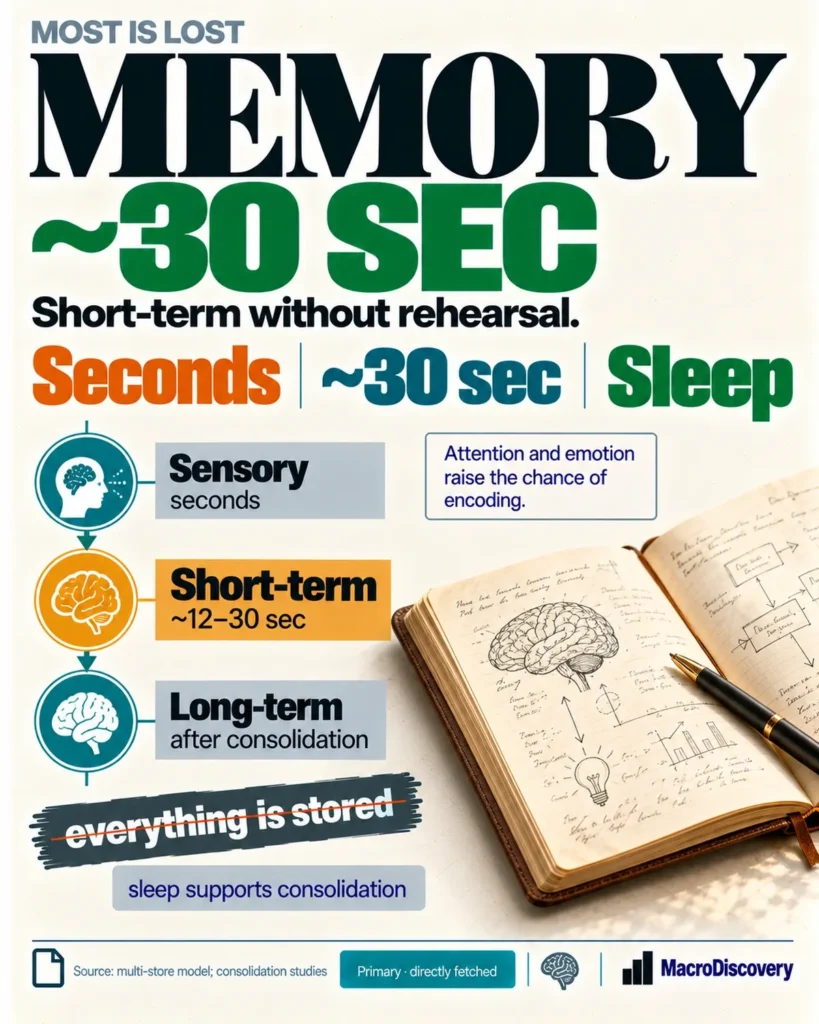
At the cellular level, the leading candidate mechanism is long-term potentiation (LTP), a persistent increase in the strength of synaptic transmission. It has been studied extensively at hippocampal synapses. Early phases of LTP can form rapidly, but lasting forms (beyond one to three hours in slices) require de novo protein synthesis. This synaptic consolidation stabilizes the change at the local connection. Systems consolidation operates on a longer scale. Many episodic memories initially depend on the hippocampus. Over days to weeks or longer, the supporting circuitry reorganizes so that the memory becomes less dependent on the hippocampus and more distributed across neocortical networks. Sleep and offline reactivation support this reorganization. Not every trace completes both stages. Weak or unrehearsed information often fails to stabilize and is lost, matching the steep early portion of the forgetting curve.
The difference between a memory that lasts minutes and one that lasts years is therefore the difference between a labile trace that is not consolidated and one that undergoes synaptic strengthening plus systems-level reorganization. Emotional significance, repetition and sleep increase the probability of consolidation. The measured forgetting curve shows that, without these processes, loss is rapid and front-loaded. The science of memory is the science of selective stabilization: most input decays; a subset is reinforced at the synapse and redistributed across the brain.
| Process | Time scale | What it does |
|---|---|---|
| Initial encoding | Seconds to minutes | Labile trace; high risk of loss |
| Synaptic consolidation / LTP | Minutes to hours | Protein-synthesis-dependent synaptic strengthening |
| Systems consolidation | Days to years | Shift from hippocampus to distributed cortical storage |
| Forgetting curve | Steep in first hours | ~58% savings at 20 min; ~34% at 24 h without review |
Ebbinghaus savings data from 1885; shape replicated by Murre & Dros 2015 (PLOS ONE). LTP mechanism from hippocampal physiology literature (Physiological Reviews and related). Systems consolidation from studies of hippocampal-to-cortical reorganization.
How it was measured
Ebbinghaus quantified retention by the savings method: the percentage reduction in relearning time. Murre and Dros repeated the procedure and confirmed the curve. LTP is measured as a lasting increase in synaptic response after high-frequency stimulation in hippocampal slices or in vivo. Systems consolidation is inferred from the changing dependence of memory on the hippocampus versus cortex over time, supported by lesion, imaging and optogenetic studies. The claim of all-or-nothing memory is contradicted by the measured early loss and the multi-stage consolidation process.
What it means
It is settled that forgetting is steepest in the first hours after learning, as measured by Ebbinghaus and replicated in 2015. It is settled that LTP is a persistent synaptic change requiring protein synthesis for lasting forms. It is settled that many memories undergo systems consolidation from hippocampus to cortex. It is not settled that LTP is the sole cellular mechanism of every memory, or that every memory fully migrates. Use the savings percentages and the consolidation stages as the measured framework. Do not treat memory as either permanent or instantly erased.
Common misreadings
- Forgetting is not uniform. Most loss occurs early, then slows.
- An “approved” or encoded experience is not yet a lasting memory. Consolidation is required.
- Long-term potentiation is a cellular candidate, not a complete explanation of every lasting memory.
Where the numbers come from
How we built this
- Dataset: Ebbinghaus 1885 savings data and 2015 replication. Hippocampal LTP physiology. Systems consolidation literature.
- Scope: Early forgetting curve. Synaptic consolidation via LTP. Systems-level reorganization.
- Figures: ~58% savings at 20 min. ~34% at 24 hours. LTP as cellular mechanism.