The Science of Sleep Cycles
What happens to the brain during the eight hours most people are asleep.
A sleep cycle lasts about 90 to 110 minutes and repeats four to six times a night. N2 light sleep is about 45% of the night. Deep N3 sleep dominates early cycles. REM dominates later ones. Brain activity in REM looks close to waking.
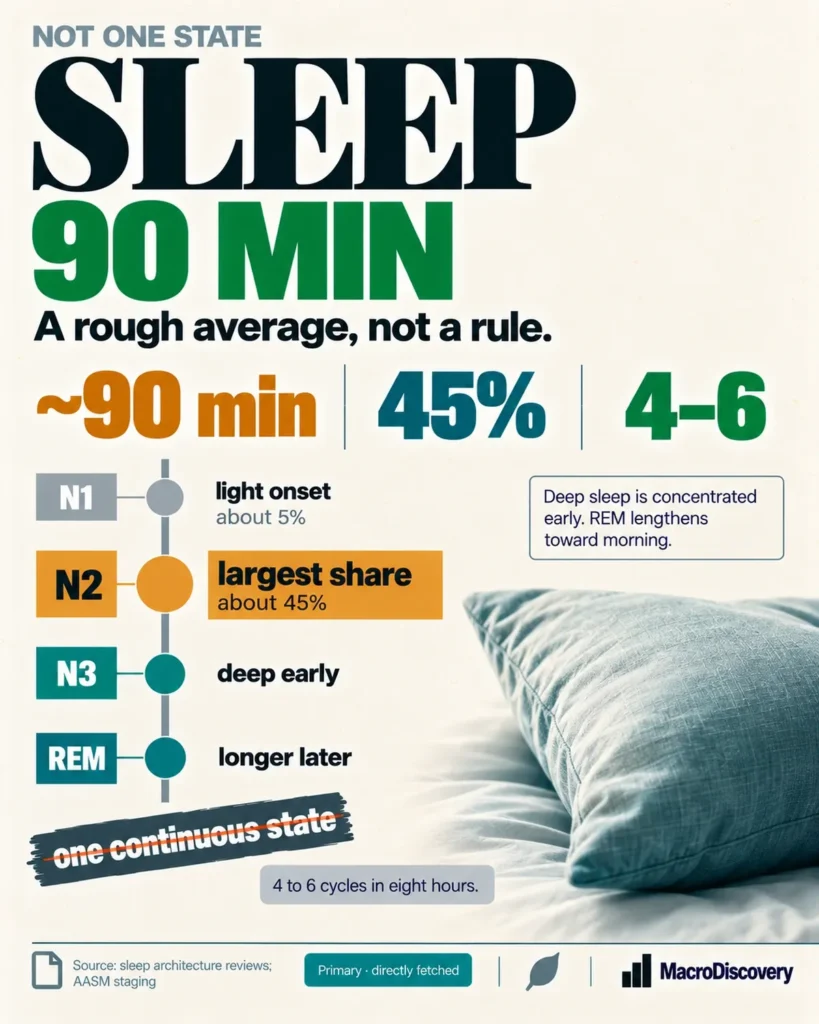
Three numbers
- 90–110 minutes — length of one full sleep cycle in healthy adults. Source: StatPearls, NHLBI.
- 4–6 — cycles completed in a typical full night. Source: StatPearls.
- ~45% — share of the night spent in N2 light sleep, the largest stage. Source: Sleep literature summaries.
What the data shows
A common claim is that sleep is one continuous state and that the brain simply switches off. The fact is that sleep is a sequence of distinct stages, repeated in cycles. A typical adult cycle lasts about 90 to 110 minutes and moves through N1, N2, N3 and REM. Most adults complete four to six cycles in a full night. The composition of those cycles changes as the night progresses.
N2 is the largest share. It accounts for roughly 45% of total sleep time and is marked by sleep spindles and K-complexes on the EEG. N3, deep slow-wave sleep, is concentrated in the first half of the night and declines with each cycle. REM starts short — about 10 minutes in the first cycle — and lengthens toward morning, sometimes reaching an hour. In REM the brain’s electrical activity looks close to waking, the eyes move rapidly, and most skeletal muscles go limp. Vivid dreams are most common here.
The practical result is that the first half of the night is dominated by deep sleep and the second half by longer REM periods. Cutting a night short removes mostly REM. Going to bed late removes mostly deep sleep. The 90-minute figure is an average, not a clock. Individual cycles vary, and the first is often shorter than later ones. The brain does not rest uniformly. It cycles through stages with different electrical signatures and different functions.
| Stage | Share of night | What the brain does |
|---|---|---|
| N1 | ~5% | Transition from wake. Theta waves. Brief. |
| N2 | ~45% | Spindles and K-complexes. Largest share. |
| N3 | ~20–25% | Slow delta waves. Deep. Early cycles. |
| REM | ~20–25% | Wake-like activity. Dreaming. Later cycles. |
Figures are typical adult ranges. Deep and REM shares decline with age. Sources: StatPearls, NHLBI, sleep literature summaries.
How it was measured
Sleep stages are scored from polysomnography: EEG for brain waves, eye movements and muscle tone. Modern AASM scoring divides sleep into N1, N2, N3 and REM. Cycle length is the interval from the start of one REM period to the next, averaging 90–110 minutes. Stage shares are from normative adult data. The “brain switches off” claim is contradicted by the EEG: N3 shows slow high-amplitude waves, and REM shows fast activity similar to waking.
What it means
It is settled that sleep is organised into cycles of roughly 90–110 minutes, repeated four to six times a night, and that N2 is the largest stage. It is settled that deep sleep dominates early cycles and REM dominates later ones. It is not settled that every cycle is exactly 90 minutes or that every adult gets the same stage shares. Use 90–110 minutes for cycle length. Use 4–6 for the number of cycles. Use ~45% for N2. Do not treat sleep as a single uniform state.
Common misreadings
- Sleep is not one continuous state. It cycles through four stages with different brain activity.
- The 90-minute figure is an average. Cycles vary and the first is often shorter.
- Deep sleep is front-loaded. REM is back-loaded. Cutting the night short removes mostly REM.
Where the numbers come from
How we built this
- Dataset: StatPearls and NHLBI for cycle length and stage structure. Normative adult stage shares from sleep literature.
- Scope: Healthy adult architecture. Age-related decline in deep and REM noted. The 90-minute figure treated as an average, not a clock.
- Figures: 90–110 minutes is cycle length. 4–6 is the number of cycles. ~45% is N2. REM and N3 are each about 20–25%.