How GPS Works
Every phone knows where it is. Here is the science.
GPS is a timing system. At least four satellites are required. A one-nanosecond timing error equals about 30 cm of distance error. Typical phone accuracy under open sky is roughly 5 meters.
Three numbers
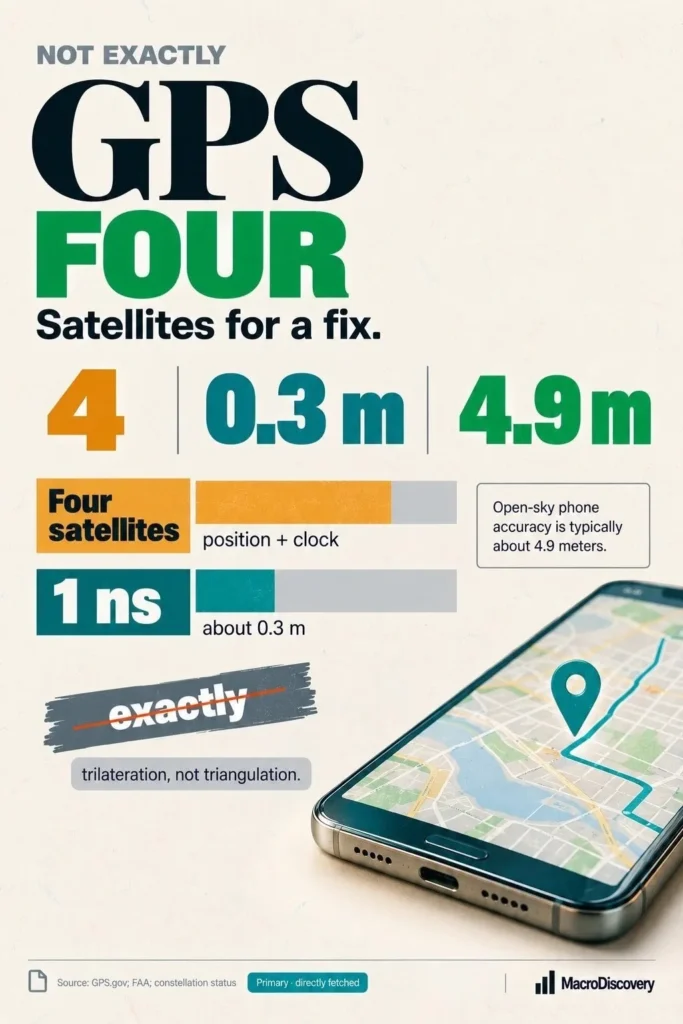
- Four — minimum satellites required. Three for position, one for the phone’s clock error. Source: GPS geometry.
- One nanosecond ≈ 30 cm — the distance error caused by a one-billionth-of-a-second timing error at the speed of light. Source: speed of light.
- Roughly 5 meters — typical smartphone accuracy under open sky. Source: GPS.gov and FAA performance reports.
What the system does
A common claim is that GPS works by satellites “seeing” your phone. The fact is that the phone only receives signals. Each GPS satellite carries atomic clocks and broadcasts its position and the exact time the signal left. The phone measures how long the signal took to arrive. Distance equals that time multiplied by the speed of light. The phone solves for its own position from those distances.
Three satellites are enough to locate a point in three dimensions if the phone’s clock is perfect. The phone’s clock is not perfect. A fourth satellite solves for the phone’s clock error at the same time. That is why at least four satellites are required. The operational constellation keeps at least 24 satellites in six orbital planes so that four or more are visible from almost anywhere on Earth. The current operational count is higher, typically around 31–32.
Timing is the limiting factor. Light travels about 30 cm in one nanosecond. A one-microsecond error produces about 300 meters of distance error. GPS satellites carry atomic clocks accurate to nanoseconds and are corrected from the ground. Relativity also matters. Satellite clocks run fast relative to clocks on Earth because of weaker gravity and slower relative to clocks on Earth because of orbital speed. Both effects are corrected in the signal. Typical smartphone accuracy under open sky is roughly 5 meters. Accuracy worsens under trees, between tall buildings, or indoors because signals are blocked or reflected.
| Timing error | Distance error |
|---|---|
| 1 nanosecond | ~30 cm |
| 100 nanoseconds | ~30 m |
| 1 microsecond | ~300 m |
| 1 millisecond | ~300 km |
Distance = speed of light × time. 299,792,458 m/s × 1 ns ≈ 0.3 m. These are ranging errors to one satellite, not the final position error after geometry is solved.
How a fix is calculated
The phone receives signals from at least four satellites. Each signal includes the satellite’s position and the time the signal was sent. The phone records the arrival time on its own clock. The difference is the travel time. Travel time multiplied by the speed of light is the distance to that satellite. The phone then solves a system of equations for four unknowns: latitude, longitude, height, and its own clock offset. Additional satellites improve the geometry and reduce error. Atmospheric delays and reflected signals are corrected or filtered by the receiver.
What it means
It is settled that GPS is a timing system, that at least four satellites are required, and that a one-nanosecond error equals about 30 cm of distance error. It is not settled that every phone achieves 5-meter accuracy in every environment. Use four for the minimum. Use 1 ns ≈ 30 cm for the timing-to-distance conversion. Use roughly 5 meters for typical open-sky phone accuracy. Do not treat GPS as a system in which satellites locate the phone.
Common misreadings
- Satellites do not track the phone. The phone only receives signals.
- Three satellites are not enough for a full fix because the phone’s clock is not atomic.
- Indoor or urban accuracy is worse than open-sky accuracy because signals are blocked or reflected.
Where the numbers come from
How we built this
- Dataset: GPS.gov and FAA performance standards, atomic-clock timing literature, and standard trilateration geometry.
- Scope: Civilian Standard Positioning Service. Military encrypted signals and differential techniques noted as higher accuracy. Phone accuracy is open-sky typical, not indoor.
- Figures: Four is the minimum satellites. One nanosecond equals about 30 cm. Roughly 5 meters is typical open-sky phone accuracy. GPS is treated as a one-way timing system.