World’s Largest Databases
Tech companies hold the world’s largest databases. Science is a rounding error.
There is no ranking. The counted public stock is CERN’s 1 exabyte of collider data. Company totals are not published.
Three numbers
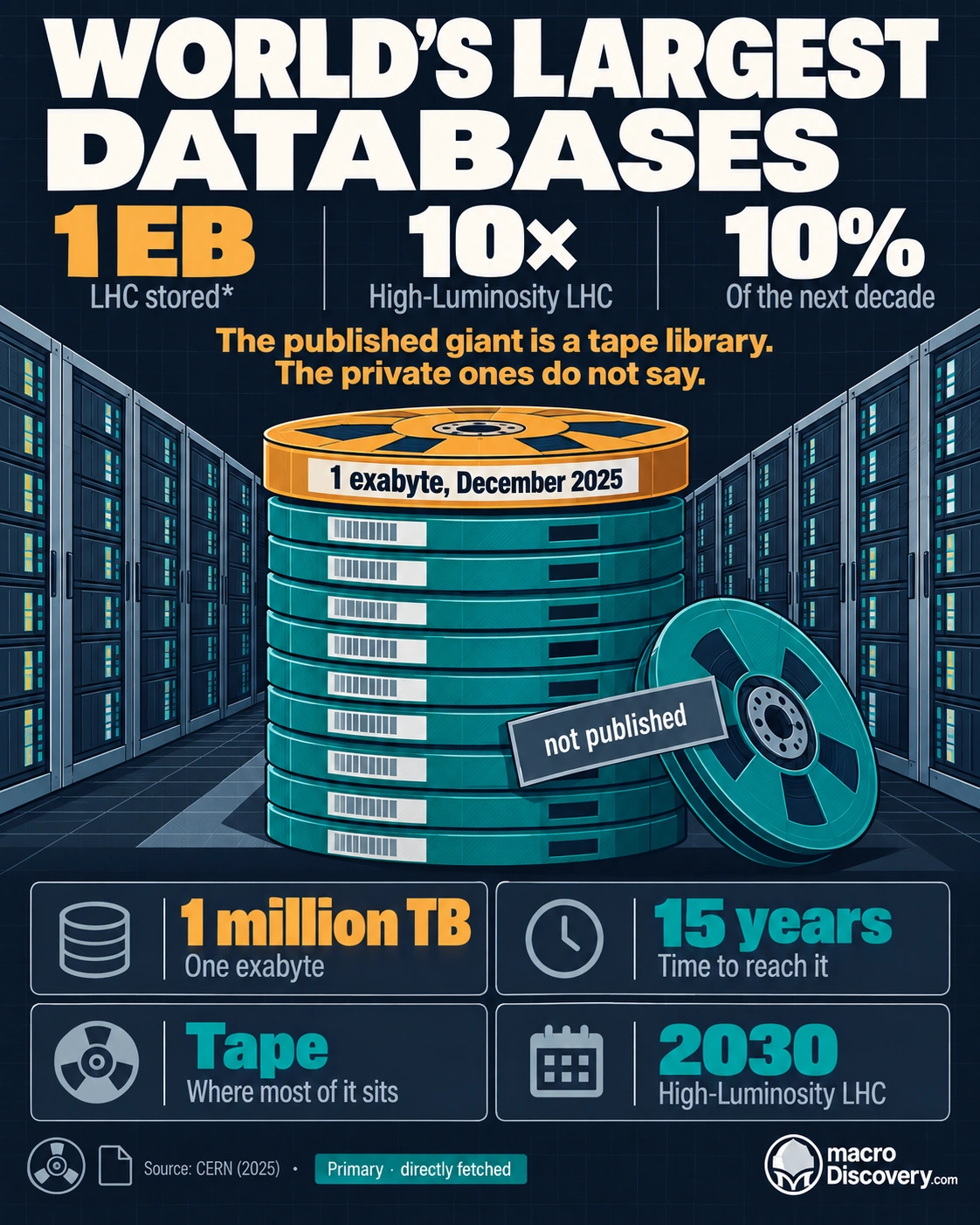
- 1 exabyte — experimental data from the Large Hadron Collider stored at CERN by December 2025. One million terabytes. Source: CERN.
- 34 trillion — base pairs in GenBank, from more than 4.7 billion sequences. A sequence count, not an exabyte. Source: NCBI, 2025 update.
- No published total — private platforms do not release a stored-byte census comparable to CERN’s. A claim that they are larger is not a count.
What the data shows
A common claim is that tech companies hold the world’s largest databases, and that science is a rounding error. The fact is that “largest” has no shared unit, and the counted public stock is a physics archive. In December 2025 CERN said it had stored 1 exabyte of experimental data from the Large Hadron Collider, after more than 15 years of running. An exabyte is a million terabytes. Most of it sits on magnetic tape, because analysis can happen years later. CERN said this stock is about 10% of what the next decade will require. The High-Luminosity upgrade, expected in the middle of the 2030s, is planned to generate about 10 times more data.
Biology publishes a different unit. GenBank’s 2025 update reported 34 trillion base pairs from more than 4.7 billion nucleotide sequences, for 581,000 formally described species. The archive exchanges records daily with the European Nucleotide Archive and the DNA Data Bank of Japan. A base pair is not a byte in this table. Adding 34 trillion to 1 exabyte is a unit error. The Worldwide LHC Computing Grid is a different object again: about 160 computing centres in more than 40 countries, built to move and analyse the collider’s output, not to be a single disk.
Private platforms can be larger. They have not published the stock. A search index, a video library, and an ad profile are not the same database, and none of them releases a figure next to CERN’s 1 exabyte. Older papers guessed at YouTube’s growth from upload rates. A guess is not a census. The claim that science is a rounding error treats an unpublished company total as a fact and a published archive as small. The ranking does not exist until the units match.
GenBank’s 34 trillion base pairs are left off this chart. A sequence is not an exabyte.
| Count | Figure | What it is |
|---|---|---|
| LHC stored data | 1 exabyte | December 2025. Mostly tape |
| Next decade | about 10 times | CERN’s own storage warning |
| GenBank sequences | 4.7 billion | 34 trillion base pairs. Different unit |
| Species in GenBank | 581,000 | Formally described |
| Company stock | not published | No comparable census |
How it was measured
CERN counts experimental data sent to its storage system. Raw collisions are filtered before that step. The 1 exabyte is the stored remainder, not every proton collision. Tape is the archive. Disk is the working copy. The grid figure of about 160 centres is a collaboration count, not a second exabyte.
GenBank counts nucleotide sequences and base pairs. Daily exchange with two partner archives is meant to avoid a split record, not to triple the total. A video hour and a gene sequence cannot be ranked against an exabyte without a conversion the archives do not publish.
What it means
It is settled that CERN had stored 1 exabyte of LHC data by December 2025, and that GenBank held 34 trillion base pairs. It is not settled that a tech company is larger, or that science is a rounding error. Use 1 exabyte for the counted physics stock. Use 34 trillion only for base pairs. Use “not published” for company totals. Do not rank them on one chart.
Common misreadings
- There is no world’s-largest database. The units do not match.
- 1 exabyte is stored collider data, not every collision, and not a company index.
- 34 trillion base pairs are not 34 trillion bytes. Do not add them to the exabyte.
Where the numbers come from
How we built this
- Dataset: CERN’s December 2025 storage milestone; GenBank 2025 sequence totals; WLCG centre count.
- Scope: Published stocks only. Company indexes and video libraries are marked unpublished. No conversion of base pairs into bytes.
- Figures: 1 exabyte is the LHC store. 34 trillion is base pairs. The company bar is a missing number, not a size.