Home AI Technology Gaming Future Automobile Geography Top 10 Trending How To Discover
---Advertisement---

What Happens When 1 Billion Tonnes of Food Go to Waste? – Food Waste Crisis

Macro Discovery
On: August 15, 2026 7:27 AM
Follow Us:
---Advertisement---
Global Food Waste Crisis , How much food is wasted globally each year? , How much does food waste contribute to climate change? , Which country wastes the most food? , What is being done to reduce food waste globally? , What is the economic cost of food waste? ,
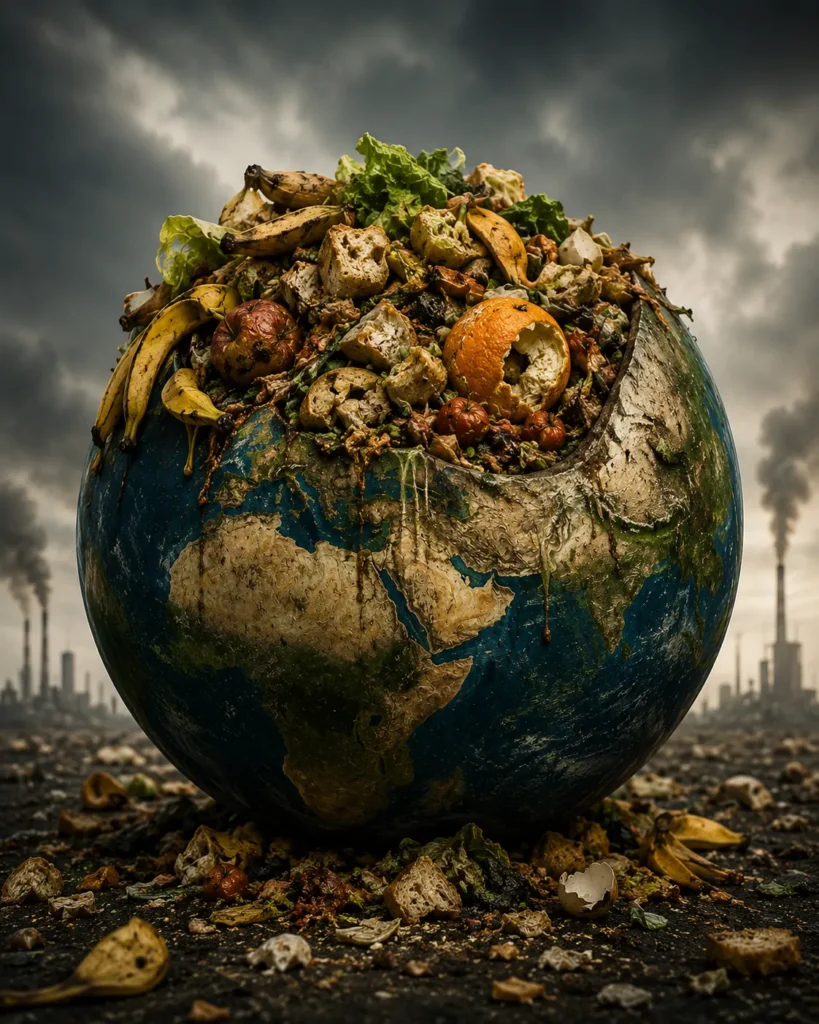
Food Waste Crisis represented by Earth overflowing with wasted food
Food Waste Crisis
Visualized: The Global Food Waste Crisis — MacroDiscovery
MacroDiscovery
Food Systems & Climate · 5 min read · UNEP Mar 2024 · UN SDG 2025 · FAO · Primary
UNEP — Food Waste Index Report 2024 (PRIMARY · unep.org · directly fetched · March 27, 2024 · co-authored with WRAP · 93 countries · 2022 data) · UN SDG Progress Report 2025 (PRIMARY · unstats.un.org · published July 2025 · Goal 12) · FAO Food Loss Index (PRIMARY · fao.org)
Food Systems · Climate · SDG 12.3

Visualized: The Global
Food Waste Crisis

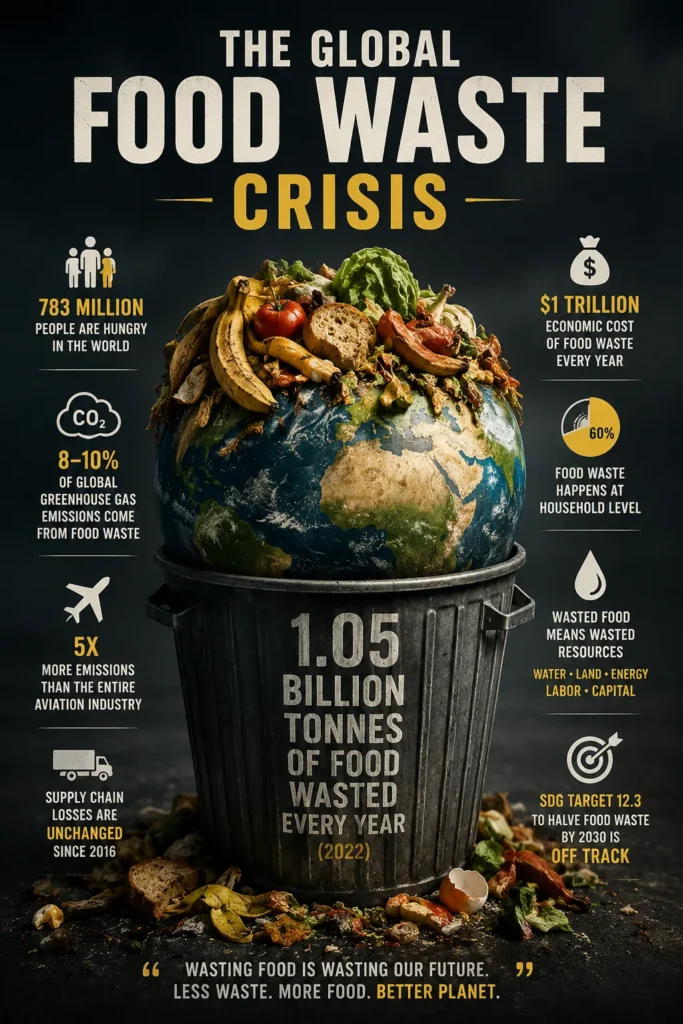
In 2022, the world wasted 1.05 billion tonnes of food — while 783 million people went hungry. That wasted food generates 8-10% of global greenhouse gas emissions, five times more than the entire aviation industry. The SDG target to halve food waste by 2030 is off track. Supply chain losses are unchanged from 2016. Here is what the data actually shows.

By MacroDiscovery
Source: UNEP Food Waste Index 2024 (primary · unep.org · directly fetched) · UN SDG Report 2025 (primary · 1 week ago)
Quote: “Food waste is a global tragedy.” — Inger Andersen, UNEP Executive Director
1.05B
tonnes of food wasted in 2022 · = 132 kg per capita · = almost one-fifth of all food available · UNEP primary · March 2024
783M
people facing hunger while the world wastes over 1 billion meals every single day · UNEP/UN primary
8–10%
of global greenhouse gas emissions from food waste · “almost 5 times that of the aviation sector” · UNEP verbatim
−31%
Japan’s food waste reduction · UK: −18% · “change at scale is possible” · UNEP primary · What success looks like
Visualization 01 — Where Food Is Lost and Wasted · 2022 Data
32% of All Food Produced Never Gets Eaten — Here Is Where It Goes

Food is lost and wasted at every stage of its journey — from farm to fork. The scale is a third of all food produced, every year. Sources: UNEP Food Waste Index Report 2024 (primary · unep.org · directly fetched · March 27, 2024) · FAO Food Loss Index (primary · fao.org) · UN SDG Progress Report 2025 (primary · unstats.un.org · July 2025).
The Full Journey — What Happens to Every 100kg of Food Produced
13%
Supply
Chain
19%
Consumer
Waste
~68% — Food that actually reaches and feeds people
13.2% Lost — supply chain (post-harvest to retail) · FAO primary · “unchanged from 2016” · UN SDG 2025
19% Wasted — retail, food service & households · UNEP 2024 · = 1.05 billion tonnes in 2022
~68% — food that actually nourishes people
Total: 32% of all food produced is lost or wasted. Combined, 1.05B tonnes at consumer level + 13% through supply chains. Source: UNEP Food Waste Index 2024 (primary · directly fetched) + FAO (primary)
Where Consumer-Level Waste Happens — the 1.05 Billion Tonnes
60% — Households · 631M tonnes
28% — Food service · 290M t
12% Retail
Households: 60% · 631 million tonnes · “most food waste comes from households” · UNEP verbatim
Food service: 28% · 290 million tonnes · restaurants, cafeterias, catering
Retail: 12% · 131 million tonnes · supermarkets, shops
132 kg
Per capita · total
= 1.05B tonnes ÷ 8B people
Every person on Earth is associated with 132 kg of wasted food per year — including inedible parts
79 kg
Per capita · household
= 631M tonnes ÷ 8B people
79 kg per person per year wasted at home — equivalent to over 1 billion household meals daily
7 kg
Rich vs poor gap
High vs lower-middle income
The difference in household food waste between high- and lower-middle-income countries is just 7 kg per capita per year
Food Waste Crisis infographic showing 1.05 billion tonnes of food wasted globally
Food Waste Crisis
Visualization 02 — The Race to 2030 · SDG 12.3 Progress Timeline
The World Promised to Halve Food Waste by 2030. The Data Says It Is Not on Track.

SDG Target 12.3 commits countries to halving per capita food waste by 2030. Source: UN SDG Progress Report 2025 (primary · unstats.un.org · published July 2025 · “unchanged from 2016 and far from the target”) · UNEP Food Waste Index 2024 (primary · directly fetched) · WRAP COP29 briefing (November 2024).

2015
Target set
The UN Adopts SDG 12.3: Halve Global Per Capita Food Waste by 2030. 193 Countries Sign On.
In September 2015, 193 UN member states adopted the Sustainable Development Goals, including SDG 12.3: to halve per capita global food waste at the retail and consumer levels, and reduce food losses along production and supply chains, by 2030. At the time, the global scale of food waste was not well quantified. The 2021 UNEP Food Waste Index Report would provide the first systematic global estimate, covering 54 countries. It revealed the problem was larger than expected — and not confined to wealthy nations.
SDG 12.3 adopted · 193 countriesTarget: halve by 2030
Mar 2024
The data
UNEP Food Waste Index 2024: 1.05 Billion Tonnes Wasted. A Fifth of All Food. “A Global Tragedy.”
On March 27, 2024, the UN Environment Programme published the Food Waste Index Report 2024 — the most comprehensive assessment of global food waste ever produced, covering 93 countries. The finding: 1.05 billion tonnes of food wasted in 2022 at the consumer level, 132 kg per capita, generating 8-10% of global greenhouse gas emissions — almost five times the aviation sector. “Food waste is a global tragedy,” said UNEP Executive Director Inger Andersen. “Millions will go hungry today as food is wasted across the world.” The data also showed that food waste is not just a rich-country problem: the gap between high- and lower-middle-income countries is just 7 kg per person per year.
1.05B tonnes wasted · 20228-10% of global GHG“Global tragedy” — AndersenNot just rich countries: 7kg gap
Nov 2024
COP29 gap
COP29: 88% of Attending Countries Had No Food Waste Commitments in Their Climate Plans.
At COP29 in Baku, WRAP — co-author of the UNEP Food Waste Index — presented a damning finding: 88% of the countries attending COP29 had made no commitments to tackle food loss or waste in their Nationally Determined Contributions (NDCs). Only 21 countries had included food waste in their national climate plans as of 2022. Food loss and waste generates 8-10% of global greenhouse gas emissions — yet it features in almost no government climate commitments. WRAP’s CEO called for “greater coordinated action across continents and supply chains.”
88% COP29 countries: no food NDCsOnly 21 countries: food in NDCs8-10% GHG · absent from plans
Jul 2025
Off track
UN SDG Progress Report 2025: Supply Chain Food Loss “Unchanged from 2016 and Far from the Target.”
The UN SDG Progress Report 2025, published just weeks ago, confirmed that global food loss in the supply chain stands at 13.2% — unchanged from 2016 and “far from the target of halving post-harvest food losses by 2030.” At the consumer level, food waste remains at 1.05 billion tonnes. With five years left to the deadline, no major improvement in supply chain losses has occurred in nearly a decade. Only four G20 countries — Australia, Japan, the UK, and the USA — plus the EU have data systems capable of tracking SDG 12.3 progress at all.
13.2% loss: unchanged from 2016“Far from the target” · UN verbatimOnly 4 G20 + EU tracking progress
2030
Deadline
The 2030 Deadline: Halve Food Waste. At Current Pace: Projected 2.1 Billion Tonnes by 2030, Costing $1.5 Trillion.
If the current trend continues without intervention, WRAP estimates global food waste will reach 2.1 billion tonnes per year by 2030, costing $1.5 trillion. Instead of halving the problem, the world is on track to nearly double it. Japan and the UK demonstrate that large-scale reduction is achievable — Japan cut food waste by 31% through sustained national policy and public-private partnerships; the UK reduced household food waste per capita by more than a quarter between 2007 and 2018 through similar mechanisms. But these remain the exception. The majority of the world has not yet started measuring food waste at the scale required to reverse it.
Projected: 2.1B tonnes by 2030Cost: $1.5T (if trend continues)Japan: −31% · UK: −18% proof possible

The numbers are hard to process. One billion tonnes of food — every year — thrown away. At the same moment, 783 million people go hungry. The wasted food uses a third of the world’s agricultural land, guzzles a fifth of its water applied to agriculture, and generates greenhouse gas emissions five times larger than the entire aviation industry. It is one of the most solvable large-scale problems that humanity consistently fails to solve.

UNEP Food Waste Index Report 2024 · PRIMARY · unep.org · directly fetched · March 27, 2024
1.05B
“Food waste is a global tragedy. Millions will go hungry today as food is wasted across the world.” — Inger Andersen, Executive Director of UNEP · March 27, 2024
The UNEP Food Waste Index Report 2024 found that 1.05 billion tonnes of food were wasted at the consumer level in 2022 alone — 132 kg per person — amounting to almost one-fifth of all food available. At the household level, the average person wastes 79 kg per year, equivalent to more than one billion household meals discarded every single day. This is in addition to the 13.2% of food lost earlier in the supply chain from post-harvest to retail, according to the FAO. Combined, roughly 32% of all food produced on Earth never nourishes anyone. The wasted food alone — if it were a country — would be the world’s third-largest emitter of greenhouse gases.
Source: UNEP — “World squanders over 1 billion meals a day” (PRIMARY · directly fetched · unep.org/news-and-stories/press-release/world-squanders-over-1-billion-meals-day-un-report · March 27, 2024 · “1.05 billion tonnes of food waste generated (including inedible parts), amounting to 132 kilograms per capita and almost one-fifth of all food available to consumers” · “60 per cent happened at the household level, with food services responsible for 28 per cent and retail 12 per cent” · “Food waste is a global tragedy. Millions will go hungry today as food is wasted across the world.” — Inger Andersen, Executive Director of UNEP)

“Not only is this a major development issue, but the impacts of such unnecessary waste are causing substantial costs to the climate and nature. The good news is we know if countries prioritise this issue, they can significantly reverse food loss and waste, reduce climate impacts and economic losses, and accelerate progress on global goals.”

— Inger Andersen, Executive Director, UN Environment Programme · UNEP primary (directly fetched · March 27, 2024)

Not a Rich-Country Problem — The 7 Kilogram Gap

The assumption that food waste is a wealthy-country indulgence is wrong. The UNEP Food Waste Index found that the average difference in household food waste between high-income and lower-middle-income countries is just 7 kilograms per capita per year. Populations in hotter climates tend to generate more waste per capita — not because they are richer but because they consume more fresh foods with substantial inedible parts and often lack robust cold chains. The structural causes of food waste look different between rich and poor countries: in wealthy nations, consumers over-buy and discard food past arbitrary best-before dates; in lower-income nations, inadequate infrastructure means food spoils before it can be eaten or sold. Both end in waste. Neither is adequately addressed in national climate policies.

Why it matters: most food policy treats waste as a consumer behaviour problem in rich countries. The UNEP data shows it is a food system infrastructure problem everywhere — and that the solutions need to match the cause rather than the stereotype.
UN SDG Progress Report 2025 · PRIMARY · unstats.un.org · July 2025 · Goal 12 · One week ago
32%
Combined, 32% of all food produced globally is lost or wasted — 13.2% in the supply chain (FAO) plus 19% at the consumer level (UNEP). Supply chain losses are “unchanged from 2016 and far from the target.”
The UN SDG Progress Report 2025 — published just weeks ago — confirmed that global food loss in the supply chain stands at 13.2% in 2021, unchanged from 2016 and “far from the target of halving post-harvest food losses by 2030.” This is the most authoritative and current assessment available. At the economic level, the toll is roughly $1 trillion annually in direct economic costs, according to World Bank estimates cited by UNEP — alongside $700 billion in environmental costs and $900 billion in social costs calculated by the FAO, representing a true systemic cost of approximately $2.6 trillion per year.
Source: UN SDG Progress Report 2025 (PRIMARY · unstats.un.org/sdgs/report/2025/goal-12/ · published July 2025 · verbatim: “The percentage of food lost globally…is estimated at 13.2% in 2021, unchanged from 2016 and far from the target of halving post-harvest food losses by 2030”) · UNEP primary (directly fetched · $1 trillion: “estimated at roughly USD 1 trillion” · World Bank cited by UNEP) · FAO: $700B environmental + $900B social costs

Japan’s 31% Reduction — and What It Actually Takes to Fix This

Japan reduced national food waste by 31%. The UK reduced household food waste per capita by more than a quarter between 2007 and 2018. Both used the same core mechanism: sustained national policy combined with public-private partnerships that brought government, retailers, food manufacturers, and hospitality businesses into binding commitments. Japan’s approach centred on a national food waste reduction law, mandatory business reporting, and consumer campaigns. The UK’s WRAP programme created industry-level agreements with major supermarkets and food manufacturers, generating measurable and independently verified reductions. Neither result happened quickly. Neither happened without policy. The UNEP report names these as the only two countries showing “that change at scale is possible.” Five years remain until the 2030 deadline. Most of the world has not started.
Why it matters: food waste reduction is achievable at national scale without new technology — Japan and the UK prove it. What it requires is sustained political commitment, industry accountability, and measurement rigorous enough to verify real change.
UNEP PRIMARY (directly fetched) · WRAP COP29 Briefing · November 2024
Food loss and waste generates 8-10% of annual global greenhouse gas emissions — “almost 5 times that of the aviation sector.” Yet 88% of countries at COP29 had no food waste commitments in their climate plans.
The comparison to aviation is striking because aviation is discussed as a major climate challenge while food waste — which emits five times more — rarely features in the same conversations. Food waste also takes up the equivalent of almost a third of the world’s agricultural land. That land absorbs freshwater, releases fertiliser runoff, and drives deforestation. Reducing food waste is therefore simultaneously a climate intervention, a land-use intervention, and a water intervention — one of the few actions that improves multiple planetary boundaries simultaneously. And it is off every major government’s radar: at COP29, 88% of attending countries had made no commitment on food loss or waste in their climate plans.
Source: UNEP Food Waste Index 2024 (PRIMARY · directly fetched · “food loss and waste generates 8-10 per cent of annual global greenhouse gas (GHG) emissions – almost 5 times that of the aviation sector”) · WRAP COP29 Briefing (November 13, 2024 · wrap.ngo · “88% of countries attending COP29 have no commitments to tackle food loss or waste in their Nationally Determined Contributions”)
Key Numbers at a Glance
Scale · UNEP 2024
1.05B
Tonnes of food wasted at consumer level in 2022 — 132 kg per person, almost one-fifth of all food available. Plus 13.2% lost earlier in supply chains.
UNEP Food Waste Index 2024 (primary)
Climate · UNEP/IPCC
8–10%
Of global greenhouse gas emissions from food loss and waste — almost five times the entire aviation sector. Takes up 1/3 of world’s agricultural land.
UNEP primary (directly fetched)
Economy · World Bank/FAO
$1T
Annual economic cost of food loss and waste. Plus $700B in environmental costs and $900B in social costs (FAO) — $2.6T true total cost per year.
UNEP primary (citing World Bank)
Progress · Success Stories
−31%
Japan’s food waste reduction. UK: −18%. Both via sustained national policy and public-private partnerships. UNEP: “change at scale is possible.”
UNEP Food Waste Index 2024 (primary)
Frequently Asked Questions
How much food is wasted globally each year?
1.05 billion tonnes of food were wasted at the consumer level (retail, food service, and households) in 2022, according to the UNEP Food Waste Index Report 2024 — the most comprehensive global assessment ever produced, covering 93 countries. That amounts to 132 kg per capita and almost one-fifth of all food available to consumers. In addition, the FAO estimates a further 13.2% of food is lost earlier in the supply chain (post-harvest to retail), bringing the combined total to roughly 32% of all food produced. Source: UNEP (primary · directly fetched · March 27, 2024) · FAO · UN SDG Report 2025 (primary · July 2025).
How much does food waste contribute to climate change?
8-10% of global greenhouse gas emissions — “almost 5 times that of the aviation sector,” according to the UNEP Food Waste Index Report 2024 (primary, directly fetched). Food waste also takes up the equivalent of almost a third of the world’s agricultural land. If food waste were a country, it would be the world’s third-largest emitter of greenhouse gases. Despite this, 88% of countries at COP29 (November 2024) had no commitments on food loss or waste in their national climate plans (NDCs), according to WRAP, co-author of the UNEP report.
Which country wastes the most food?
The UNEP Food Waste Index 2024 found that food waste is not primarily a rich-country problem. The difference in household food waste between high-income and lower-middle-income countries is just 7 kg per capita per year. Hotter countries tend to generate more waste due to higher consumption of fresh foods and weaker cold-chain infrastructure. Only four G20 countries (Australia, Japan, the UK, and the USA) plus the EU have data systems suitable for tracking food waste at the scale needed to monitor SDG 12.3 progress. Most of the world lacks this baseline measurement. Source: UNEP primary (March 27, 2024).
What is being done to reduce food waste globally?
Not enough, and not fast enough. The UN SDG 12.3 target requires halving food waste by 2030. The UN SDG Progress Report 2025 confirmed that supply chain food losses stand at 13.2% — “unchanged from 2016 and far from the target.” However, Japan has reduced food waste by 31% and the UK by 18%, both through sustained national policy combined with public-private partnerships. UNEP identifies these as proof that “change at scale is possible.” As of 2024, 530 food-related sustainability policies had been submitted across 71 countries — up 6% from 2023. But 88% of COP29 countries had no food waste commitments at all.
What is the economic cost of food waste?
Approximately $1 trillion per year in direct economic costs, according to World Bank estimates cited by UNEP in the Food Waste Index 2024. The FAO adds a further $700 billion in environmental costs and $900 billion in social costs — bringing the full estimated cost to approximately $2.6 trillion per year. WRAP projects this will rise to $1.5 trillion in economic costs alone by 2030 if current trends continue. This occurs while 783 million people face hunger and 2.3 billion people were moderately or severely food insecure in 2024. Source: UNEP primary (directly fetched) · World Bank · FAO · WRAP.
Sources
  • UNEP — “World squanders over 1 billion meals a day — UN report” (PRIMARY · directly fetched · unep.org/news-and-stories/press-release/world-squanders-over-1-billion-meals-day-un-report · March 27, 2024 · KEY VERBATIM: “In 2022 there were 1.05 billion tonnes of food waste generated (including inedible parts), amounting to 132 kilograms per capita and almost one-fifth of all food available to consumers” · “60 per cent happened at the household level, with food services responsible for 28 per cent and retail 12 per cent” · “Food waste is a global tragedy. Millions will go hungry today as food is wasted across the world.” — Inger Andersen, Executive Director of UNEP · “food loss and waste generates 8-10 per cent of annual global greenhouse gas (GHG) emissions – almost 5 times that of the aviation sector – and significant biodiversity loss by taking up the equivalent of almost a third of the world’s agricultural land” · “The toll of both food loss and waste on the global economy is estimated at roughly USD 1 trillion” (citing World Bank) · “only 21 countries have included food loss and/or waste reduction in their national climate plans (NDCs)” · “countries such as Japan and the UK show that change at scale is possible, with reductions of 31 per cent and 18 per cent respectively” · “food waste is not just a ‘rich country’ problem…differing…by just 7 kg per capita” · “hotter countries appear to generate more food waste per capita in households, potentially due to higher consumption of fresh foods with substantial inedible parts and a lack of robust cold chains” · “In the UK where they [PPPs] have helped cut over a quarter of household food waste per capita from 2007-18”)
  • UNEP — Food Waste Index Report 2024 (PRIMARY · unep.org/resources/publication/food-waste-index-report-2024 · published March 27, 2024 · co-authored with WRAP · 93 countries · 2022 data · “most accurate global estimate on food waste at retail and consumer levels” · Households: 631M tonnes · Food service: 290M tonnes · Retail: 131M tonnes · 79 kg per capita household waste · “at least 1 billion meals wasted every day” · “Only four G20 countries (Australia, Japan, UK, USA) and the EU have food waste estimates suitable for tracking progress to 2030”)
  • UN SDG Progress Report 2025 (PRIMARY · unstats.un.org/sdgs/report/2025/goal-12/ · published July 2025 · Goal 12 chapter · verbatim: “The percentage of food lost globally after harvest on farm, transport, storage, wholesale, and processing levels…is estimated at 13.2% in 2021, unchanged from 2016 and far from the target of halving post-harvest food losses by 2030” · “$1 trillion annual economic losses” · “Japan and the UK reduced food waste by 18 and 31 per cent, respectively” · “as of 2024, 530 policies related to sustainable consumption and production (SCP) were submitted across 71 countries, a 6 per cent increase from 2023”)
  • FAO — Food Loss Index (PRIMARY · fao.org · 13.2% food loss post-harvest to retail · “unchanged from 2016” · confirmed by UN SDG 2025 report · FAO full cost: $700B environmental costs + $900B social costs in addition to $1T economic costs)
  • WRAP — “Food waste contributes 10% to global emissions but 9 out of 10 countries’ NDCs fail to focus on food loss and waste” (PRIMARY · wrap.ngo · November 13, 2024 · COP29 briefing · “88% of countries attending COP29 have no commitments to tackle food loss or waste in their Nationally Determined Contributions” · “food loss and waste is predicted to top 2.1 billion tonnes per annum by 2030, costing $1.5 trillion” · Harriet Lamb CEO WRAP: “We need greater coordinated action across continents and supply chains”)
  • UNFCCC — “Food loss and waste account for 8-10% of annual global greenhouse gas emissions; cost USD 1 trillion annually” (September 30, 2024 · unfccc.int · confirming UNEP data · “2.3 billion people worldwide are estimated to have been moderately or severely food insecure in 2024”)
  • UN DESA / Social Development — “With 783 million people going hungry, a fifth of all food goes to waste” (social.desa.un.org · citing UNEP Food Waste Index 2024 · “the equivalent of 1.3 meals every day for everyone in the world impacted by hunger”)

Macro Discovery

Sukh Dhaliwal

Sukh Dhaliwal is the founder of Macro Discovery, an independent digital publication covering AI, technology, science, future trends, and global innovation through visual storytelling and data-driven analysis.

Join WhatsApp

Join Now

Join Facebook

Follow us

Leave a Comment