
The Economics of Cryptocurrency —
What the Data Actually Shows
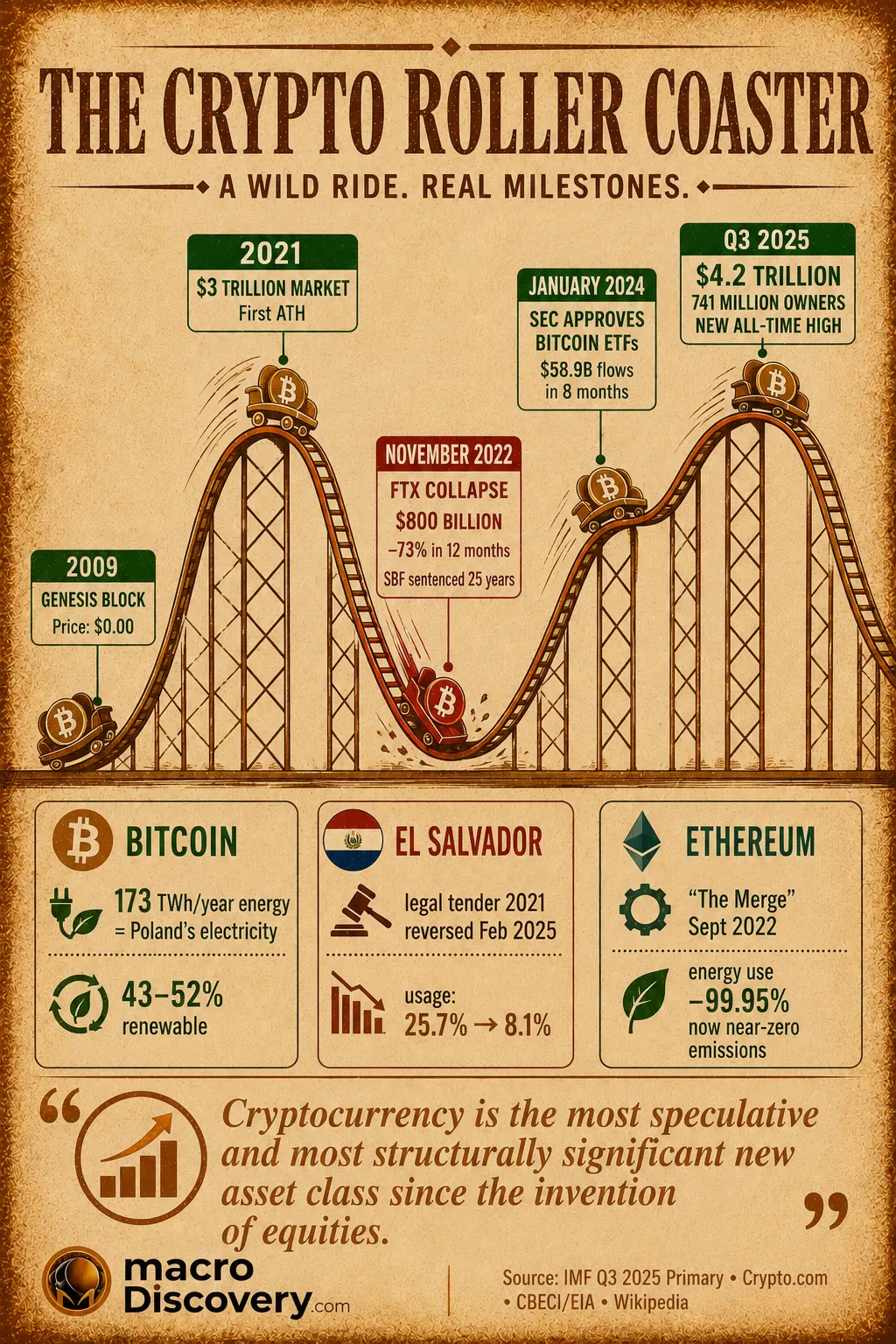
The global cryptocurrency market reached $4.2 trillion in Q3 2025 — a new all-time high — according to the IMF Crypto Assets Monitor (primary, October 2025). 741 million people now own some form of cryptocurrency. In January 2024, the SEC approved spot Bitcoin ETFs that attracted $58.9 billion in their first eight months — the fastest-growing ETF launch in US history. Yet El Salvador, which made Bitcoin legal tender in 2021, effectively reversed course in February 2025 after IMF loan conditions revealed what the data already showed: most Salvadorans had stopped using it. Cryptocurrency is simultaneously the fastest-growing financial asset class on earth and the most contested one.
| Asset type | Market cap | Holders / scale | Primary use case | Key characteristic |
|---|---|---|---|---|
| ₿ Bitcoin (BTC) | ~$2.35T | 365M holders (2025). $120B held by public companies. BTC ETFs: $58.9B inflows in first 8 months post-approval. | Store of value / “digital gold”. Fixed 21M supply cap. Deflationary by design. | 56% of total crypto |
| ⛤ Ethereum (ETH) | ~$390–520B | 175M holders (2025). +22.6% growth in 2025. Leading DeFi + smart contract platform. | Smart contracts, DeFi, NFTs, tokenisation. “The Merge” (Sept 2022): energy -99.95%. | ~12% of total crypto |
| 🎉 Stablecoins | $300B+ | Tether (USDT) $184B / USDC $76B. Cross-border payments: >40% of stablecoin transfers. Growing 14% Q2→Q3 2025. | Price stability pegged to fiat. Bridge between crypto and traditional finance. Rising regulatory attention. | Genius Act (US) / MiCA (EU) |
| 🌤 DeFi protocols | Rising TVL | Ethereum primary platform. Total value locked (TVL) and decentralised exchange volumes rising in Q3 2025 (IMF primary). | Decentralised lending, borrowing, trading without intermediaries or banks. | Accelerating Q3 2025 |
| 📜 Other altcoins | ~$1.5T combined | ~30% of market (IMF primary). Includes Solana, BNB, XRP, Cardano and 16,000+ others tracked (CoinGecko). | Varies: payments, smart contracts, Layer-2 scaling, DAOs, gaming tokens. | High volatility / high concentration risk |
Sources: Market cap and structure: IMF Crypto Assets Monitor Q3 2025 (primary, directly fetched, October 9, 2025). Holders: Crypto.com Market Sizing Report 2025 (primary, January 2026). Stablecoins (Tether/USDC): Visual Capitalist (November 2025) / CoinGecko. Bitcoin ETFs $58.9B: Bloomberg / Reuters. DeFi TVL: IMF Q3 2025 primary. CoinGecko: 16,489 cryptocurrencies across 1,497 exchanges tracked.
What Is Cryptocurrency — and What Economic Problem Does It Claim to Solve?
Cryptocurrency emerged from a specific economic argument, articulated in Satoshi Nakamoto’s 2008 Bitcoin white paper: that peer-to-peer electronic cash could allow payments without passing through a financial institution, eliminating both intermediary fees and the need to trust centralised authorities. The deeper economic case rests on Bitcoin’s fixed supply of 21 million coins — designed to make it immune to the inflationary money-printing that erodes purchasing power in fiat currencies. More than 90% of the maximum supply has already been mined. The counterargument from mainstream economics is that Bitcoin’s volatility makes it a poor unit of account and medium of exchange — the two functions a currency most needs to perform — while functioning better as a speculative asset or, for some holders, a store of value comparable to gold.
Why it matters: the core economic debate about cryptocurrency is not about technology — it is about whether a fixed-supply, decentralised asset can perform the functions of money, or whether it remains a new asset class in search of a stable use case.
The Bitcoin ETF Moment: Why January 2024 Changed the Asset Class
On January 11, 2024, the US Securities and Exchange Commission approved 11 spot Bitcoin exchange-traded funds — including offerings from BlackRock, Fidelity, Ark Investments, and Invesco — after years of rejections. BlackRock’s iShares Bitcoin Trust (IBIT) surpassed $15 billion in assets under management within three months, making it the fastest-growing ETF debut in US history. Total inflows into US spot Bitcoin ETFs reached $58.9 billion in their first eight months. The approval effectively allowed ordinary retail investors and large institutional funds to hold Bitcoin exposure within regulated brokerage accounts for the first time. The IMF Crypto Assets Monitor Q3 2025 (primary) notes public companies globally now hold $120 billion in Bitcoin, with exposures highest in the US, Japan, and Canada — a structural shift from crypto as a fringe asset to one embedded in mainstream financial portfolios.
Why it matters: the ETF approval transformed Bitcoin from an asset requiring specialist custody into one accessible through any brokerage account — removing the single largest barrier to institutional adoption.
The El Salvador Experiment: What Actually Happens When a Country Makes Bitcoin Legal Tender
In September 2021, El Salvador became the first country in the world to adopt Bitcoin as legal tender, driven by President Nayib Bukele’s stated goals of financial inclusion and reduced remittance costs. The government introduced the Chivo Wallet with a $30 sign-up bonus. The academic verdict, delivered by Fernando Alvarez, David Argente, and Diana Van Patten (NBER, University of Chicago Becker Friedman Institute), was direct: “everyday bitcoin use is low and concentrated among the banked, educated, young, and male population” — the opposite of the unbanked population financial inclusion was supposed to serve. Bitcoin usage fell from 25.7% of Salvadorans in 2021 to 8.1% by 2024 (Iudop/UCA surveys). In December 2024, El Salvador agreed to an IMF $1.4 billion loan on the condition of unwinding Bitcoin mandates. The Bitcoin legal tender requirement ended on February 7, 2025. The government still holds approximately 6,313 Bitcoin worth ~$702 million.
A bank-run dynamic played out in days: customers attempted to withdraw funds; FTX did not have them; trading was suspended; bankruptcy was filed. Founder Sam Bankman-Fried (SBF) was arrested and subsequently sentenced to 25 years in prison in March 2024 for fraud and conspiracy.
The total crypto market fell from approximately $3 trillion at its 2021 peak to roughly $800 billion by November 2022 — erasing an equivalent of two-thirds of the market’s value. The FTX collapse was not caused by blockchain failure or a technical hack. It was caused by conventional fraud: misappropriation of customer funds, false accounting, and undisclosed conflicts of interest.
The lesson: crypto exchanges, unlike banks, have no deposit insurance, no regulatory capital requirements, and no lender of last resort. The risk that FTX embodied is custodial risk — the same risk that existed in unregulated banking before the 20th century.
Sources: Bloomberg · Wikipedia: FTX collapse · Reuters · Statista.
Why it matters: El Salvador tested whether Bitcoin could function as a national currency; the FTX collapse tested whether unregulated crypto exchanges could be trusted. Both tests produced cautionary findings.
Energy, Stablecoins, and What the Next Phase of Cryptocurrency Economics Looks Like
Bitcoin consumes approximately 173 terawatt-hours of electricity annually — roughly equivalent to Poland’s entire electricity consumption and about 0.5% of global usage (Cambridge Bitcoin Electricity Consumption Index, via EIA, primary). Between 43% and 52.4% of Bitcoin mining now uses renewable energy. Ethereum eliminated 99.95% of its energy consumption by switching from Proof of Work to Proof of Stake in September 2022 (“The Merge”). The structural shift in the asset class’s next phase involves two parallel tracks: stablecoins — which have surpassed $300 billion and are attracting serious regulatory frameworks (the US Genius Act, the EU’s MiCA regulation) because they function as a real payment instrument — and institutional integration, as the IMF Q3 2025 data confirms crypto now represents 7% of the US equity market and 13% of the debt market in value terms.
Why it matters: the economic future of cryptocurrency is diverging into two tracks — speculative assets (Bitcoin as digital gold) and functional financial infrastructure (stablecoins, DeFi) — with different regulatory and adoption trajectories.
- The global crypto market reached $4.2 trillion in Q3 2025 — a new all-time high, up 13% from the previous record of $3.9 trillion in December 2024 (IMF Crypto Assets Monitor Q3 2025, primary, directly fetched).
- 741 million people worldwide own cryptocurrency in 2025, up 12.4% from 659 million in 2024. India, the US, and Pakistan lead global adoption (Crypto.com Research / IMF Chainalysis data).
- US spot Bitcoin ETFs attracted $58.9 billion in their first 8 months after SEC approval on January 11, 2024. BlackRock’s IBIT was the fastest-growing ETF debut in US history.
- El Salvador’s Bitcoin legal tender experiment effectively ended February 7, 2025 after Bitcoin usage declined from 25.7% of Salvadorans in 2021 to 8.1% in 2024, and an IMF $1.4B loan required unwinding mandates.
- Bitcoin consumes ~173 TWh annually — comparable to Poland’s electricity use — but 43–52.4% now comes from renewable energy (CBECI/Cambridge, via EIA primary).
- Ethereum eliminated ~99.95% of its energy consumption by switching to Proof of Stake in “The Merge” (September 2022), making it one of the cleanest major financial networks.
- Stablecoins surpassed $300 billion in market cap in Q3 2025, attracting formal regulatory frameworks (Genius Act / MiCA) as cross-border payment infrastructure (IMF primary).
Cryptocurrency is simultaneously the most speculative and most structurally significant new asset class since the invention of equities. Bitcoin’s $4.2 trillion market and $58.9 billion in ETF inflows show institutional adoption is real and accelerating. El Salvador’s failure shows that adoption cannot be mandated — that currency derives its value from network effects, not legislation. The FTX collapse showed that crypto custodians can fail exactly like unregulated banks did before deposit insurance existed. The question the economics raises is not whether cryptocurrency has value — the market has answered that — but which part of it provides durable, functional value, and which is still finding out.
- IMF — Crypto Assets Monitor Q3 2025 (primary · directly fetched · October 9, 2025 · Yokoyama et al. · “$4.2 trillion over Q3 2025 — new historical high” · BTC 56% dominance · stablecoins $300B+ +14% · public companies $120B Bitcoin · India/US/Pakistan top adopters · DeFi TVL rising · crypto = 7% US equity / 13% US debt markets)
- Crypto.com Research — Crypto Market Sizing Report 2025 (primary · January 2026 · 741 million global crypto owners 2025 · up 12.4% from 659M in 2024 · Bitcoin holders 365M +8.3% · ETH holders 175M +22.6% · institutional interest + pro-crypto US policies as catalysts)
- US Energy Information Administration (EIA) — “Tracking electricity consumption from US cryptocurrency mining operations” (primary · CBECI basis · Jan 2024 estimate: 80–390 TWh range, mid ~170 TWh · 2023 point estimate 120 TWh · lower/upper bounds methodology · US mining = 37.8% of global hashrate)
- Alvarez F, Argente D, Van Patten D — “Are Cryptocurrencies Currencies? Bitcoin as Legal Tender in El Salvador” (NBER Working Paper · Becker Friedman Institute, University of Chicago · primary · “everyday bitcoin use is low and concentrated among the banked, educated, young, and male population” · 75% would not have downloaded without $30 bonus · 20% continued after spending bonus)
- Wikipedia — Bitcoin in El Salvador (citing Iudop/UCA surveys · usage 25.7% (2021) → 8.1% (2024) · “7 February 2025: Bitcoin is no longer legal tender” · IMF $1.4B loan Dec 2024 condition · government holds ~6,313 BTC ~$702M · volcanic mining confirmed)
- SQ Magazine — Bitcoin Energy Consumption Statistics 2026 (citing CBECI, Digiconomist, EIA · ~173 TWh annually 2025 · ~0.5% global electricity · renewable share 43–52.4% · carbon 98.10 Mt CO2/yr · per-transaction ~1,335 kWh · comparable to Poland or Ukraine)