The World’s Largest Armies —
Military Power, Ranked
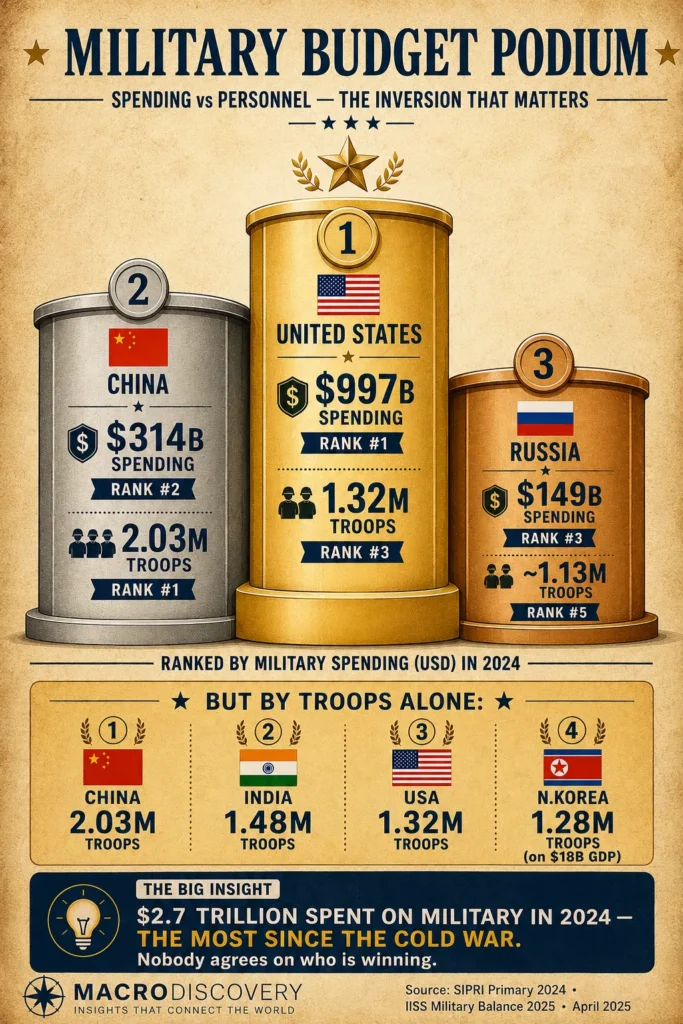
The United States spent $997 billion on its military in 2024 — 37% of all global military spending and 3.2 times more than China. Yet in active personnel, the US ranks third, behind China’s 2 million and India’s 1.5 million. Military spending and military headcount tell completely different stories. Meanwhile, the world spent more on preparing for war in 2024 than at any point since the Cold War — and the country with the most troops has not fought a major conflict since 1979.
| Country | Spending rank | Budget 2024 | Personnel rank | Active troops | Note |
|---|---|---|---|---|---|
| 🇺🇸 United States | #1 | $997B | #3 | ~1.32M | 37% of world total. 3.2× China. No decisive major-war victory since 1991. |
| 🇨🇳 China (PLA) | #2 | $314B | #1 | ~2.03M | 30 consecutive years of spending growth. Last major conflict: 1979. 45-year combat gap. |
| 🇷🇺 Russia | #3 | $149B | #5 | ~1.13M | 7.1% of GDP. Authorized 1.5M. Actual ~1.13M; losses outpace recruitment in Ukraine. |
| 🇩🇪 Germany | #4 | ~$100B | ~180K | — | +28% in 2024. NATO’s largest European member by spending. |
| 🇮🇳 India | #5 | $86.1B | #2 | ~1.48M | World’s largest all-volunteer force. Disputed borders with China and Pakistan. |
| 🇰🇵 North Korea | ~$6–8B est. | ~GDP $18B | #4 | ~1.28M | Nearly as many troops as the US on a fraction of the budget. Nuclear-armed. |
| 🇺🇦 Ukraine | $64.7B | 34% of GDP | Wartime | ~730K+ | World’s highest military burden. Most battle-hardened force in Europe. Grew from 204K in 2018. |
Sources: Spending: SIPRI “Trends in World Military Expenditure 2024” (primary, directly fetched, April 28, 2025, sipri.org). Personnel: IISS Military Balance 2025 + Global Firepower 2026 via businesstats.com (March 2026). Russia actual vs authorized: 19FortyFive (July 2026) citing CRS and IISS. Ukraine: World Atlas citing IISS.
Why Does the United States Spend More on Defence Than Anyone Else — by a Factor of Three?
The United States military budget of $997 billion in 2024 reflects a doctrine built entirely around technological superiority and global power projection rather than mass. The US operates 11 nuclear-powered aircraft carrier groups; no other country operates more than two. It maintains approximately 750 overseas military bases. Its defence priorities, as defined by the 2022 National Defense Strategy, are to deter Russia in the near term and China in the long term — simultaneously, across multiple theatres. This global posture is structurally expensive in ways that a regionally focused force is not. For 2026, Congress approved spending exceeding $1 trillion; President Trump’s 2027 proposal could reach $1.5 trillion (SIPRI, April 2026).
Why it matters: the US defence budget is not primarily paying for soldiers — it is paying for global reach, technological dominance, and deterrence at continental scale.
Why China Has the World’s Largest Army — and Why That Number May Be Misleading
China’s People’s Liberation Army fields approximately 2,035,000 active personnel, funded by a budget that has grown for 30 consecutive years, reaching $314 billion in 2024 and $336 billion in 2025 (SIPRI primary). The PLA has undergone profound structural modernisation: five integrated theatre commands, hypersonic missile systems, expanding nuclear forces, and its first blue-water carrier groups. But the PLA has not fought a major armed conflict since its 1979 border war with Vietnam — a combat experience gap of over 45 years. Doctrine, equipment, and coordination can be trained; the institutional knowledge that only comes under fire cannot be simulated, and every major military analyst treats it as the PLA’s most significant unresolved vulnerability.
Why it matters: China’s military is the fastest-modernising large force on earth and the least battle-tested among the major powers — a tension that shapes every Taiwan Strait contingency.
What Does North Korea’s 1.28 Million Troops — on an $18 Billion Economy — Actually Represent?
North Korea fields approximately 1,280,000 active military personnel (Global Firepower 2026), the world’s fourth-largest army by headcount — nearly equal to the United States — despite an estimated GDP of roughly $18 billion, less than the state of Vermont. This is only possible because the military absorbs a structurally dominant share of state resources through mandatory conscription and a command economy. The resulting force has limited modern equipment by global standards, but it is nuclear-armed, missile-capable, and positioned along one of the most heavily fortified borders on earth. North Korea is the clearest demonstration that military size and military effectiveness are entirely different variables.
Why it matters: headcount rankings obscure everything that determines battlefield outcomes — logistics, training, equipment quality, and the ability to sustain operations.
What Does the 2024–2025 Global Rearmament Surge Actually Signal?
Global military spending reached $2,718 billion in 2024 — a 9.4% real-terms increase and the steepest single-year rise since at least 1988 — rising further to $2,887 billion in 2025 (SIPRI, April 2026). Spending rose in all five world regions simultaneously. The Russia–Ukraine war pushed 17 of 30 European NATO members to the 2% GDP spending threshold — something years of diplomatic pressure had failed to achieve. China’s expansion triggered reciprocal spending in Japan (+21% in 2024, its largest annual increase since 1952), Taiwan (+14%), and South Korea. Ukraine at 34% of GDP carries the world’s highest military burden and has become through three years of high-intensity combat one of the most experienced fighting forces on the planet.
Gulf War 1991: decisive conventional victory with limited objectives and a broad coalition. Generally considered the last unambiguous large-scale US military success.
Afghanistan 2001–2021: initial objectives achieved rapidly; 20-year counterinsurgency ended in withdrawal with the Taliban returning to power within weeks.
Iraq 2003–2011: rapid conventional victory followed by a multi-year insurgency and a regional security environment most analysts assess as significantly destabilised.
The structural explanation: US military capacity is optimised for defeating another nation’s armed forces in direct conventional combat, at which it has no equal. Post-conflict governance, counterinsurgency, and political reconciliation — the factors that determine whether a military campaign produces durable strategic results — are distinct capabilities that spending on weapons systems does not automatically provide. This is a doctrine and strategy question, not a budget question.
Sources: SIPRI (primary) · Congressional Research Service · 19FortyFive (July 2026).
Why it matters: the world is in its most sustained rearmament cycle since the Cold War, but more spending has not historically produced proportionate improvements in strategic outcomes.
- Global military spending reached $2,718 billion in 2024 — a 9.4% real-terms increase, the steepest since at least 1988, with rises in all five world regions simultaneously (SIPRI primary).
- The US spent $997 billion — 37% of all global military spending and 3.2 times more than China’s $314 billion (SIPRI 2024, primary).
- By personnel, the US ranks third: China leads at 2,035,000 PLA troops; India second at 1,475,750 (world’s largest all-volunteer force); the US third at ~1,315,600.
- China’s military has not fought a major conflict since 1979 — a 45-year combat experience gap analysts consider a structural vulnerability.
- North Korea fields ~1.28 million troops on an ~$18 billion GDP — nearly as many active personnel as the United States at roughly 1/125th of its budget.
- Ukraine carries the world’s highest military burden at 34% of GDP and has become Europe’s most battle-hardened force after three years of high-intensity war.
- China’s military budget has grown for 31 consecutive years, reaching $336 billion in 2025 — the longest unbroken streak in SIPRI’s database.
The country that spends the most ranks third in troops. The country with the most troops has not fought a war in 45 years. The country spending the largest share of its economy on defence is also absorbing the most casualties. Military power is not a single number — it is a combination of spending, personnel, technology, doctrine, alliances, and hard-won combat experience that no ranking fully captures. What the SIPRI data shows clearly is that the world spent more on preparing for war in 2024 than at any point since the Cold War. Whether that preparation proves adequate depends on questions no spreadsheet can answer.
- SIPRI — Trends in World Military Expenditure 2024 (primary · directly fetched · April 28, 2025 · $2,718B · +9.4% · US $997B = 37% · 3.2x China · China $314B 30th year · Russia $149B 7.1% GDP · NATO $1,506B 55% · India $86.1B · Ukraine $64.7B 34% GDP · Japan +21% · Israel +65%)
- SIPRI — Global Military Spending 2025 press release (primary · April 27, 2026 · World $2,887B · US $954B –7.5% · China $336B +7.4% 31st year · NATO $1,581B · Congress approved >$1T for 2026 · Trump $1.5T 2027 proposal · Japan $62.2B · Taiwan $18.2B +14%)
- Businesstats.com — Largest Armies in the World 2026 (March 2026 · IISS Military Balance 2025 + GFP 2026 · China PLA 2,035,000 #1 · India 1,475,750 #2 all-volunteer · US 1,315,600 #3 · PLA last conflict 1979 · combat gap analysis)
- 19FortyFive — Five Largest Armies 2026 (July 2026 · CRS + IISS · Russia authorized 1.5M vs actual ~1.13M · 2025 losses ~419K vs intake ~406K · India largest all-volunteer confirmed · US ~1.32M #3)
- Visual Capitalist — Ranked: World’s Largest Armies 2026 (April 2026 · SIPRI basis · US larger than next 7 spenders combined · NATO 3.44M active · Spain +49.6% Norway +49% largest European % rises 2025)