The Countries That Work the Most —
and Whether It Makes Them Richer
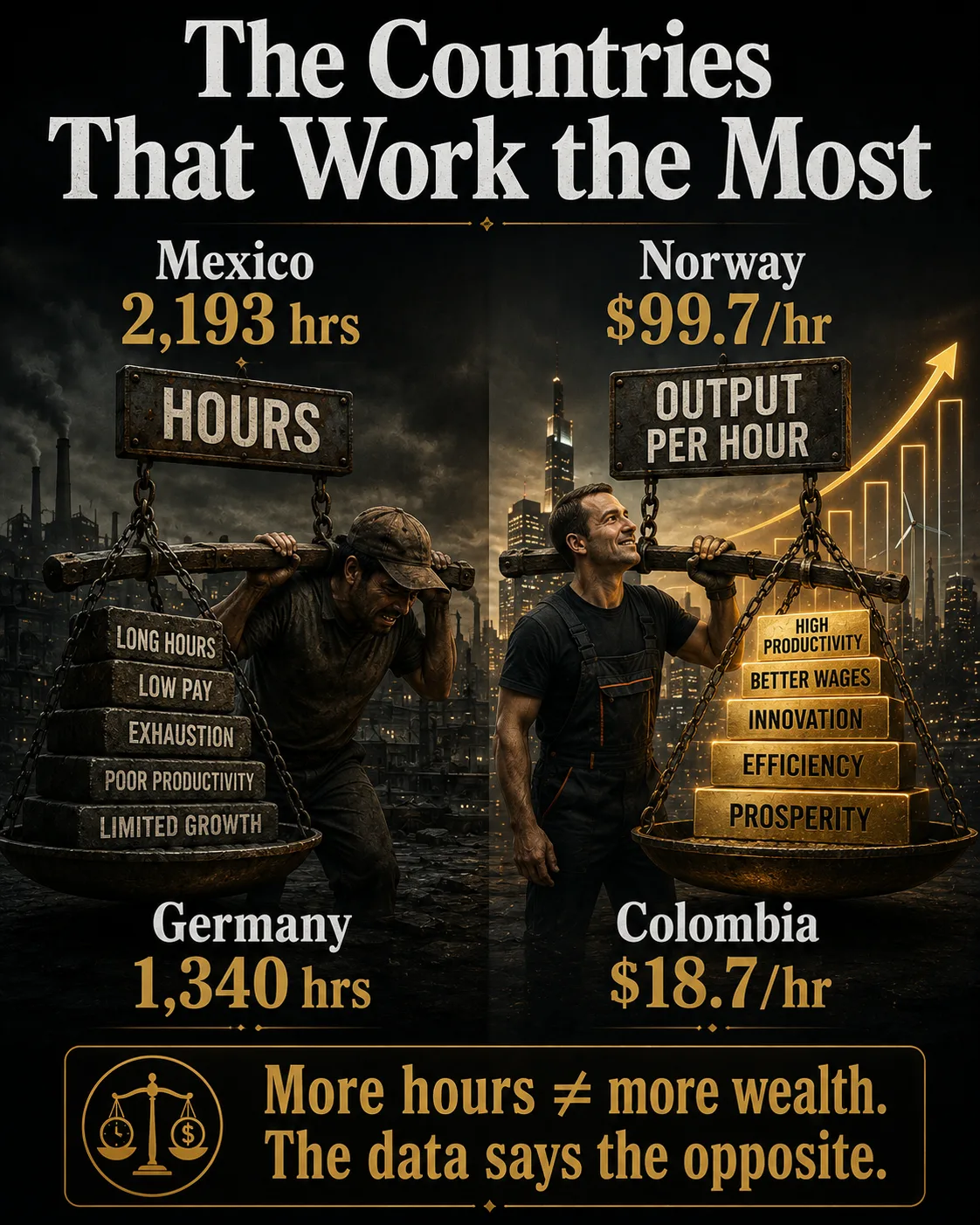
Mexico’s workers clock 2,193 hours a year — 853 more than Germany. But a German worker produces nearly six times more GDP per hour. Across the OECD, the pattern is almost perfectly inverse: the countries with the longest hours have the lowest output per hour. That relationship is now reshaping labour law. Mexico, Chile, and South Korea are all cutting maximum working hours. The evidence from Iceland and the UK suggests they may produce more by working less.
Sources: Hours worked: OECD Hours Worked indicator 2024, cited in Fisher Phillips (February 2026) and Wikipedia (April 2026). Mexico 2,193 hrs: Fisher Phillips citing OECD 2024. OECD average 1,736: Fisher Phillips. Germany ~1,340: Wikipedia citing OECD. GDP per hour worked: OECD Compendium of Productivity Indicators 2026 (primary, directly fetched, June 2026) — confirmed figures: Colombia $18.7, USA $84.1, Norway $99.7, Denmark $92.2, Ireland $135.7 (excluded as benchmark due to multinational distortion; Ireland GNI* = 57% of GDP per Ireland CSO 2024). Bar lengths proportional within each column; left bars anchored at Mexico (2,193 hrs); right bars anchored at Norway ($99.7/hr). All GDP per hour figures in 2020 constant USD PPP.
Why Do the Hardest-Working Countries Produce the Least per Hour?
The inverse relationship between hours worked and hourly output is one of the most consistent patterns in labour economics. Mexico, Colombia, and Costa Rica anchor the top of the hours-worked ranking and the bottom of the GDP-per-hour ranking simultaneously. Norway, Denmark, and Germany cluster at the opposite end of both axes. This is not coincidence — it reflects the composition of each economy.
Countries at the hours-worked top have large shares of employment in agriculture, informal services, and labour-intensive manufacturing. Economies at the productivity top are concentrated in capital-intensive industries — finance, pharmaceuticals, advanced technology — where each labour hour is amplified by expensive equipment and proprietary knowledge. A Norwegian oil engineer and a Mexican agricultural worker both appear as “one hour worked” in the data; the output differs by a factor of five.
The US occupies a telling middle position: 1,791 hours per year — more than any other G7 nation — and $84.1 per hour (OECD Compendium 2026). It works harder than European peers and is more productive per hour than most, but still trails Norway and Denmark. The gap between the US and the Nordic leaders reflects in part America’s greater inequality of outcomes: highly productive sectors coexist with large low-wage service sectors that pull the average down. The US is not as efficient as it looks from GDP alone, nor as inefficient as it looks from hours alone.
Why it matters: The composition of an economy — not the diligence of its workers — determines how much each hour of labour produces.
Is Greece a Warning About What Happens When Long Hours Become Policy?
Greece presents the starkest exception in Europe. At 1,886 hours per year, it logs the most hours of any EU member — substantially above the EU average of approximately 1,571 hours. Yet its GDP per capita sits well below the OECD average and has not converged toward peers despite a decade of structural adjustment. In 2024, the Greek government moved in the opposite direction from the global reform trend, permitting certain employers to introduce a six-day workweek. The stated logic was productivity through presence.
The data offers no support for this logic. Greece already works more hours than Germany and produces less. Additional hours within a low-productivity economic structure do not change the structure. The Greek economy’s persistent underperformance reflects factors that more hours cannot address: a large informal sector, limited capital investment, relatively low R&D expenditure, and an industrial mix weighted toward tourism and agriculture rather than high-value tradeable sectors. Working longer in a low-productivity sector produces more output from that sector, but it does not transform the sector itself.
Japan demonstrates the same trap from the opposite direction. Its official figure of ~1,607 hours appears moderate, but nearly 40% of Japan’s workforce is non-regular (part-time and contract), skewing the average down. Full-time Japanese workers log far more hours; karoshi — death from overwork — is a documented public health issue. Japan now promotes shorter hours as a demographic strategy: with a fertility rate of 0.75 and a shrinking labour force, the government calculates that working smarter, not harder, is the only viable path.
Why it matters: Adding hours to a low-productivity economy is like accelerating in the wrong direction — effort increases but the destination does not change.
What Happened When Countries Actually Tried Working Less?
The evidence from controlled reductions in working time is more consistent than the policy debate around it. Iceland conducted the most rigorous trial: between 2015 and 2019, it reduced working hours from 40 to 35–36 per week across a wide range of public sector workplaces, with no reduction in pay. The result was the same or better productivity across virtually all participating workplaces, accompanied by significant improvements in worker wellbeing, fewer sick days, and reduced burnout rates. The scale and duration of the trial — involving a substantial fraction of Iceland’s entire workforce over four years — make it among the most credible natural experiments in labour economics.
The UK followed with a 2022 trial involving 61 companies and approximately 3,000 workers. Ninety-two percent of participating companies chose to continue the four-day week after the trial ended. Revenue rose slightly on average. Worker stress fell sharply. Staff retention improved substantially. France’s 35-hour working week, introduced through the Aubry Laws of 1998–2000, created an estimated 350,000 jobs between 1998 and 2003, with disproportionate benefits for young people and women entering the labour force.
The gains depend on reorganisation, not mere reduction. When shorter hours prompt fewer unnecessary meetings, sharper task focus, and process automation, output holds. When hours are cut without structural change, output falls. Mexico’s February 2026 reform — phasing from 48 to 40 hours by 2030 — is the largest current test of this principle at scale, affecting 13.5 million workers in an economy where long hours and low productivity co-exist as structural features.
Chile (2023–2028): Law 21,561 reduces standard workweek 45 → 40 hours over five years. Phase 2 (42 hours) took effect April 2026.
South Korea: 2018 reform capped the workweek at 52 hours (down from 68). New president (2025) pushing a 4.5-day week framed explicitly as a productivity reform, not welfare: “If we cannot grow our labour force, we must make each working hour count more.”
Iceland (2015–2019): 40 → 35–36 hours with no pay cut. Same or better productivity. Now standard across most of Iceland’s public sector.
UK (2022 trial): 61 companies, ~3,000 workers. 92% continued the four-day week permanently. Revenue rose; stress fell; retention improved.
Sources: CELIA Alliance (January 2026) · Mexico Business News (March 2026) · TechFixated (June 2026) · Fisher Phillips (February 2026).
Why it matters: The global shift toward shorter statutory hours is driven not by ideology but by productivity evidence — and the countries most resistant to it are the ones that need it most.
Does the United States Work Too Much — or Too Little?
The United States is the only advanced economy without a legally mandated minimum paid annual leave and the only industrialised nation that does not guarantee workers paid vacation (World Policy Center). American full-time workers average approximately 38–40 hours per week, producing a national average of around 1,791 hours per year — more than any other G7 nation. The share of US workers logging more than 50 hours per week is among the highest in the OECD at approximately 11%.
At $84.1 per hour (OECD Compendium 2026, primary), the US trails Norway ($99.7) and Denmark ($92.2) — two countries where workers put in 370–450 fewer hours per year. The gap reflects economic structure: US healthcare, hospitality, and retail employ a much larger share of the workforce in low-automation, lower-output roles than their Nordic equivalents. The US works harder than Europe in aggregate partly because its low-wage sectors have less bargaining power to refuse those hours.
The deeper US question is distributional. A software engineer producing $500 per hour sits in the same national average as a retail worker producing $20. The absence of mandated leave and weak union density in many sectors means the US’s longer hours partly reflect inequality masquerading as ambition. Countries with stronger labour protections tend to show both shorter hours and higher output per hour — not because they are less industrious, but because productivity gains are more evenly shared.
Why it matters: The US works more than Europe and produces more in total — but the gap reflects inequality and structural composition as much as ambition or efficiency.
- Mexico leads the OECD in hours worked at 2,193 per year — 853 more than Germany, the OECD minimum.
- The ranking almost perfectly inverts on productivity: Norway ($99.7/hr) and Denmark ($92.2/hr) work the fewest hours and produce the most per hour.
- Colombia produces just $18.7 per hour — the lowest in the OECD — despite working among the most hours (OECD Compendium 2026, primary).
- Ireland’s apparent #1 ranking ($135.7/hr) is a statistical artefact: its modified GNI is just 57% of GDP due to multinational profit-shifting.
- Iceland’s 2015–2019 trial found that cutting hours from 40 to 35–36 per week produced the same or better output, with fewer sick days.
- Mexico passed a constitutional reform in February 2026 reducing the maximum workweek from 48 to 40 hours by 2030, affecting 13.5 million workers.
- The US is the only industrialised country without mandated paid vacation — its longer hours partly reflect inequality, not productivity ambition.
The countries that work the most hours are not richer for it. They are structurally trapped — locked into labour-intensive industries where the only way to produce more is to work more, because capital, technology, and skills have not yet substituted for raw time. The countries that produce the most per hour work the least. That is not a coincidence. It is the most important fact in labour economics — and the reason why every major economy reforming its working hours right now is doing so not as a concession to workers, but as a bet on productivity.
- OECD — Compendium of Productivity Indicators 2026 (primary · directly fetched · June 2026 · Colombia $18.7/hr · Ireland $135.7/hr · USA $84.1/hr · Norway $99.7 · Denmark $92.2 · Ireland GNI* 57% of GDP · “between 2014 and 2024 virtually all countries saw productivity levels rise”)
- OECD — Hours Worked Indicator (primary · oecd.org · “total hours actually worked per year divided by average number of people in employment per year” · 2024 data)
- Fisher Phillips — “Employers Should Prepare for Mexico’s Proposed 40-Hour Workweek” (February 2026 · Mexico 2,193 hrs 2024 · OECD average 1,736 · Germany/Denmark/Netherlands 30–35 hrs/wk · reform details)
- TechFixated — Mexico workweek reform analysis (June 2026 · Iceland trials 2015–2019 confirmed · UK trial 2022: 61 companies, 92% continued · South Korea 4.5-day framing as productivity reform · Japan demographic argument)
- Mexico Business News — Nordic 4-day workweek pilot results (March 2026 · Sweden + Norway pilot: improved sleep, stress, perceived productivity · no negative financial outcomes · Mexico Feb 2026 reform confirmed · 13M+ workers affected)
- CELIA Alliance — Mexico workweek reform legal analysis (January 2026 · 46 hrs 2027 / 44 hrs 2028 / 42 hrs 2029 / 40 hrs 2030 · France Aubry Laws 1998–2000 · 350,000 jobs created 1998–2003 · Chile Law 21,561 2023 · Valencia pilot 2023)
- Wikipedia — List of countries by average annual labor hours (April 2026 · OECD basis · Colombia + Mexico + Costa Rica top · Germany + Denmark lowest · Greece 1,886 EU highest · Cambodia 2,456 in 2017 66-country study · S.Korea/Singapore exception noted)
- Randal S. Olson — “The countries that work the most hours produce the least per hour” (June 2026 · OECD 40-economy scatter analysis · inverse relationship confirmed · Ireland/Luxembourg distortion explained · Germany/Denmark/Norway top-left · Mexico/Colombia bottom-right)