The Countries With the Most Lakes
Canada has more lakes than every other country on Earth combined — under one definition.
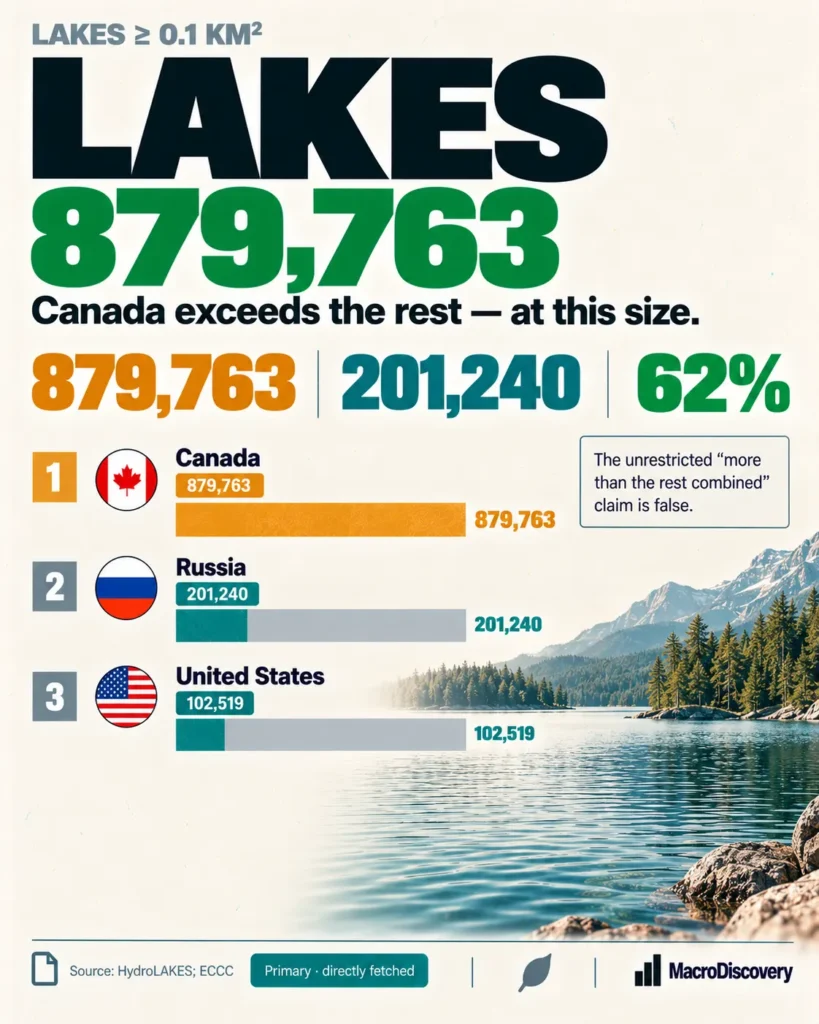
Canada has about 880,000 lakes of at least 0.1 km² in the HydroLAKES dataset. That is roughly 62% of the global total in that set — more than every other country combined under the same size threshold. Russia has about 201,000. The United States has about 103,000.
Three numbers
- About 880,000 — lakes of at least 0.1 km² in Canada according to HydroLAKES. Source: HydroLAKES database.
- About 62% — Canada’s share of the ~1.42 million lakes in the same dataset. Source: HydroLAKES.
- About 201,000 — lakes in Russia, the second-ranked country. Source: HydroLAKES.
What the ranking shows
A common claim is that Canada has more lakes than every other country on Earth combined. The fact is that the claim is true under one specific definition and false under others. In the HydroLAKES database of natural lakes at least 0.1 km² (about 0.04 square miles), Canada has about 879,763 lakes. That is roughly 62% of the ~1.42 million lakes in the dataset. The remaining countries together have fewer. Under that size threshold, Canada has more lakes than the rest of the world combined.
The claim does not hold if every pond and water body of any size is counted. Global totals of smaller water bodies run into the tens of millions. No single country approaches half of that larger set. The ranking below uses the HydroLAKES threshold so the numbers are comparable. Russia ranks second with about 201,240 lakes. The United States ranks third with about 102,519. China, Sweden, Brazil and Norway each have roughly 20,000–24,000. The drop after the top three is steep.
Canada also has the largest total lake area. Glacial activity during the last ice age carved the depressions that became most of these lakes. The Canadian Shield retains large numbers of them. Counting lakes is different from measuring their size. Russia’s total lake area is substantial in part because it includes the Caspian Sea, the world’s largest lake by surface area. Canada’s lead is in the number of individual lakes above the threshold, not solely in total area.
Figures from HydroLAKES for natural lakes ≥ 0.1 km², excluding reservoirs and regulated lakes. Canada’s share is about 62% of the ~1.42 million lakes in the dataset. Sources: HydroLAKES, Visual Capitalist compilation.
How it was measured
The ranking uses the HydroLAKES database of natural lakes at least 0.1 km². Reservoirs and regulated lakes are excluded. Cross-border lakes are assigned according to the dataset’s rules. The “more than the rest combined” claim holds only inside this definition. Global counts that include every pond of any size are far larger, and no single country holds a majority of that broader set. Canada’s government cites a range from roughly 880,000 lakes of 10 hectares and larger up to about 2 million water bodies of all sizes.
What it means
It is settled that Canada has more lakes than any other country in the HydroLAKES dataset of lakes ≥ 0.1 km², and that its total exceeds the rest of the world combined under that definition. It is not settled that Canada has more lakes than every other country combined when every possible water body is counted. Use about 880,000 for Canada’s HydroLAKES count. Use about 62% for its share of that dataset. Use about 201,000 for Russia. Do not treat the “more than the rest combined” claim as true for all definitions of a lake.
Common misreadings
- The “more than every other country combined” claim is true only for lakes above a size threshold in HydroLAKES. It is not true for every pond.
- Number of lakes is not the same as total lake area. Russia’s area is large in part because of the Caspian Sea.
- Finland is often called the land of a thousand lakes. It has many relative to its size, but far fewer than Canada in absolute count under the same definition.
Where the numbers come from
How we built this
- Dataset: HydroLAKES for lakes ≥ 0.1 km², excluding reservoirs. National estimates from Environment and Climate Change Canada for context.
- Scope: Absolute counts under a consistent size threshold. The “more than the rest combined” claim is limited to that threshold. Glacial origin noted. Area versus count distinguished.
- Figures: About 880,000 is Canada’s HydroLAKES count. About 62% is its share of the dataset. About 201,000 is Russia. The claim is treated as definition-dependent.