The Race to Decode the Brain
Scientists mapped 1 cubic millimeter of human brain. It contains 57,000 cells and 150 million connections.
The map is real. It is one cubic millimetre of temporal cortex, about a millionth of a brain, from tissue removed in surgery. The data are 1.4 petabytes.
Three numbers
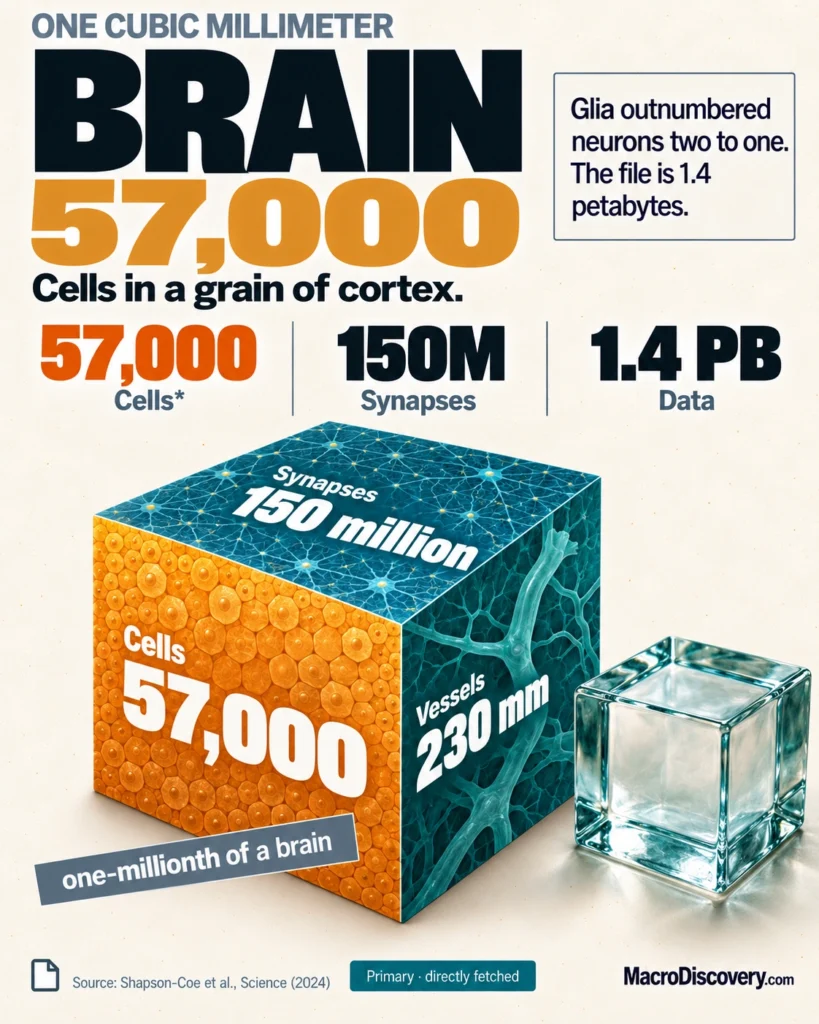
- About 57,000 — cells in one cubic millimetre of human temporal cortex. Glia outnumbered neurons about 2 to 1. Source: Science, 2024.
- About 150 million — synapses in that same cube. The dataset was 1.4 petabytes. Source: Science, 2024.
- About a millionth — the cube as a share of a whole brain. Scaling the data by a million is a sketch, not a plan. Source: volume comparison.
What the data shows
A common claim is that scientists have mapped a cubic millimetre of human brain, with 57,000 cells and 150 million connections, as if the race to decode the brain had cleared a meaningful fraction. The fact is that the map is real, and the fraction is about a millionth. Shapson-Coe and colleagues, in Science in May 2024, reconstructed one cubic millimetre of human temporal cortex at nanoscale resolution. It held about 57,000 cells, about 150 million synapses, and about 230 millimetres of blood vessels. The electron-microscopy data were 1.4 petabytes. The sample was cut into about 5,000 slices, each 34 nanometres thick. The tissue came from a 45-year-old woman and was removed to reach an underlying epileptic focus. It is a surgical offcut of cortex, not a random cube of a healthy brain.
The counts inside the cube are precise and narrow. Machine classification found 149,871,669 synapses: about 111 million excitatory and 39 million inhibitory. About 99.4% were on dendrites. Neuron density was about 16,000 per cubic millimetre, lower than some earlier light-microscopy estimates. Glia outnumbered neurons about 2 to 1. Oligodendrocytes were the most common cell. Among thousands of weak connections to a neuron, rare axons made up to 50 synapses onto one cell. The data are public, with a tool for people to proofread the automated segmentation. A finished millimetre is a finished millimetre. It is not a finished brain.
The scale is the correction. One cubic millimetre is about a millionth of a whole brain. Multiplying 1.4 petabytes by a million is an order-of-magnitude sketch of the storage, not a budget or a timeline. The sample is one region of temporal cortex. Other regions differ. A connectome of a mouse brain is a different project, already large. A human whole-brain map at this resolution is not the next paper. The race is at the first millimetre, and the first millimetre took a surgical sample, thousands of slices, and a petabyte-scale reconstruction.
The dataset for this cube was 1.4 petabytes. A million such cubes is a sketch, not a plan.
| Count | Figure | What it is |
|---|---|---|
| Cells | about 57,000 | Glia outnumbered neurons about 2:1 |
| Synapses | about 150 million | About 111 million excitatory |
| Data | 1.4 petabytes | About 5,000 slices, 34 nm thick |
| Share of a brain | about 1 millionth | Order of magnitude |
| Sample | surgical offcut | Temporal cortex, access to a focus |
How it was measured
The tissue was preserved, stained with heavy metals, and cut into slices about 34 nanometres thick for electron microscopy. Machine learning segmented cells and synapses. Humans can proofread the result. The 57,000 and 150 million are counts in this cube, not averages across brains. The patient was undergoing surgery for epilepsy. The cortex itself was removed to reach the focus.
A millionth is a volume comparison, not a measured share of every structure. Cortex is not the whole brain. Storage does not scale in a straight line with useful biology. The public tool is for this dataset. It is not a viewer for a whole human connectome.
What it means
It is settled that one cubic millimetre of human temporal cortex has been reconstructed, with about 57,000 cells and 150 million synapses, in 1.4 petabytes. It is not settled that this is a meaningful fraction of a decoded brain. Use 57,000 for the cells. Use 150 million for the synapses. Use a millionth for the scale. Do not treat the first millimetre as the race finished.
Common misreadings
- The map is one cubic millimetre. That is about a millionth of a brain.
- The tissue was a surgical offcut, removed to reach an epileptic focus.
- 1.4 petabytes is the cube. A million cubes is a sketch, not a timeline.
Where the numbers come from
How we built this
- Dataset: Shapson-Coe et al., Science, May 2024, one cubic millimetre of human temporal cortex.
- Scope: Counts kept inside the cube. The millionth kept as a volume comparison. The surgical origin kept visible.
- Figures: 57,000 is cells. 150 million is synapses. A millionth is the scale. A decoded brain is treated as not this paper.