The History of Video Game Consoles
From Pong in 1972 to consoles with 10 teraflops — how 50 years of gaming hardware evolved.
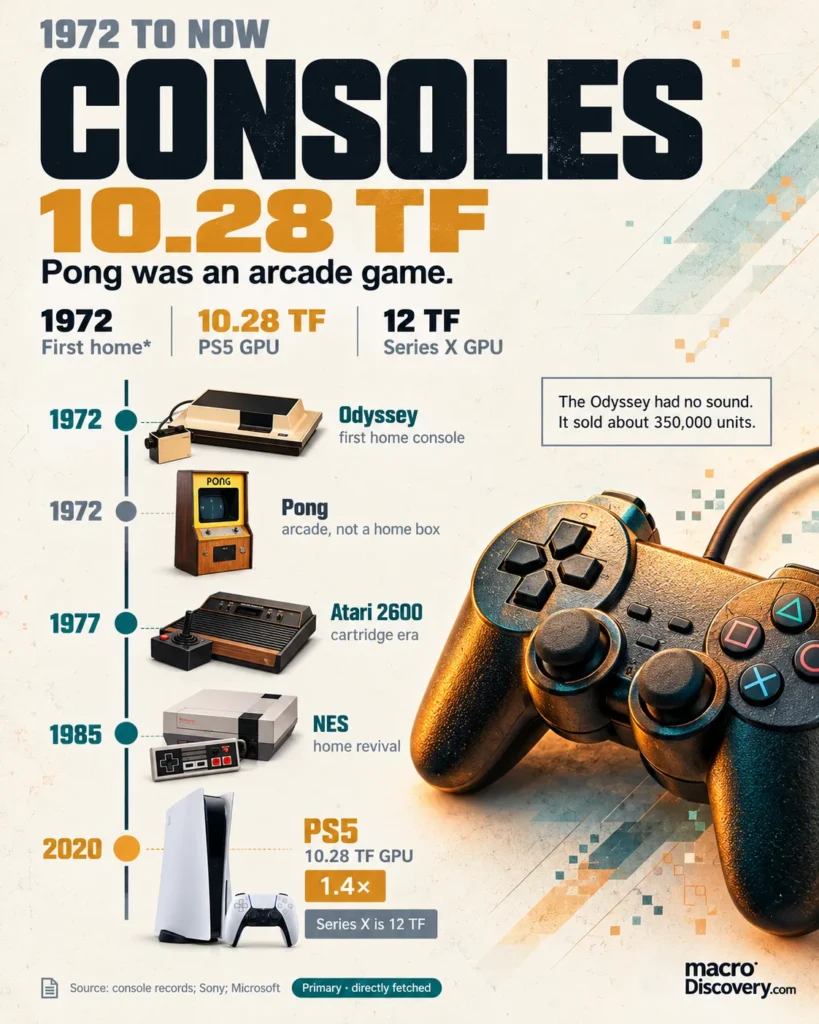
The first home console was the Magnavox Odyssey in 1972. PS5 is about 10.3 teraflops. The sales peak is still the PlayStation 2 at 160 million.
Three numbers
- 1972 — Magnavox Odyssey, the first commercial home console. About 350,000 units. Source: console records.
- 10.3 and 12.1 — PS5 and Xbox Series X teraflops. A peak GPU figure, not a full measure. Source: manufacturer specs.
- 160 million — PlayStation 2 units. Still the best-selling console. Source: Sony.
What the data shows
A common claim is that consoles began with Pong in 1972 and now deliver 10 teraflops. The fact is that the first commercial home console was the Magnavox Odyssey, on sale in North America in September 1972 at $99.95. Ralph Baer designed it at Sanders Associates. It displayed three square dots, had no sound, and used plastic overlays on the television. It sold about 350,000 units by 1975. Pong was an Atari arcade game in 1972. Nolan Bushnell had seen an Odyssey demonstration. Magnavox later won a patent case. Home Pong came after. The console came before the famous arcade game.
The 10-teraflop line is the PlayStation 5, rated at about 10.3. The Xbox Series X is about 12.1. The Series S is about 4. The PS4 was 1.84 and the Xbox One 1.41 at launch. A teraflop is a peak theoretical figure for the GPU. It does not include the CPU, memory bandwidth, storage speed, or ray tracing. Two machines with similar teraflops can run a game differently. The jump from about 1.5 to about 10 is real. It is not a complete score of the generation.
Sales and power are different ranks. The PlayStation 2 remains the best-selling console at 160 million units. The Nintendo Switch is next at about 156.6 million and still on the market. The Nintendo DS is about 154 million. The PlayStation 5 is at about 95.3 million. A 10-teraflop machine has not passed a console from 2000. The Atari 2600, from 1977, sold about 30 million. Fifty years of hardware is a rise in peak GPU numbers and a sales peak that is still two decades old.
The PlayStation 2 sold 160 million units. A higher teraflop count has not produced a higher sales peak.
| Count | Figure | What it is |
|---|---|---|
| First home console | 1972 | Magnavox Odyssey. About 350,000 units |
| PS5 / Series X | 10.3 / 12.1 | Peak GPU teraflops |
| PS4 / Xbox One | 1.84 / 1.41 | Previous generation at launch |
| PlayStation 2 | 160 million | Still the sales peak |
| Switch / DS | 156.6 / 154 million | Next two |
How it was measured
A home console is a device sold to play games on a television. The Odyssey was the first commercial one. An arcade cabinet is a different product. Teraflops are calculated from the GPU’s peak floating-point rate. Manufacturers publish them. They are not measured frame rates in a named game.
Sales figures are manufacturer totals or widely cited industry totals. The PS2 figure is Sony’s. The Switch figure is still moving. A timeline that starts at Pong has skipped the console that came first.
What it means
It is settled that the Odyssey was the first commercial home console in 1972, that PS5 is about 10.3 teraflops and Series X about 12.1, and that the PS2 sold 160 million. It is not settled that teraflops rank the generation, or that power ranks sales. Use 1972 for the Odyssey. Use 10.3 and 12.1 for the GPU peaks. Use 160 million for the sales peak. Do not start the console at Pong.
Common misreadings
- Pong was an arcade game. The first home console was the Odyssey.
- 10.3 teraflops is the PS5. Series X is 12.1. Neither is a full score.
- The sales peak is the PS2 at 160 million, not a current console.
Where the numbers come from
How we built this
- Dataset: Odyssey launch records; manufacturer teraflop ratings; Sony and industry sales totals.
- Scope: Home consoles. Arcade Pong kept apart. Teraflops kept as a peak GPU figure. Sales kept as a separate rank.
- Figures: 1972 is the Odyssey. 10.3 and 12.1 are the GPU peaks. 160 million is the PS2. A start at Pong is treated as the wrong product.