World’s Deepest Lakes
Lake Baikal is the deepest lake on Earth. Here is the ranking.
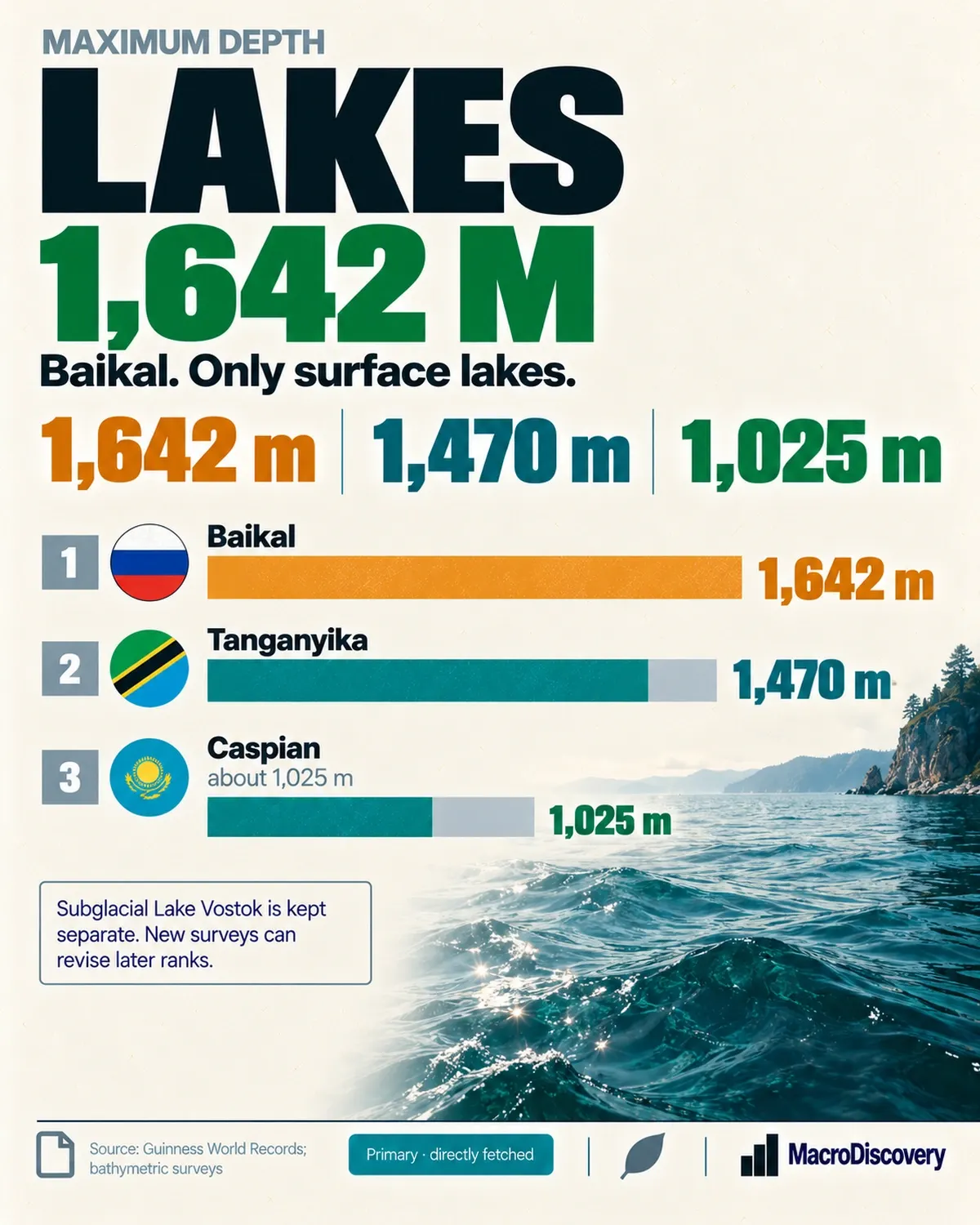
Lake Baikal is the deepest lake on Earth at 1,642 metres. Lake Tanganyika is second at 1,470 metres. The Caspian Sea is third at 1,025 metres. Only one lake is deeper than a mile.
Three numbers
- 1,642 metres — maximum depth of Lake Baikal, Russia. The deepest lake on Earth. Source: standard bathymetric records.
- 1,470 metres — maximum depth of Lake Tanganyika, East Africa. Second deepest. Source: standard bathymetric records.
- 1,025 metres — maximum depth of the Caspian Sea. Third deepest, and the world’s largest inland lake. Source: standard bathymetric records.
What the data shows
A common claim is that the deepest lakes are the largest ones, or that the Caspian Sea is the deepest. The fact is that depth and area are different measures. Lake Baikal is the deepest at 1,642 metres. Lake Tanganyika is second at 1,470 metres. The Caspian Sea is third at about 1,025 metres. Baikal is the only lake deeper than one mile. Both Baikal and Tanganyika are ancient rift lakes. Their basins formed where the Earth’s crust stretched, creating deep troughs that filled with water over millions of years.
The ranking by maximum depth is stable at the top. Baikal holds roughly 20% of the world’s unfrozen surface freshwater and is the oldest large freshwater lake. Tanganyika is the longest freshwater lake and supports high endemism. The Caspian is saline and is treated by geographers as a lake despite its name. Below these three, the list includes subglacial Lake Vostok under the Antarctic ice sheet (roughly 900–1,000 metres of water column) and several glacial and rift lakes in the 500–800 metre range. New bathymetric surveys can refine the lower ranks, but the top three are well established.
The practical distinction is between maximum depth and mean depth. Baikal’s mean depth is also the greatest. Many large lakes by surface area are relatively shallow. The deepest lakes are concentrated in tectonic rifts or under ice. Ranking by maximum measured depth places Baikal first, Tanganyika second, and the Caspian third.
Full ranking by maximum depth
Bars scaled to Baikal’s 1,642 m. Depths are maximum measured values. Vostok is subglacial. Caspian is saline. Sources: Wikipedia list of lakes by depth, World Atlas, standard bathymetric records.
How it was measured
Maximum depth is the distance from the water surface to the deepest surveyed point. Figures come from bathymetric surveys compiled in standard geographic references. Lake Vostok’s water-column depth is estimated under ice. The Caspian is included because geographers classify it as a lake. Rankings by maximum depth are more stable than rankings by mean depth for the top lakes.
What it means
It is settled that Lake Baikal is the deepest lake at 1,642 metres, that Tanganyika is second at 1,470 metres, and that the Caspian is third at about 1,025 metres. It is settled that Baikal is the only lake deeper than one mile. It is not settled that every lower-rank depth is final — new surveys can refine them. Use 1,642 m for Baikal. Use 1,470 m for Tanganyika. Use 1,025 m for the Caspian. Do not equate largest surface area with deepest.
Common misreadings
- The Caspian Sea is not the deepest lake. It is the largest by area and ranks third by depth.
- Only Lake Baikal is deeper than one mile.
- Depth and surface area are different. The largest lakes by area are not the deepest.
Where the numbers come from
How we built this
- Dataset: Maximum-depth rankings from standard bathymetric compilations.
- Scope: Lakes ranked by maximum measured depth. Subglacial Vostok included. Caspian treated as a lake. Mean depth distinguished from maximum.
- Figures: 1,642 m is Baikal. 1,470 m is Tanganyika. 1,025 m is the Caspian. Only Baikal exceeds one mile.